
Contribution-Weighted Democracy
What is it called, that a democracy, that's built upon the contribution-aware? For example, if we're doing a voting system on a website, a member with long account history, many post/comments/followers, and overall 'contribution', their 1 like is much more meaningful signal than a ghost member who joined yesterday leaving 1 like. It's still 1 like, but it's unfair to be the same. Gating doesn't seem right, like Stack Overflow. You can still join as a new member but should be able to do stuff... just not at a high influence. So, for each votes, decisions, rankings, recommendations, there needs to be some "karma" based votings and democracy. Is there an officially coined term for this? Firecrawl and research.
Used 2 tools2/2
- Bash
- Bash
Bash
supermemory search "research question answer thread no change end gate" --namespace anaclumos --limit 10 2>&1 | head -60; echo ---; supermemory search "reputation weighted voting karma democracy" --namespace anaclumos --limit 10 2>&1 | head -40
Search Supermemory for rulings on research threads and prior notes
bashsupermemory search "research question answer thread no change end gate" --namespace anaclumos --limit 10 2>&1 | head -60; echo ---; supermemory search "reputation weighted voting karma democracy" --namespace anaclumos --limit 10 2>&1 | head -40resulttext{ "results": [ { "id": "c115e96825756919a625f9", "chunk": "The end gate covers the whole thread through an inventory: the first round's seat returns, beside its findings, an inventory of every user ask and later correction it found, the thread itself reads its whole conversation against that inventory before round two and adds what the seat left out, and each later round's brief carries the inventory updated with the memory IDs, issue URLs, and PR URLs recorded since plus the previous gate report and the conversation since it, so a later seat reads nothing earlier than the previous report (summary: general__thread-finish-end-gate).", "metadata": { "type": "ruling", "capture_mode": "manual", "source_thread": "claude-code:id:2", "source_url": "https://github.com/anaclumos/skills/blob/main/GLOBAL.md", "temporalContext": { "documentDate": "2026-10-18", "eventDate": null }, "temporalEventStartMs": 1792281600000, "temporalEventEndMs": 1792368000000 }, "similarity": 0.75792426, "isLatest": true, "isInference": false, "system": { "updatedAt": "2026-10-18T01:39:11.119Z", "createdAt": "2026-10-18T01:38:32.341Z", "filepath": null } }, { "id": "s7GSkVi4iHBgpdQVgCUcU4", "memory": "Every thread ends with exit interview + end gate + self‑settle + finish mark.", "metadata": { "type": "workflow", "verified": "2026-10-16", "sm_source": "hermes", "capture_mode": "manual", "temporalContext": { "eventDate": null, "documentDate": "2026-10-16" }, "temporalEventEndMs": 1792195200000, "temporalEventStartMs": 1792108800000 }, "similarity": 0.75298393, "isLatest": true, "isInference": false, "system": { "updatedAt": "2026-10-16T02:40:08.418Z", "createdAt": "2026-10-16T02:40:08.418Z", "filepath": null } }, { "id": "ba31c14f47d7ba8eda97d1", "chunk": "## End gate: no thread finishes unchecked\n\nThe gate covers the whole thread through an inventory. The first round's seat returns, beside its findings, an inventory of every user ask and later correction it found; each later round's brief carries that inventory, updated with the memory IDs, issue URLs, and PR URLs recorded since, plus the previous gate report and the conversation since it, so a later round catches an inventoried ask still unanswered. A later round reads nothing earlier than the previous report, so it catches only what the inventory names: before round two the thread itself reads its whole conversation against the inventory and adds every user ask and later correction the first seat left out of both its findings and its inventory, and no later seat re-reads the conversation before the previous report.", "metadata": { "type": "reference", "project": "[project]", "source_file": "GLOBAL.md", "capture_mode": "automatic", "temporalContext": { "documentDate": "2026-10-18", --- { "results": [ { "id": "c33f22d7e6544056ba8152", "chunk": "### Human panel\n\nExperts reached alpha about 0.60 on research ideas ([Ideation Arena](https://arxiv.org/html/2608.29696v1)), and single sycophancy raters were unreliable while the mean of 106 experts was not ([expert study](https://arxiv.org/abs/2605.21778)) [established]. Every item gets at least three raters, and a set below alpha 0.667 gates nothing.", "metadata": { "type": "reference", "project": "[project]", "source_file": "docs/research-plan.md", "temporalContext": { "documentDate": "2026-10-05", "eventDate": null }, "temporalEventStartMs": 1791158400000, "temporalEventEndMs": 1791244800000 }, "similarity": 0.624098, "isLatest": true, "isInference": false, "system": { "updatedAt": "2026-10-14T06:54:14.323Z", "createdAt": "2026-10-14T06:53:50.777Z", "filepath": null } }, { "id": "da9a6d9b35b18ce1e1655f", "chunk": "### 9. Verify\n\nEach cluster goes through 3 lenses, on `verify.md`. An item is one lens over up to 6 clusters of one repository, keyed `<lens>-<repo>-<n>`. Every verify seat is fresh: no seat that wrote a cluster verifies it.\n\n### 10. Judge\n\nA cluster that some lens refuted at medium or low confidence, and none at high confidence, gets one judge seat on `judge.md`.", "metadata": { "type": "reference", "project": "[project]", "source_file": "skills/streamline/SKILL.md", "temporalContext": { "documentDate": "2026-10-14", "eventDate": null }, "temporalEventStartMs": 1791936000000, "temporalEventEndMs": 1792022400000 }, "similarity": 0.6218988999999999,Bash
cd /tmp && firecrawl search "reputation-weighted voting term karma weighted votes online community" --limit 8 2>&1 | head -120
Search the web for reputation-weighted voting terminology
bashcd /tmp && firecrawl search "reputation-weighted voting term karma weighted votes online community" --limit 8 2>&1 | head -120resulttext=== Web Results === What is karma? Quantifying online influence and credibility URL: https://snap.stanford.edu/class/cs224w-2013/projects2013/cs224w-068-final.pdf Many online communities explicitly publicize the concept of karma or reputation for users, computed as a sum of positive votes by other. Karma-based voting explained: a fairer way to make ... URL: https://www.pikarama.com/blog/karma-based-voting-explained Karma-based voting gives more influence to people whose picks keep losing, then resets when their choice wins. Here is how it works and when to use it. Not understanding Post Karma versus Comment Karma. URL: https://www.reddit.com/r/NewToReddit/comments/1aq9d7k/not_understanding_post_karma_versus_comment_karma/ They are weighted different in terms of how many votes it takes to get a point of karma, in that it takes mores on your posts to get a point of ... Reputation-Weighted Voting: The End of Token Plutocracy URL: https://chainscorelabs.com/blog/web3-social-decentralizing-the-feed/on-chain-reputation-systems/reputation-weighted-voting-is-the-future-of-governance Reputation-weighted voting replaces one-token-one-vote with a Sybil-resistant system that measures and rewards genuine contribution. Best Civic Governance Platform in 2026 URL: https://civichalls.com/civic-governance-platform/ Votes are weighted by reputation (0.1 to 3), and a resolution passes with at least 3 votes and at least half of all vote weight in support. RepIndex Rating System Explained URL: https://repindex.org/en/rating-system/ RepIndex uses a weighted voting system to ensure that ratings reflect community trust and expertise. Every vote receives a weight between 0.0 and 10.0, ... Quantifying Voter Biases in Online Platforms URL: https://arxiv.org/html/1910.00757v1 Reputation bias captures how the reputation of a user who creates content affects the aggregate vote on that content; social influence bias ... Quantifying Voter Biases in Online Platforms: An ... - Hari Sundaram URL: https://sundaram.cs.illinois.edu/pubs/2019/2019dev_iv.pdf For instance, any weighted voting policy where all votes are not equal is likely to dissuade the disadvantaged voters from participation. Community Dependent ... === Alexandria Tools === arxiv-org/papers/get_bibtex Cite a paper found with `search_papers`, `list_category` or `get_paper`. arxiv-org/papers/get_paper Look up one paper by identifier or URL. Use `get_bibtex` for a citation entry and `harvest_records` for the license. arxiv-org/papers/harvest_records Bulk or incremental synchronisation of arXiv metadata by date window, or the only surface that states a paper's license. For topical search use `search_papers`. arxiv-org/papers/list_category Browse what was announced in a category, or walk a month's submissions. Identifiers feed `get_paper` and `get_bibtex`. arxiv-org/papers/list_sets Discover valid `set` values for `harvest_records` and category codes for `list_category`. arxiv-org/papers/search_papers Find papers by topic, title, author or category, or find the arXiv identifier that `get_paper`, `get_bibtex` and the listing functions take. Citing or replicating papers are not an arXiv concept: arXiv serves no citation graph. Inspect: firecrawl list <provider> <capability> --pretty Use find-tools for tool sets or missing contracts; execute selected tools with scrape --alexandria <provider/capability> --options <json>. Shell cwd was reset to [worktree]stdouttext=== Web Results === What is karma? Quantifying online influence and credibility URL: https://snap.stanford.edu/class/cs224w-2013/projects2013/cs224w-068-final.pdf Many online communities explicitly publicize the concept of karma or reputation for users, computed as a sum of positive votes by other. Karma-based voting explained: a fairer way to make ... URL: https://www.pikarama.com/blog/karma-based-voting-explained Karma-based voting gives more influence to people whose picks keep losing, then resets when their choice wins. Here is how it works and when to use it. Not understanding Post Karma versus Comment Karma. URL: https://www.reddit.com/r/NewToReddit/comments/1aq9d7k/not_understanding_post_karma_versus_comment_karma/ They are weighted different in terms of how many votes it takes to get a point of karma, in that it takes mores on your posts to get a point of ... Reputation-Weighted Voting: The End of Token Plutocracy URL: https://chainscorelabs.com/blog/web3-social-decentralizing-the-feed/on-chain-reputation-systems/reputation-weighted-voting-is-the-future-of-governance Reputation-weighted voting replaces one-token-one-vote with a Sybil-resistant system that measures and rewards genuine contribution. Best Civic Governance Platform in 2026 URL: https://civichalls.com/civic-governance-platform/ Votes are weighted by reputation (0.1 to 3), and a resolution passes with at least 3 votes and at least half of all vote weight in support. RepIndex Rating System Explained URL: https://repindex.org/en/rating-system/ RepIndex uses a weighted voting system to ensure that ratings reflect community trust and expertise. Every vote receives a weight between 0.0 and 10.0, ... Quantifying Voter Biases in Online Platforms URL: https://arxiv.org/html/1910.00757v1 Reputation bias captures how the reputation of a user who creates content affects the aggregate vote on that content; social influence bias ... Quantifying Voter Biases in Online Platforms: An ... - Hari Sundaram URL: https://sundaram.cs.illinois.edu/pubs/2019/2019dev_iv.pdf For instance, any weighted voting policy where all votes are not equal is likely to dissuade the disadvantaged voters from participation. Community Dependent ... === Alexandria Tools === arxiv-org/papers/get_bibtex Cite a paper found with `search_papers`, `list_category` or `get_paper`. arxiv-org/papers/get_paper Look up one paper by identifier or URL. Use `get_bibtex` for a citation entry and `harvest_records` for the license. arxiv-org/papers/harvest_records Bulk or incremental synchronisation of arXiv metadata by date window, or the only surface that states a paper's license. For topical search use `search_papers`. arxiv-org/papers/list_category Browse what was announced in a category, or walk a month's submissions. Identifiers feed `get_paper` and `get_bibtex`. arxiv-org/papers/list_sets Discover valid `set` values for `harvest_records` and category codes for `list_category`. arxiv-org/papers/search_papers Find papers by topic, title, author or category, or find the arXiv identifier that `get_paper`, `get_bibtex` and the listing functions take. Citing or replicating papers are not an arXiv concept: arXiv serves no citation graph. Inspect: firecrawl list <provider> <capability> --pretty Use find-tools for tool sets or missing contracts; execute selected tools with scrape --alexandria <provider/capability> --options <json>.stderrtextShell cwd was reset to [worktree]
Used 2 tools2/2
- Bash
- Bash
Bash
cd /tmp && for q in "plural voting John Stuart Mill extra votes weighted franchise" "epistocracy weighted voting Jason Brennan" "SourceCred cred-weighted voting contribution governance" "Colony reputation-weighted voting decay non-transferable reputation" "Reddit contributor quality score CQS" "Slashdot karma moderation points metamoderation reputation weighted" ; do echo "##### $q"; firecrawl search "$q" --limit 5 2>&1 | sed -n '/=== Web Results ===/,/=== Alexandria/p' | head -40; done
Run several web searches on weighted-voting terms
bashcd /tmp && for q in "plural voting John Stuart Mill extra votes weighted franchise" "epistocracy weighted voting Jason Brennan" "SourceCred cred-weighted voting contribution governance" "Colony reputation-weighted voting decay non-transferable reputation" "Reddit contributor quality score CQS" "Slashdot karma moderation points metamoderation reputation weighted" ; do echo "##### $q"; firecrawl search "$q" --limit 5 2>&1 | sed -n '/=== Web Results ===/,/=== Alexandria/p' | head -40; doneresulttext##### plural voting John Stuart Mill extra votes weighted franchise === Web Results === Plural voting URL: https://en.wikipedia.org/wiki/Plural_voting Because plural voting gives a voter more votes than another, it creates voting inequality and breaks the one man, one vote rule. Political philosopher John ... JS MILL ON PLURAL VOTING, COMPETENCE URL: https://www.jstor.org/stable/26220010 by JJ Miller · 2003 · Cited by 44 — Plural voting is designed to prov this balance between competence and participation. Plural voting provides that citizens receive different numbers of votes, w. Rejecting Mill on Plural Votes - Philosopher URL: https://politicalphilosopher.net/2013/08/09/rejecting-mill-on-plural-votes/ In short, Mill favours plural votes because he thinks that everyone, even the uneducated, who have fewer votes, will benefit from such a scheme. What justifies electoral voice? J. S. Mill on voting - ePrints Soton URL: https://eprints.soton.ac.uk/487010/1/Mill_on_voting_Mind_FINAL_07.02.24.pdf by J Turner · 2024 · Cited by 2 — Mill thinks that the claim to a voice is a claim in justice, and is compatible with the instrumental argument for a weighted franchise. But it is not clear ... Plural voting and political equality: A thought experiment in ... URL: https://journals.sagepub.com/doi/10.1177/1474885115591344 ... John Stuart Mill's (1977) infamous plural voting proposal. Mill thought that the well-educated (or the occupationally privileged) ought to have extra votes. === Alexandria Tools === ##### epistocracy weighted voting Jason Brennan ##### SourceCred cred-weighted voting contribution governance === Web Results === Voting - The CredSperiment URL: https://discourse.sourcecred.io/t/voting/510 Voting will allow the SourceCred community to signal and make decisions via Cred or Grain weighted voting. power will be based not on number of ... SourceCred URL: https://gitcoin.co/mechanisms/sourcecred SourceCred is a mechanism for tracking community contributions and distributing rewards proportionally. , forum participation, and governance ... Sourcecred | Allo.capital Mechanisms URL: https://www.allo.capital/mechanisms/sourcecred SourceCred is a mechanism that tracks and scores community contributions using a reputation graph, then allocates rewards proportionally. 🌱 Introduction | SourceCred URL: https://sourcecred.io/docs/ The algorithm uses what we call "weights", which are a set of rules stating which types of contributions are worth what amounts of Cred. SourceCred - P2P Foundation Wiki URL: https://wiki.p2pfoundation.net/SourceCred The algorithm uses what we call "weights", which are a set of rules stating which types of contributions are worth what amounts of Cred. The ... === Alexandria Tools === ##### Colony reputation-weighted voting decay non-transferable reputation === Web Results === What is Reputation-Based Voting in DAOs - Colony Blog URL: https://blog.colony.io/what-is-reputation-based-governance ... reputation in Colony must be earned through meaningful participation and contributions. This reputation is strictly non-transferable, meaning it cannot be ... What is Colony? Understanding Decentralized Governance URL: https://www.thecrypto.it.com/post/what-is-colony Non-transferable reputation: Reputation cannot be sold or given away, preventing manipulation of voting power. Decay over time: Reputation slowly decreases ... colony-io-reputation-system.md - governance-economics URL: https://github.com/Playful-Sincerity/governance-economics/blob/main/research/sources/governance/reputation-systems/colony-io-reputation-system.md Colony's design premise: reputation is non-transferable and non-purchasable. Unlike tokens, "reputation cannot be transferred between accounts and can only ... Category: github Colony: Decentralized Collaboration Platform for DAOs URL: https://chainscorelabs.com/glossary/desci-decentralized-science/governance-for-science-daos/colony Unlike simple token voting, Colony's reputation system measures a member's historical contributions and expertise within specific domains. This reputation ... Reputation | Colony Knowledge Realm URL: https://docs.colony.io/develop/dev-learning/reputation One of the unique characteristics of reputation is that it decays over time. This is meant to incentivize frequent and consistent contributions to a colony, and ... === Alexandria Tools === ##### Reddit contributor quality score CQS ##### Slashdot karma moderation points metamoderation reputation weighted === Web Results === Slashdot Moderation URL: https://slashdot.org/moderation.shtml Karma is an internal value Slashdot uses to determine things like initial posting score, and moderation eligibility. To you, karma is a label ... Slashdot's Meta Moderation URL: https://slashdot.org/story/99/09/07/155233/slashdots-meta-moderation Essentially eligible users are presented with 10 comments the moderation done to them. They are then asked to rate the moderation as Fair, or ... Slashdot uses (used?) meta moderation. You could review ... URL: https://news.ycombinator.com/item?id=15234304 Metamoderation was used to grade the moderators. If enough people disagreed with your moderation, eventually you got mod points less often. If people liked your ... Distributed Moderation in a Large Online Conversation ... URL: https://dl.acm.org/doi/pdf/10.1145/985692.985761 by C Lampe · 2004 · Cited by 612 — Slashdot users achieve moderator eligibility by having high karma. A moderator is given five moderation points at a time, to be used within three days ... Meta-moderation system URL: https://en.wikipedia.org/wiki/Meta-moderation_system Meta-moderation is a second level of comment moderation. A user is invited to rate a moderator's decision by being shown a post that was moderated up or ... === Alexandria Tools === Shell cwd was reset to [worktree]stdouttext##### plural voting John Stuart Mill extra votes weighted franchise === Web Results === Plural voting URL: https://en.wikipedia.org/wiki/Plural_voting Because plural voting gives a voter more votes than another, it creates voting inequality and breaks the one man, one vote rule. Political philosopher John ... JS MILL ON PLURAL VOTING, COMPETENCE URL: https://www.jstor.org/stable/26220010 by JJ Miller · 2003 · Cited by 44 — Plural voting is designed to prov this balance between competence and participation. Plural voting provides that citizens receive different numbers of votes, w. Rejecting Mill on Plural Votes - Philosopher URL: https://politicalphilosopher.net/2013/08/09/rejecting-mill-on-plural-votes/ In short, Mill favours plural votes because he thinks that everyone, even the uneducated, who have fewer votes, will benefit from such a scheme. What justifies electoral voice? J. S. Mill on voting - ePrints Soton URL: https://eprints.soton.ac.uk/487010/1/Mill_on_voting_Mind_FINAL_07.02.24.pdf by J Turner · 2024 · Cited by 2 — Mill thinks that the claim to a voice is a claim in justice, and is compatible with the instrumental argument for a weighted franchise. But it is not clear ... Plural voting and political equality: A thought experiment in ... URL: https://journals.sagepub.com/doi/10.1177/1474885115591344 ... John Stuart Mill's (1977) infamous plural voting proposal. Mill thought that the well-educated (or the occupationally privileged) ought to have extra votes. === Alexandria Tools === ##### epistocracy weighted voting Jason Brennan ##### SourceCred cred-weighted voting contribution governance === Web Results === Voting - The CredSperiment URL: https://discourse.sourcecred.io/t/voting/510 Voting will allow the SourceCred community to signal and make decisions via Cred or Grain weighted voting. power will be based not on number of ... SourceCred URL: https://gitcoin.co/mechanisms/sourcecred SourceCred is a mechanism for tracking community contributions and distributing rewards proportionally. , forum participation, and governance ... Sourcecred | Allo.capital Mechanisms URL: https://www.allo.capital/mechanisms/sourcecred SourceCred is a mechanism that tracks and scores community contributions using a reputation graph, then allocates rewards proportionally. 🌱 Introduction | SourceCred URL: https://sourcecred.io/docs/ The algorithm uses what we call "weights", which are a set of rules stating which types of contributions are worth what amounts of Cred. SourceCred - P2P Foundation Wiki URL: https://wiki.p2pfoundation.net/SourceCred The algorithm uses what we call "weights", which are a set of rules stating which types of contributions are worth what amounts of Cred. The ... === Alexandria Tools === ##### Colony reputation-weighted voting decay non-transferable reputation === Web Results === What is Reputation-Based Voting in DAOs - Colony Blog URL: https://blog.colony.io/what-is-reputation-based-governance ... reputation in Colony must be earned through meaningful participation and contributions. This reputation is strictly non-transferable, meaning it cannot be ... What is Colony? Understanding Decentralized Governance URL: https://www.thecrypto.it.com/post/what-is-colony Non-transferable reputation: Reputation cannot be sold or given away, preventing manipulation of voting power. Decay over time: Reputation slowly decreases ... colony-io-reputation-system.md - governance-economics URL: https://github.com/Playful-Sincerity/governance-economics/blob/main/research/sources/governance/reputation-systems/colony-io-reputation-system.md Colony's design premise: reputation is non-transferable and non-purchasable. Unlike tokens, "reputation cannot be transferred between accounts and can only ... Category: github Colony: Decentralized Collaboration Platform for DAOs URL: https://chainscorelabs.com/glossary/desci-decentralized-science/governance-for-science-daos/colony Unlike simple token voting, Colony's reputation system measures a member's historical contributions and expertise within specific domains. This reputation ... Reputation | Colony Knowledge Realm URL: https://docs.colony.io/develop/dev-learning/reputation One of the unique characteristics of reputation is that it decays over time. This is meant to incentivize frequent and consistent contributions to a colony, and ... === Alexandria Tools === ##### Reddit contributor quality score CQS ##### Slashdot karma moderation points metamoderation reputation weighted === Web Results === Slashdot Moderation URL: https://slashdot.org/moderation.shtml Karma is an internal value Slashdot uses to determine things like initial posting score, and moderation eligibility. To you, karma is a label ... Slashdot's Meta Moderation URL: https://slashdot.org/story/99/09/07/155233/slashdots-meta-moderation Essentially eligible users are presented with 10 comments the moderation done to them. They are then asked to rate the moderation as Fair, or ... Slashdot uses (used?) meta moderation. You could review ... URL: https://news.ycombinator.com/item?id=15234304 Metamoderation was used to grade the moderators. If enough people disagreed with your moderation, eventually you got mod points less often. If people liked your ... Distributed Moderation in a Large Online Conversation ... URL: https://dl.acm.org/doi/pdf/10.1145/985692.985761 by C Lampe · 2004 · Cited by 612 — Slashdot users achieve moderator eligibility by having high karma. A moderator is given five moderation points at a time, to be used within three days ... Meta-moderation system URL: https://en.wikipedia.org/wiki/Meta-moderation_system Meta-moderation is a second level of comment moderation. A user is invited to rate a moderator's decision by being shown a post that was moderated up or ... === Alexandria Tools ===stderrtextShell cwd was reset to [worktree]Bash
cd /tmp && for q in "trust-weighted ratings recommender system rater reputation weighting votes" "Community Notes rater helpfulness score weighting matrix factorization" "IMDb weighted average rating not all votes equal impact" "Hacker News vote weighting karma account age" "proof of personhood vs reputation weighted voting sybil resistance" "meritocracy weighted voting term contribution-weighted democracy" ; do echo "##### $q"; firecrawl search "$q" --limit 5 2>&1 | sed -n '/=== Web Results ===/,/=== Alexandria/p' | head -40; done
Run more web searches on rating-system weighting terms
bashcd /tmp && for q in "trust-weighted ratings recommender system rater reputation weighting votes" "Community Notes rater helpfulness score weighting matrix factorization" "IMDb weighted average rating not all votes equal impact" "Hacker News vote weighting karma account age" "proof of personhood vs reputation weighted voting sybil resistance" "meritocracy weighted voting term contribution-weighted democracy" ; do echo "##### $q"; firecrawl search "$q" --limit 5 2>&1 | sed -n '/=== Web Results ===/,/=== Alexandria/p' | head -40; doneresulttext##### trust-weighted ratings recommender system rater reputation weighting votes ##### Community Notes rater helpfulness score weighting matrix factorization === Web Results === Note ranking algorithm URL: https://communitynotes.x.com/guide/en/under-the-hood/ranking-notes The main technique we use to determine which notes are helpful or unhelpful is matrix factorization on the note-rater matrix, a sparse matrix that encodes, for ... A Dataset for Exploring the Helpfulness of Fact-Checking ... URL: https://arxiv.org/html/2510.24810v1 # COMMUNITYNOTES: A Dataset for Exploring the Helpfulness of Fact-Checking Explanations ## Appendix A Appendix ### A.2 COMMUNITYNOTES Pre-processing Details #### Note Ranking Algorithm The algorithm is based on a Matrix Factorization (MF) model fit on the sparse note-rater matrix which generates a continuous "Note Helpfulness Score" for each note. A note receives CURRENTLY_RATED_HELPFUL status if its score is greater than 0.40. A note is assigned CURRENTLY_RATED_NOT_HELPFUL if its score is smaller than -0.05 - 0.8 ×\times|noteFactorScore||\text{noteFactorScore}|, or if its upper confidence bound is smaller than -0.04. AI Writers on Community Notes: An Evaluation of Seven ... URL: https://www.rstreet.org/?post_type=research&p=100319 # AI Writers on Community Notes: An Evaluation of Seven Months of Data ## Executive Summary In our analysis, AI notes achieved a VSR of 88.8 percent compared to 68.5 percent for human-written notes (chi-squared _P_ < 0.001). ## **1. Introduction** At the heart of the system is the bridging algorithm—a matrix factorization approach (i.e., a mathematical technique for identifying hidden patterns in large datasets of user ratings) designed to surface notes that earn agreement across ideologically diverse raters. How the Request Function Shapes X's Community Notes ... URL: https://research.chalmers.se/publication/552248/file/552248_Fulltext.pdf by Y Chuai · 2026 · Cited by 13 — The Community Notes program employs a matrix-factorization-based approach to identify annotations that resonate across heterogeneous user ... Community Notes: Crowdsourced Moderation URL: https://www.emergentmind.com/topics/community-notes X then uses a bridging-based matrix factorization algorithm to score notes based on ratings from users with diverse viewpoints; only notes ... === Alexandria Tools === ##### IMDb weighted average rating not all votes equal impact ##### Hacker News vote weighting karma account age ##### proof of personhood vs reputation weighted voting sybil resistance ##### meritocracy weighted voting term contribution-weighted democracy === Web Results === Political Meritocracy and Democracy - CDN URL: https://bpb-us-e1.wpmucdn.com/wp.nyu.edu/dist/b/7118/files/2025/06/annurev-polisci-050123-113309.pdf We detail two prominent families of meritocratic proposals: nondemocratic meritocracy and weighted voting. We then describe and briefly evaluate ... Weighted voting URL: https://en.wikipedia.org/wiki/Weighted_voting Weighted voting are voting rules that grant some voters a greater influence than others (which contrasts with rules that assign every voter an equal vote). Political Meritocracy in the 21st Century URL: https://www.cambridge.org/core/elements/political-meritocracy-in-the-21st-century/AACAB43634DBE4476BD4F2E6A1C78298 by B Kogelmann · 2025 · Cited by 4 — A regime that allocates voting power to competent citizens counts as a political meritocracy, as does one that embraces universal suffrage, but ... Weighted Voting: How it Works in Representative Democracy URL: https://www.eballot.com/blog/this-independence-day-learn-how-weighted-voting-works-in-representative-democracy Although weighted voting is mostly employed in the Electoral College process for selecting future presidents, there are other forms of voting ... Weighted Voting Definition and Usage URL: https://modeldiplomat.com/learn/glossary/weighted-voting Weighted voting is a system where votes have different weights based on member size or stake, commonly used in shareholder meetings. === Alexandria Tools === Shell cwd was reset to [worktree]stdouttext##### trust-weighted ratings recommender system rater reputation weighting votes ##### Community Notes rater helpfulness score weighting matrix factorization === Web Results === Note ranking algorithm URL: https://communitynotes.x.com/guide/en/under-the-hood/ranking-notes The main technique we use to determine which notes are helpful or unhelpful is matrix factorization on the note-rater matrix, a sparse matrix that encodes, for ... A Dataset for Exploring the Helpfulness of Fact-Checking ... URL: https://arxiv.org/html/2510.24810v1 # COMMUNITYNOTES: A Dataset for Exploring the Helpfulness of Fact-Checking Explanations ## Appendix A Appendix ### A.2 COMMUNITYNOTES Pre-processing Details #### Note Ranking Algorithm The algorithm is based on a Matrix Factorization (MF) model fit on the sparse note-rater matrix which generates a continuous "Note Helpfulness Score" for each note. A note receives CURRENTLY_RATED_HELPFUL status if its score is greater than 0.40. A note is assigned CURRENTLY_RATED_NOT_HELPFUL if its score is smaller than -0.05 - 0.8 ×\times|noteFactorScore||\text{noteFactorScore}|, or if its upper confidence bound is smaller than -0.04. AI Writers on Community Notes: An Evaluation of Seven ... URL: https://www.rstreet.org/?post_type=research&p=100319 # AI Writers on Community Notes: An Evaluation of Seven Months of Data ## Executive Summary In our analysis, AI notes achieved a VSR of 88.8 percent compared to 68.5 percent for human-written notes (chi-squared _P_ < 0.001). ## **1. Introduction** At the heart of the system is the bridging algorithm—a matrix factorization approach (i.e., a mathematical technique for identifying hidden patterns in large datasets of user ratings) designed to surface notes that earn agreement across ideologically diverse raters. How the Request Function Shapes X's Community Notes ... URL: https://research.chalmers.se/publication/552248/file/552248_Fulltext.pdf by Y Chuai · 2026 · Cited by 13 — The Community Notes program employs a matrix-factorization-based approach to identify annotations that resonate across heterogeneous user ... Community Notes: Crowdsourced Moderation URL: https://www.emergentmind.com/topics/community-notes X then uses a bridging-based matrix factorization algorithm to score notes based on ratings from users with diverse viewpoints; only notes ... === Alexandria Tools === ##### IMDb weighted average rating not all votes equal impact ##### Hacker News vote weighting karma account age ##### proof of personhood vs reputation weighted voting sybil resistance ##### meritocracy weighted voting term contribution-weighted democracy === Web Results === Political Meritocracy and Democracy - CDN URL: https://bpb-us-e1.wpmucdn.com/wp.nyu.edu/dist/b/7118/files/2025/06/annurev-polisci-050123-113309.pdf We detail two prominent families of meritocratic proposals: nondemocratic meritocracy and weighted voting. We then describe and briefly evaluate ... Weighted voting URL: https://en.wikipedia.org/wiki/Weighted_voting Weighted voting are voting rules that grant some voters a greater influence than others (which contrasts with rules that assign every voter an equal vote). Political Meritocracy in the 21st Century URL: https://www.cambridge.org/core/elements/political-meritocracy-in-the-21st-century/AACAB43634DBE4476BD4F2E6A1C78298 by B Kogelmann · 2025 · Cited by 4 — A regime that allocates voting power to competent citizens counts as a political meritocracy, as does one that embraces universal suffrage, but ... Weighted Voting: How it Works in Representative Democracy URL: https://www.eballot.com/blog/this-independence-day-learn-how-weighted-voting-works-in-representative-democracy Although weighted voting is mostly employed in the Electoral College process for selecting future presidents, there are other forms of voting ... Weighted Voting Definition and Usage URL: https://modeldiplomat.com/learn/glossary/weighted-voting Weighted voting is a system where votes have different weights based on member size or stake, commonly used in shareholder meetings. === Alexandria Tools ===stderrtextShell cwd was reset to [worktree]
Used 1 tool1/1
- Bash
Bash
cd /tmp && for q in "epistocracy Brennan knowledge weighted voting" "Reddit Contributor Quality Score" "trust metric Advogato attack resistant reputation weighting" "IMDb weighted rating vote stuffing filters votes not equal" "Hacker News flag weight karma" "EigenTrust reputation weighted by rater trust" "Optimism Citizens House reputation non-transferable badge voting" ; do echo "##### $q"; firecrawl search "$q" --limit 5 2>&1 | sed -n '/=== Web Results ===/,/=== Alexandria/p' | head -40; done
Retry empty searches and add trust-metric queries
bashcd /tmp && for q in "epistocracy Brennan knowledge weighted voting" "Reddit Contributor Quality Score" "trust metric Advogato attack resistant reputation weighting" "IMDb weighted rating vote stuffing filters votes not equal" "Hacker News flag weight karma" "EigenTrust reputation weighted by rater trust" "Optimism Citizens House reputation non-transferable badge voting" ; do echo "##### $q"; firecrawl search "$q" --limit 5 2>&1 | sed -n '/=== Web Results ===/,/=== Alexandria/p' | head -40; doneresulttext##### epistocracy Brennan knowledge weighted voting ##### Reddit Contributor Quality Score ##### trust metric Advogato attack resistant reputation weighting ##### IMDb weighted rating vote stuffing filters votes not equal ##### Hacker News flag weight karma === Web Results === Yes, you can flag comments-- but you need to click on the " ... URL: https://news.ycombinator.com/item?id=2414340 This is because it 'hurts' more (with regards to your karma) when your comment gets downvoted than when it gets flagged. AFAIK, flagging has no impact on karma, ... Hacker News FAQ - Y Combinator URL: https://news.ycombinator.com/newsfaq.html How do I flag a comment? Click on its timestamp to go to its page, then click the 'flag' link at the top. There's a small karma threshold before flag links ... Perhaps your post getting flagged counts as negative ... URL: https://news.ycombinator.com/item?id=36766246 Anyone can flag a post or comment (look for that "flag" on the top line), and it does not result in any notification. HN has some non-transparent rules hacker-news-undocumented/README.md at master URL: https://github.com/minimaxir/hacker-news-undocumented/blob/master/README.md On Hacker News, users receive Karma whenever another user upvotes a submission or comment they made, If a user has 31 Karma, they can flag submissions. flags ... Category: github Ask HN: What unlocks with karma, and when? URL: https://news.ycombinator.com/item?id=438936 I now have a "flag" link under the title on comments pages, and can set a topcolor in my profile. What becomes unlockable, and what are the ... === Alexandria Tools === ##### EigenTrust reputation weighted by rater trust ##### Optimism Citizens House reputation non-transferable badge voting Shell cwd was reset to [worktree]stdouttext##### epistocracy Brennan knowledge weighted voting ##### Reddit Contributor Quality Score ##### trust metric Advogato attack resistant reputation weighting ##### IMDb weighted rating vote stuffing filters votes not equal ##### Hacker News flag weight karma === Web Results === Yes, you can flag comments-- but you need to click on the " ... URL: https://news.ycombinator.com/item?id=2414340 This is because it 'hurts' more (with regards to your karma) when your comment gets downvoted than when it gets flagged. AFAIK, flagging has no impact on karma, ... Hacker News FAQ - Y Combinator URL: https://news.ycombinator.com/newsfaq.html How do I flag a comment? Click on its timestamp to go to its page, then click the 'flag' link at the top. There's a small karma threshold before flag links ... Perhaps your post getting flagged counts as negative ... URL: https://news.ycombinator.com/item?id=36766246 Anyone can flag a post or comment (look for that "flag" on the top line), and it does not result in any notification. HN has some non-transparent rules hacker-news-undocumented/README.md at master URL: https://github.com/minimaxir/hacker-news-undocumented/blob/master/README.md On Hacker News, users receive Karma whenever another user upvotes a submission or comment they made, If a user has 31 Karma, they can flag submissions. flags ... Category: github Ask HN: What unlocks with karma, and when? URL: https://news.ycombinator.com/item?id=438936 I now have a "flag" link under the title on comments pages, and can set a topcolor in my profile. What becomes unlockable, and what are the ... === Alexandria Tools === ##### EigenTrust reputation weighted by rater trust ##### Optimism Citizens House reputation non-transferable badge votingstderrtextShell cwd was reset to [worktree]
Used 1 tool1/1
- Bash
Bash
cd /tmp && firecrawl search "epistocracy Brennan knowledge weighted voting" --limit 5 2>&1 | head -30; echo ----; firecrawl search "Reddit Contributor Quality Score" --limit 5 2>&1 | head -30
Show raw output of two empty search queries
bashcd /tmp && firecrawl search "epistocracy Brennan knowledge weighted voting" --limit 5 2>&1 | head -30; echo ----; firecrawl search "Reddit Contributor Quality Score" --limit 5 2>&1 | head -30resulttextCan epistocracy, or knowledge-based voting, fix democracy? URL: https://www.latimes.com/opinion/op-ed/la-oe-brennan-epistocracy-20160828-snap-story.html In an epistocracy, voting power is widespread, but votes are weighted: More knowledgeable citizens' votes count more. Advertisement. The right to vote should be restricted to those with knowledge URL: https://aeon.co/ideas/the-right-to-vote-should-be-restricted-to-those-with-knowledge Voters mean well but to vote well takes tremendous knowledge. That's why an epistrocracy works better than a democracy. Epistocracy: a political theorist's case for letting only the ... - Vox URL: https://www.vox.com/2018/7/23/17581394/against-democracy-book-epistocracy-jason-brennan ” Epistocracy is a system in which the votes of people who can prove their political knowledge count more than the votes of people who can't. Refined Epistocracy: URL: https://papers.ssrn.com/sol3/Delivery.cfm/6463943.pdf?abstractid=6463943&mirid=1 Brennan proposes various epistocratic corrections, including enfranchisement tests and plural voting for the informed. His work builds on earlier strands in ... 32 - The Epistocratic Challenge to Democratic Education URL: https://www.cambridge.org/core/books/abs/cambridge-handbook-of-democratic-education/epistocratic-challenge-to-democratic-education/CDD9C8C1002C5CC7A2F60973B46249BC According to proponents of epistocracy, the ordinary citizenry is too stupid, irrational, and demotivated to vote intelligently and better- ... ---- r/WhatIsMyCQS URL: https://www.reddit.com/r/WhatIsMyCQS/ THIS IS SIMPLY A TOOL TO TEST YOUR CQS SCORE. Reddit is launching a new automod property, Contributor Quality Score (CQS). Moderation teams ... What is the Contributor Quality Score? - Reddit Help URL: https://support.reddithelp.com/hc/en-us/articles/19023371170196-What-is-the-Contributor-Quality-Score - [Moderation Tools](https://support.reddithelp.com/hc/en-us/categories/15482740053780-Moderation-Tools) - [Moderation tools](https://support.reddithelp.com/hc/en-us/sections/15483198381332-Moderation-tools) - [Accessing communities you moderate](https://support.reddithelp.com/hc/en-us/articles/15484287252244-Accessing-communities-you-moderate) - [What is the Contributor Quality Score?](https://support.reddithelp.com/hc/en-us/articles/19023371170196-What-is-the-Contributor-Quality-Score) ## How can I use CQS? contributor_quality: "< moderate" What is CQS? : r/help URL: https://www.reddit.com/r/help/comments/1i03eng/what_is_cqs/ Hi people, i have a problem with my account, i can't follow people. I mass followed and now i can't do that. Someone said to me to check my CQS. Can ... What should users do when they have a poor Contributor ... URL: https://www.reddit.com/r/ModSupport/comments/16nmxl1/what_should_users_do_when_they_have_a_poor/ Every account is assigned a CQS [Contributor Quality Score] based on a host of signals including past actions taken on a user's account, network ... Understanding Reddit's Contributor Quality Score (CQS) URL: https://www.postpone.app/blog/understanding-reddits-contributor-quality-score One of the biggest behind-the-scenes factors is something called the [**Contributor Quality Score (CQS)**](https://www.postpone.app/social-media-glossary/contributor-quality-score). ## [What is the Contributor Quality Score (CQS)?](https://www.postpone.app/blog/understanding-reddits-contributor-quality-score#what-is-the-contributor-quality-score-cqs) Every Reddit user has a hidden reputation score called the Contributor Quality Score (CQS). CQS is essentially an **internal classification Reddit uses to identify how likely a user is to contribute positively** (or negatively) to the platform. In plainer terms, it's a bit like a **credit score for your Reddit account's behavior**. But instead of measuring financial trust, it measures community trust. Shell cwd was reset to [worktree]stdouttextCan epistocracy, or knowledge-based voting, fix democracy? URL: https://www.latimes.com/opinion/op-ed/la-oe-brennan-epistocracy-20160828-snap-story.html In an epistocracy, voting power is widespread, but votes are weighted: More knowledgeable citizens' votes count more. Advertisement. The right to vote should be restricted to those with knowledge URL: https://aeon.co/ideas/the-right-to-vote-should-be-restricted-to-those-with-knowledge Voters mean well but to vote well takes tremendous knowledge. That's why an epistrocracy works better than a democracy. Epistocracy: a political theorist's case for letting only the ... - Vox URL: https://www.vox.com/2018/7/23/17581394/against-democracy-book-epistocracy-jason-brennan ” Epistocracy is a system in which the votes of people who can prove their political knowledge count more than the votes of people who can't. Refined Epistocracy: URL: https://papers.ssrn.com/sol3/Delivery.cfm/6463943.pdf?abstractid=6463943&mirid=1 Brennan proposes various epistocratic corrections, including enfranchisement tests and plural voting for the informed. His work builds on earlier strands in ... 32 - The Epistocratic Challenge to Democratic Education URL: https://www.cambridge.org/core/books/abs/cambridge-handbook-of-democratic-education/epistocratic-challenge-to-democratic-education/CDD9C8C1002C5CC7A2F60973B46249BC According to proponents of epistocracy, the ordinary citizenry is too stupid, irrational, and demotivated to vote intelligently and better- ... ---- r/WhatIsMyCQS URL: https://www.reddit.com/r/WhatIsMyCQS/ THIS IS SIMPLY A TOOL TO TEST YOUR CQS SCORE. Reddit is launching a new automod property, Contributor Quality Score (CQS). Moderation teams ... What is the Contributor Quality Score? - Reddit Help URL: https://support.reddithelp.com/hc/en-us/articles/19023371170196-What-is-the-Contributor-Quality-Score - [Moderation Tools](https://support.reddithelp.com/hc/en-us/categories/15482740053780-Moderation-Tools) - [Moderation tools](https://support.reddithelp.com/hc/en-us/sections/15483198381332-Moderation-tools) - [Accessing communities you moderate](https://support.reddithelp.com/hc/en-us/articles/15484287252244-Accessing-communities-you-moderate) - [What is the Contributor Quality Score?](https://support.reddithelp.com/hc/en-us/articles/19023371170196-What-is-the-Contributor-Quality-Score) ## How can I use CQS? contributor_quality: "< moderate" What is CQS? : r/help URL: https://www.reddit.com/r/help/comments/1i03eng/what_is_cqs/ Hi people, i have a problem with my account, i can't follow people. I mass followed and now i can't do that. Someone said to me to check my CQS. Can ... What should users do when they have a poor Contributor ... URL: https://www.reddit.com/r/ModSupport/comments/16nmxl1/what_should_users_do_when_they_have_a_poor/ Every account is assigned a CQS [Contributor Quality Score] based on a host of signals including past actions taken on a user's account, network ... Understanding Reddit's Contributor Quality Score (CQS) URL: https://www.postpone.app/blog/understanding-reddits-contributor-quality-score One of the biggest behind-the-scenes factors is something called the [**Contributor Quality Score (CQS)**](https://www.postpone.app/social-media-glossary/contributor-quality-score). ## [What is the Contributor Quality Score (CQS)?](https://www.postpone.app/blog/understanding-reddits-contributor-quality-score#what-is-the-contributor-quality-score-cqs) Every Reddit user has a hidden reputation score called the Contributor Quality Score (CQS). CQS is essentially an **internal classification Reddit uses to identify how likely a user is to contribute positively** (or negatively) to the platform. In plainer terms, it's a bit like a **credit score for your Reddit account's behavior**. But instead of measuring financial trust, it measures community trust.stderrtextShell cwd was reset to [worktree]
Used 1 tool1/1
- Bash
Bash
cd /tmp && for q in "trust metric Advogato attack resistant reputation weighting" "IMDb weighted rating vote stuffing not all votes same impact" "EigenTrust reputation weighted by rater trust" "trust-aware recommender system weight ratings by user reputation" "proof of personhood vs reputation weighted voting sybil" "Optimism Citizens House non-transferable badge voting" "Steemit vote weight steem power" ; do echo "##### $q"; firecrawl search "$q" --limit 4 2>&1 | grep -v '^$' | sed '/=== Alexandria/,$d' | head -25; done
Rerun remaining searches without header filter
bashcd /tmp && for q in "trust metric Advogato attack resistant reputation weighting" "IMDb weighted rating vote stuffing not all votes same impact" "EigenTrust reputation weighted by rater trust" "trust-aware recommender system weight ratings by user reputation" "proof of personhood vs reputation weighted voting sybil" "Optimism Citizens House non-transferable badge voting" "Steemit vote weight steem power" ; do echo "##### $q"; firecrawl search "$q" --limit 4 2>&1 | grep -v '^$' | sed '/=== Alexandria/,$d' | head -25; doneresulttext##### trust metric Advogato attack resistant reputation weighting Attack-Resistant Trust Metrics | Request PDF URL: https://www.researchgate.net/publication/227080030_Attack-Resistant_Trust_Metrics Trust metrics are an attempt to compute the set of which people are trustworthy and which are likely attackers. This chapter presents two specific trust metrics ... Attack Resistant Trust Metrics URL: http://www.levien.com/thesis/compact.pdf # Introduction I built a community website for free software developers, called Advogato, that uses this group trust metric to determine who belongs to the community. Advogato is notable for the extremely low level of trolls, spam, and other forms of abuse common to bulletin board type systems, thus providing strong anecdotal evidence that the trust metric is effective. Because the group trust metric is effective in resisting attack, it has many other interesting applications. # Trust Metrics ### 2.2 Survey of the literature Reiter and Stubblebine[30] presented the first trust metric with the ability to resist nontrivial attacks. # 2.3 Framework for analysis What does it mean for a trust metric to be attack resistant? If this number is limited, the trust metric is attack resistant. If it can grow to the same order as the number of good assertions even for a fairly low cost attack, then the trust metric suffers from catastrophic failure and is not attack resistant. # 2.7 Discussion In particular, analysis of Maurer’s trust metric shows its attack resistance to be both disappointing and equivalent to much simpler metrics. A reasonable conclusion, then, is that it is the monotonicity assumption itself which is flawed, and that it is not possible to achieve good attack resistance by verifying a small, local subset of the trust edges comprising the global trust metric. Indeed, in the next chapter, we show that by relaxing the monotonicity assumption, a reasonably simple trust metric also based on maximum network flows can acheive dramatically better attack resistance. # 6.2 What makes a trust metric attack resistant? To be attack resistant, a trust metric must dilute the trust accorded to the successors of t as more successors are added, either by decreasing the value of each (as in the case of PageRank), or decreasing the relative probability that any one of these successors is accepted (as in Advogato). A group trust metric for identifying people of trust in online ... URL: https://www.sciencedirect.com/science/article/abs/pii/S0957417412008007 by S Al-Oufi · 2012 · Cited by 124 — Advogato trust metric, which is one of the well known trust metrics for attack resistance (Levien 2009). weighted social relationships into the Advogato trust ... Meta: Advogato's trust metric URL: https://www.advogato.org/article/38.html The trust metric (which is badly in need of a detailed writeup) is designed to keep out "attackers". As such, it works best when there is a rich ... ##### IMDb weighted rating vote stuffing not all votes same impact Weighted Average Ratings URL: https://help.imdb.com/article/imdb/track-movies-tv/weighted-average-ratings/GWT2DSBYVT2F25SK IMDb: IMDb: # Weighted Average Ratings The simplest way to explain it is that although we accept and consider all votes received by users, not _all_ votes have the same impact (or ‘ _weight_’) on the final rating. How do you guys feel about IMDB's "Weighted Ratings" URL: https://www.reddit.com/r/imdb/comments/1x8ew25/how_do_you_guys_feel_about_imdbs_weighted_ratings/ When unusual voting activity is detected, an alternate weighting calculation may be applied in order to preserve the reliability of our system. How IMDB Scores Are Calculated URL: https://www.facebook.com/fb-answers/how-imdb-scores-are-calculated/ IMDb uses a weighted average of registered user votes on a 1-10 scale, not a simple arithmetic mean. The exact formula and extra factors aren't disclosed... Ratings FAQ URL: https://help.imdb.com/article/imdb/track-movies-tv/ratings-faq/G67Y87TFYYP6TWAV # Ratings FAQ #### Frequently asked questions No. The simplest way to explain it is that although we accept and consider all ratings received by users, not all ratings have the same impact (or " _weight_") on the final rating. Just because many critics or other IMDb users enjoyed a particular title, does not mean everyone felt the same way. ##### EigenTrust reputation weighted by rater trust HonestPeer: An enhanced EigenTrust algorithm for ... URL: https://www.sciencedirect.com/science/article/pii/S1319157815000440 by HA Kurdi · 2015 · Cited by 71 — The PeerTrust reputation management system proposed computes the peer reputation as the average trust values weighted by the score of peers The EigenTrust Algorithm for Reputation Management in ... URL: https://www.researchgate.net/publication/2566718_The_EigenTrust_Algorithm_for_Reputation_Management_in_P2P_Networks In this paper, we describe a reputation- based trust management protocol for P2P networks where users rate the reliability of parties they deal with, and ... EigenTrust URL: https://docs.openrank.com/reputation-algorithms/eigentrust The core idea behind EigenTrust is that a person's reputation is defined recursively by the people who trust that person, weighted by those ... The EigenTrust Algorithm for Reputation Management in ... URL: https://archives.iw3c2.org/www2003/cdrom/papers/refereed/p446/p446-kamvar/index.html In EigenTrust, the global reputation of each peer $ i$ is given by the local trust values assigned to peer $ i$ by other peers, weighted by the global ... ##### trust-aware recommender system weight ratings by user reputation Trust-aware location recommendation for user groups URL: https://dl.acm.org/doi/10.1145/3570733.3570736 the trust factor of users improves the performance of group recommendation system and the proposed algorithm provides recommendations to groups with high ... Trust-aware Collaborative Filtering for Recommender Systems URL: https://static.aminer.org/pdf/PDF/000/116/041/trust_aware_collaborative_filtering_for_recommender_systems.pdf This quantity can be used as a weight representing how much the user's ratings should be considered when creating a recommendation. Trust-Aware Recommender Systems for Open and Mobile ... URL: https://www.igi-global.com/viewtitle.aspx?TitleId=39384&isxn=9781605664149 Places are rated according to a user's personalised rating that depends upon the user's trust profile and the ratings left by the people in his/her social ... Trust-aware Recommender Systems | PPTX URL: https://www.slideshare.net/slideshow/trust-aware-recommender-systems/28748755 This document summarizes a research paper on trust-aware recommender systems. It introduces collaborative filtering and its problems like sparsity and cold ... ##### proof of personhood vs reputation weighted voting sybil === Web Results === Proof of Personhood: Sybil-Resistant Decentralized Identity ... URL: https://medium.com/@gwrx2005/proof-of-personhood-sybil-resistant-decentralized-identity-with-privacy-e74d750ca2a3 # Proof of Personhood: Sybil-Resistant Decentralized Identity with Privacy ## Introduction Likewise, decentralized governance can be made more equitable by giving each verified person an equal vote, rather than weighting votes by token holdings, which favor wealthy “whales.” Proof-of-Personhood: How It's Solving Sybil Attacks In 2025 ... URL: https://digitap.app/news/guide/proof-of-personhood-solving-sybil-attacks Proof-of-Personhood is a verification method that proves an account is controlled by a unique human being without revealing the person's ... How to Design a Sybil-Resistant Voting Mechanism URL: https://chainscorelabs.com/guides/first-principles-philosophy-and-culture-of-decentralization/decentralized-governance-design/how-to-design-a-sybil-resistant-voting-mechanism A developer guide to implementing voting systems resistant to Sybil attacks. Covers token-weighted voting, proof-of-personhood, and reputation models with code Proof of personhood URL: https://en.wikipedia.org/wiki/Proof_of_personhood # Proof of personhood In PoP, each unique human participant obtains one equal unit of voting power, and any associated rewards. ##### Optimism Citizens House non-transferable badge voting Optimism Citizens' House vs Token House: Governance Role ... URL: https://chainscorelabs.com/differences/layer-2-scaling-systems/rollup-governance-models/optimism-citizens-house-vs-token-house-governance-role-differences Holds OP token or is delegated OP voting power. Verified as a unique human via a non-transferable citizenship badge. Voting power source. Transferable, liquid ... Introducing the Citizens' House: 10m OP to Public Goods URL: https://optimism.io/blog/introducing-the-citizens-house-10m-op-to-public-goods Optimism's Token House will elect ten badgeholders, each of whom will be able to distribute a voting badge to one community member of their ... Soulbound Tokens: How Non-Transferable NFTs Work URL: https://financefeeds.com/soulbound-tokens-and-digital-identity/ Optimism DAO uses reputation-based credentials for governance voting, and Otterspace issues soulbound badges to DAO members based on verified ... Soulbound Tokens Come Into Their Own With Pudgy ... URL: https://thedefiant.io/news/nfts-and-web3/sbts-pudgy-penguins The foundation issued voting “badges” in the form of SBTs that allow users to vote on which ecosystem projects should receive retroactive funding from RetroPGF2 ... ##### Steemit vote weight steem power Curation On Steemit - "Voting Weight" & "Voting Power" URL: https://steemit.com/steem-alliance/@mato445/curation-on-steemit-voting-weight-and-voting-power Over 90% is thought to be the ideal percentage. Many curators want to keep their vote weight above 90%, although even 5% of their vote weight is significant and ... The Ultimate Guide To Steemit Payouts URL: https://steemit.com/steemit/@shenanigator/the-ultimate-guide-to-steemit-payouts At any given time, the system is making an estimate of how much you will be paid based on what percentage of Steem Power-adjusted votes your post possesses. Steemit Guide : How Vote Value Is Calculated on ... URL: https://steemit.com/steemit/@jbn/steemit-guide-how-vote-value-is-calculated-on-steemit-and-factors-affecting-vote-value Steem Power is basically Steem which is just in powered up form. is how to calculate vote value. vote value is to multiply 1,000,000 with your total vests. ... Voting Power Calculator URL: https://steemit.com/steemit/@vallesleoruther/voting-power-calculator First you need to input the Steem Power, next the Voting Power percentage and lastly the Vote Weight. This tool will calculate your voting power on the right. Shell cwd was reset to [worktree]stdouttext##### trust metric Advogato attack resistant reputation weighting Attack-Resistant Trust Metrics | Request PDF URL: https://www.researchgate.net/publication/227080030_Attack-Resistant_Trust_Metrics Trust metrics are an attempt to compute the set of which people are trustworthy and which are likely attackers. This chapter presents two specific trust metrics ... Attack Resistant Trust Metrics URL: http://www.levien.com/thesis/compact.pdf # Introduction I built a community website for free software developers, called Advogato, that uses this group trust metric to determine who belongs to the community. Advogato is notable for the extremely low level of trolls, spam, and other forms of abuse common to bulletin board type systems, thus providing strong anecdotal evidence that the trust metric is effective. Because the group trust metric is effective in resisting attack, it has many other interesting applications. # Trust Metrics ### 2.2 Survey of the literature Reiter and Stubblebine[30] presented the first trust metric with the ability to resist nontrivial attacks. # 2.3 Framework for analysis What does it mean for a trust metric to be attack resistant? If this number is limited, the trust metric is attack resistant. If it can grow to the same order as the number of good assertions even for a fairly low cost attack, then the trust metric suffers from catastrophic failure and is not attack resistant. # 2.7 Discussion In particular, analysis of Maurer’s trust metric shows its attack resistance to be both disappointing and equivalent to much simpler metrics. A reasonable conclusion, then, is that it is the monotonicity assumption itself which is flawed, and that it is not possible to achieve good attack resistance by verifying a small, local subset of the trust edges comprising the global trust metric. Indeed, in the next chapter, we show that by relaxing the monotonicity assumption, a reasonably simple trust metric also based on maximum network flows can acheive dramatically better attack resistance. # 6.2 What makes a trust metric attack resistant? To be attack resistant, a trust metric must dilute the trust accorded to the successors of t as more successors are added, either by decreasing the value of each (as in the case of PageRank), or decreasing the relative probability that any one of these successors is accepted (as in Advogato). A group trust metric for identifying people of trust in online ... URL: https://www.sciencedirect.com/science/article/abs/pii/S0957417412008007 by S Al-Oufi · 2012 · Cited by 124 — Advogato trust metric, which is one of the well known trust metrics for attack resistance (Levien 2009). weighted social relationships into the Advogato trust ... Meta: Advogato's trust metric URL: https://www.advogato.org/article/38.html The trust metric (which is badly in need of a detailed writeup) is designed to keep out "attackers". As such, it works best when there is a rich ... ##### IMDb weighted rating vote stuffing not all votes same impact Weighted Average Ratings URL: https://help.imdb.com/article/imdb/track-movies-tv/weighted-average-ratings/GWT2DSBYVT2F25SK IMDb: IMDb: # Weighted Average Ratings The simplest way to explain it is that although we accept and consider all votes received by users, not _all_ votes have the same impact (or ‘ _weight_’) on the final rating. How do you guys feel about IMDB's "Weighted Ratings" URL: https://www.reddit.com/r/imdb/comments/1x8ew25/how_do_you_guys_feel_about_imdbs_weighted_ratings/ When unusual voting activity is detected, an alternate weighting calculation may be applied in order to preserve the reliability of our system. How IMDB Scores Are Calculated URL: https://www.facebook.com/fb-answers/how-imdb-scores-are-calculated/ IMDb uses a weighted average of registered user votes on a 1-10 scale, not a simple arithmetic mean. The exact formula and extra factors aren't disclosed... Ratings FAQ URL: https://help.imdb.com/article/imdb/track-movies-tv/ratings-faq/G67Y87TFYYP6TWAV # Ratings FAQ #### Frequently asked questions No. The simplest way to explain it is that although we accept and consider all ratings received by users, not all ratings have the same impact (or " _weight_") on the final rating. Just because many critics or other IMDb users enjoyed a particular title, does not mean everyone felt the same way. ##### EigenTrust reputation weighted by rater trust HonestPeer: An enhanced EigenTrust algorithm for ... URL: https://www.sciencedirect.com/science/article/pii/S1319157815000440 by HA Kurdi · 2015 · Cited by 71 — The PeerTrust reputation management system proposed computes the peer reputation as the average trust values weighted by the score of peers The EigenTrust Algorithm for Reputation Management in ... URL: https://www.researchgate.net/publication/2566718_The_EigenTrust_Algorithm_for_Reputation_Management_in_P2P_Networks In this paper, we describe a reputation- based trust management protocol for P2P networks where users rate the reliability of parties they deal with, and ... EigenTrust URL: https://docs.openrank.com/reputation-algorithms/eigentrust The core idea behind EigenTrust is that a person's reputation is defined recursively by the people who trust that person, weighted by those ... The EigenTrust Algorithm for Reputation Management in ... URL: https://archives.iw3c2.org/www2003/cdrom/papers/refereed/p446/p446-kamvar/index.html In EigenTrust, the global reputation of each peer $ i$ is given by the local trust values assigned to peer $ i$ by other peers, weighted by the global ... ##### trust-aware recommender system weight ratings by user reputation Trust-aware location recommendation for user groups URL: https://dl.acm.org/doi/10.1145/3570733.3570736 the trust factor of users improves the performance of group recommendation system and the proposed algorithm provides recommendations to groups with high ... Trust-aware Collaborative Filtering for Recommender Systems URL: https://static.aminer.org/pdf/PDF/000/116/041/trust_aware_collaborative_filtering_for_recommender_systems.pdf This quantity can be used as a weight representing how much the user's ratings should be considered when creating a recommendation. Trust-Aware Recommender Systems for Open and Mobile ... URL: https://www.igi-global.com/viewtitle.aspx?TitleId=39384&isxn=9781605664149 Places are rated according to a user's personalised rating that depends upon the user's trust profile and the ratings left by the people in his/her social ... Trust-aware Recommender Systems | PPTX URL: https://www.slideshare.net/slideshow/trust-aware-recommender-systems/28748755 This document summarizes a research paper on trust-aware recommender systems. It introduces collaborative filtering and its problems like sparsity and cold ... ##### proof of personhood vs reputation weighted voting sybil === Web Results === Proof of Personhood: Sybil-Resistant Decentralized Identity ... URL: https://medium.com/@gwrx2005/proof-of-personhood-sybil-resistant-decentralized-identity-with-privacy-e74d750ca2a3 # Proof of Personhood: Sybil-Resistant Decentralized Identity with Privacy ## Introduction Likewise, decentralized governance can be made more equitable by giving each verified person an equal vote, rather than weighting votes by token holdings, which favor wealthy “whales.” Proof-of-Personhood: How It's Solving Sybil Attacks In 2025 ... URL: https://digitap.app/news/guide/proof-of-personhood-solving-sybil-attacks Proof-of-Personhood is a verification method that proves an account is controlled by a unique human being without revealing the person's ... How to Design a Sybil-Resistant Voting Mechanism URL: https://chainscorelabs.com/guides/first-principles-philosophy-and-culture-of-decentralization/decentralized-governance-design/how-to-design-a-sybil-resistant-voting-mechanism A developer guide to implementing voting systems resistant to Sybil attacks. Covers token-weighted voting, proof-of-personhood, and reputation models with code Proof of personhood URL: https://en.wikipedia.org/wiki/Proof_of_personhood # Proof of personhood In PoP, each unique human participant obtains one equal unit of voting power, and any associated rewards. ##### Optimism Citizens House non-transferable badge voting Optimism Citizens' House vs Token House: Governance Role ... URL: https://chainscorelabs.com/differences/layer-2-scaling-systems/rollup-governance-models/optimism-citizens-house-vs-token-house-governance-role-differences Holds OP token or is delegated OP voting power. Verified as a unique human via a non-transferable citizenship badge. Voting power source. Transferable, liquid ... Introducing the Citizens' House: 10m OP to Public Goods URL: https://optimism.io/blog/introducing-the-citizens-house-10m-op-to-public-goods Optimism's Token House will elect ten badgeholders, each of whom will be able to distribute a voting badge to one community member of their ... Soulbound Tokens: How Non-Transferable NFTs Work URL: https://financefeeds.com/soulbound-tokens-and-digital-identity/ Optimism DAO uses reputation-based credentials for governance voting, and Otterspace issues soulbound badges to DAO members based on verified ... Soulbound Tokens Come Into Their Own With Pudgy ... URL: https://thedefiant.io/news/nfts-and-web3/sbts-pudgy-penguins The foundation issued voting “badges” in the form of SBTs that allow users to vote on which ecosystem projects should receive retroactive funding from RetroPGF2 ... ##### Steemit vote weight steem power Curation On Steemit - "Voting Weight" & "Voting Power" URL: https://steemit.com/steem-alliance/@mato445/curation-on-steemit-voting-weight-and-voting-power Over 90% is thought to be the ideal percentage. Many curators want to keep their vote weight above 90%, although even 5% of their vote weight is significant and ... The Ultimate Guide To Steemit Payouts URL: https://steemit.com/steemit/@shenanigator/the-ultimate-guide-to-steemit-payouts At any given time, the system is making an estimate of how much you will be paid based on what percentage of Steem Power-adjusted votes your post possesses. Steemit Guide : How Vote Value Is Calculated on ... URL: https://steemit.com/steemit/@jbn/steemit-guide-how-vote-value-is-calculated-on-steemit-and-factors-affecting-vote-value Steem Power is basically Steem which is just in powered up form. is how to calculate vote value. vote value is to multiply 1,000,000 with your total vests. ... Voting Power Calculator URL: https://steemit.com/steemit/@vallesleoruther/voting-power-calculator First you need to input the Steem Power, next the Voting Power percentage and lastly the Vote Weight. This tool will calculate your voting power on the right.stderrtextShell cwd was reset to [worktree]
Used 2 tools2/2
- Bash
- Bash
Bash
cd /tmp && firecrawl scrape "https://en.wikipedia.org/wiki/Weighted_voting" --only-main-content 2>&1 | head -90
Read Wikipedia's Weighted voting article
bashcd /tmp && firecrawl scrape "https://en.wikipedia.org/wiki/Weighted_voting" --only-main-content 2>&1 | head -90resulttextScrape ID: id:8 # Weighted voting Weighted voting Electoral or law making voting system For voting systems that choose weighted combinations of outcomes, see [Fractional social choice](https://en.wikipedia.org/wiki/Fractional_social_choice "Fractional social choice"). **Weighted voting** are voting rules that grant some voters a greater influence than others (which contrasts with rules that assign [every voter an equal vote](https://en.wikipedia.org/wiki/One_man,_one_vote "One man, one vote")). Such can be produced by some voters having more votes than others, as happens in [plural voting](https://en.wikipedia.org/wiki/Plural_voting "Plural voting"), or by group of fewer voters having the same representation as a larger group of voters. It may either be intentional or a negative byproduct of the chosen [electoral system](https://en.wikipedia.org/wiki/Electoral_system "Electoral system"). Examples include [publicly-traded companies](https://en.wikipedia.org/wiki/Public_company "Public company") (which typically grant [stockholders](https://en.wikipedia.org/wiki/Shareholder "Shareholder") one vote for each [share](https://en.wikipedia.org/wiki/Share_(finance) "Share (finance)") they own), and [qualified majority](https://en.wikipedia.org/wiki/Voting_in_the_Council_of_the_European_Union#Qualified_majority "Voting in the Council of the European Union") in the [European Council](https://en.wikipedia.org/wiki/European_Council "European Council"), where the number of votes of each member state is roughly proportional to the [square root of the population](https://en.wikipedia.org/wiki/Penrose_method "Penrose method"), which [allows an uneven ratio of voters to members](https://en.wikipedia.org/wiki/Apportionment_in_the_European_Parliament "Apportionment in the European Parliament").[\[1\]](https://en.wikipedia.org/wiki/Weighted_voting#cite_note-consilium-1) ## Historical examples | | | | --- | --- | | [](https://en.wikipedia.org/wiki/File:Question_book-new.svg) | This article **needs additional citations for [verification](https://en.wikipedia.org/wiki/Wikipedia:Verifiability "Wikipedia:Verifiability")**. Please help [improve this article](https://en.wikipedia.org/wiki/Special:EditPage/Weighted_voting "Special:EditPage/Weighted voting") by [adding citations to reliable sources](https://en.wikipedia.org/wiki/Help:Referencing_for_beginners "Help:Referencing for beginners"). Unsourced material may be challenged and removed.<br>_Find sources:_ ["Weighted voting"](https://www.google.com/search?as_eq=wikipedia&q=%22Weighted+voting%22)– [news](https://www.google.com/search?tbm=nws&q=%22Weighted+voting%22+-wikipedia&tbs=ar:1) **·** [newspapers](https://www.google.com/search?&q=%22Weighted+voting%22&tbs=bkt:s&tbm=bks) **·** [books](https://www.google.com/search?tbs=bks:1&q=%22Weighted+voting%22+-wikipedia) **·** [scholar](https://scholar.google.com/scholar?q=%22Weighted+voting%22) **·** [JSTOR](https://www.jstor.org/action/doBasicSearch?Query=%22Weighted+voting%22&acc=on&wc=on)_(March 2024)__([Learn how and when to remove this message](https://en.wikipedia.org/wiki/Help:Maintenance_template_removal "Help:Maintenance template removal"))_ | ### Ancient Rome The [Roman assemblies](https://en.wikipedia.org/wiki/Roman_assemblies "Roman assemblies") provided for weighted voting after the person's tribal affiliation and social class (i.e. wealth). Rather than counting one vote per citizen, the assemblies convened in blocs (tribes or centuries), with the plurality of voters in each bloc deciding the vote of the bloc as an entity (which candidate to support or whether to favor or reject a law, for instance). Men of certain tribes and a higher social standing convened in smaller blocs, thus giving their individual vote the effect of many poor citizens' votes. In the [Plebeian Council](https://en.wikipedia.org/wiki/Plebeian_Council "Plebeian Council"), where only the plebeians could participate, these effects were somewhat relaxed, thus making the decision to grant its decisions (called _plebiscites_) the full force of law controversial ( [Lex Hortensia](https://en.wikipedia.org/wiki/Lex_Hortensia "Lex Hortensia") in 287 BC).[\[2\]](https://en.wikipedia.org/wiki/Weighted_voting#cite_note-2) ### French colonies After 1946 and the [Brazzaville Conference of 1944](https://en.wikipedia.org/wiki/Brazzaville_Conference_of_1944 "Brazzaville Conference of 1944"), French colonial authorities set up a system of _double collège_ where the local population would be divided in two electoral colleges, both returning the same numbers of delegates, the first being composed by French citizens and [_évolués_](https://en.wikipedia.org/wiki/%C3%89volu%C3%A9 "Évolué") and the second by natives with indigenous status. The second group was far more numerous than the first. This system was also used in [French Algeria](https://en.wikipedia.org/wiki/French_Algeria "French Algeria") until 1958. This system was abolished in 1958 with the [Loi Cadre Defferre](https://en.wikipedia.org/wiki/Loi_Cadre_Defferre "Loi Cadre Defferre"). ### Prussia The [Kingdom of Prussia](https://en.wikipedia.org/wiki/Kingdom_of_Prussia "Kingdom of Prussia") used an unequal electoral system from 1848 until 1918. [Prussia's three-class franchise](https://en.wikipedia.org/wiki/Prussian_three-class_franchise "Prussian three-class franchise") gave equal representation to three differently-sized groups of citizens. ### Southern Rhodesia Under its [1961 Constitution](https://en.wikipedia.org/wiki/Southern_Rhodesian_constitutional_referendum,_1961 "Southern Rhodesian constitutional referendum, 1961"), the British colony of [Southern Rhodesia](https://en.wikipedia.org/wiki/Southern_Rhodesia "Southern Rhodesia") provided for a special form of weighted voting called cross-voting. Essentially, voters were rounded up in two voters' rolls, with the A roll bearing requirements generally reached by the European-descended population, but only in a few cases by Africans. The B roll provided for many Africans and a few Europeans, but not all the adult population. Despite its limited size in terms of voters, the A roll played the major influence in electing the 65 members of parliament, which was further bolstered by the lack of support to sign up for the B roll, and its much lower turnout. In 1969, cross-voting was abolished altogether in favor of a _de jure_ [segregationist](https://en.wikipedia.org/wiki/Racial_segregation "Racial segregation") weighted voting system, in which the A roll (electing 50 seats) was reserved for Europeans, Coloureds and Asians meeting higher property and education requirements, and the B roll (electing eight seats) reserved for Africans meeting lower property and education requirements. In [its 1970 general election](https://en.wikipedia.org/wiki/Rhodesian_general_election,_1970 "Rhodesian general election, 1970"), about 50,000 A roll voters (essentially all white) elected 50 parliamentary seats, a little more than 1000 tribal chiefs elected eight special seats, whereas the rest of the population were to be content with the remaining eight seats. ### Sweden In Sweden, weighted voting preceded equal and [universal suffrage](https://en.wikipedia.org/wiki/Universal_suffrage "Universal suffrage"), as well as [women's suffrage](https://en.wikipedia.org/wiki/Women's_suffrage "Women's suffrage"). Universal and equal male suffrage to the lower house ( _Andra kammaren_) was introduced by [Arvid Lindman](https://en.wikipedia.org/wiki/Arvid_Lindman "Arvid Lindman")'s first cabinet, while voting for city and county councils, which indirectly decided the composition of the upper house ( _Första kammaren_), was graded along a 40-degree scale. Certain corporations also had votes of their own, thus multiplying the political strength of its owners. Weighted voting was abolished in [Nils Eden](https://en.wikipedia.org/wiki/Nils_Eden "Nils Eden")'s reforms of 1918-19, when female suffrage was also introduced.[\[3\]](https://en.wikipedia.org/wiki/Weighted_voting#cite_note-3) ### Weighted voting produced by unequal districting In these examples, population groups, and groups of voters, of different sizes were each represented by just one member. New Zealand in 1881 instituted a rule that on average each rural district would be 25 percent smaller in population than each urban district. This allowed variance was decreased to 18 percent in 1887, increased to 28 percent in 1889, then finally abolished in 1945.[\[4\]](https://en.wikipedia.org/wiki/Weighted_voting#cite_note-4) [Manitoba](https://en.wikipedia.org/wiki/Manitoba,_Canada "Manitoba, Canada") when it changed from a mixed system of [single transferable voting](https://en.wikipedia.org/wiki/Single_transferable_voting "Single transferable voting") and [instant-runoff voting](https://en.wikipedia.org/wiki/Instant-runoff_voting "Instant-runoff voting") to a purely first past the post system in 1955, instituted a rule that the population of districts would adhere to a ratio of 7 to 4, urban districts to rural districts. ## Proposed applications ### Age-weighted voting Academic discussions have been held regarding the potential application of weighted voting on the basis of age, particularly with the greater weighting of younger voters. Proponents argue that giving the votes of younger voters greater weight than older cohorts allows for less bias in outcome to the interests of older voters.[\[5\]](https://en.wikipedia.org/wiki/Weighted_voting#cite_note-5)[\[6\]](https://en.wikipedia.org/wiki/Weighted_voting#cite_note-6)[\[7\]](https://en.wikipedia.org/wiki/Weighted_voting#cite_note-7) ## Weighted voting applications A weighted voting application is characterized by the players, the weights, and the quota. A player's weight ( _w_) is the number of votes he controls. The quota ( _q_) is the minimum number of votes required to pass a motion. Any integer is a possible choice for the quota as long as it is more than 50% of the total number of votes but is no more than 100% of the total number of votes. Each weighted voting system can be described using the generic form \[ _q_: _w_ 1, _w_ 2, . . ., _w_ N\].[\[8\]](https://en.wikipedia.org/wiki/Weighted_voting#cite_note-Tannenbaum-8) ### The notion of power When considering motions, which are decided by simple passage or non-passage, reasonable electoral systems have the same outcome as majority rules. Thus, the mathematics of weighted voting systems looks at the notion of power: who has it and how much do they have?[\[9\]](https://en.wikipedia.org/wiki/Weighted_voting#cite_note-Bowen-9) A player's power is defined as that player's ability to influence decisions.[\[10\]](https://en.wikipedia.org/wiki/Weighted_voting#cite_note-10) Consider a voting structure where there are ten overall votes, 6 is the quota and players have weight of 5, 3, and 2 (\[6: 5, 3, 2\]). A motion can only be passed with the support of _P_ 1, i.e. the 5. In this situation, _P_ 1 has veto power. A player is said to have veto power if a motion cannot pass without the support of that player. This does not mean a motion is guaranteed to pass with the support of that player.[\[8\]](https://en.wikipedia.org/wiki/Weighted_voting#cite_note-Tannenbaum-8) In this other weighted voting structure, there are 20 overall votes, 10 is the quota and players have weight of 11, 6, and 3 (\[10: 11, 6, 3\]). With 11 votes, _P_ 1 is called a dictator. A player is typically considered a dictator if their weight is equal to or greater than the quota. The difference between a dictator and a player with veto power is that a motion is guaranteed to pass if the dictator votes in favor of it.[\[8\]](https://en.wikipedia.org/wiki/Weighted_voting#cite_note-Tannenbaum-8) A dummy is any player, regardless of their weight, who has no say in the outcome of the election. A player without any say in the outcome is a player without power. Consider the weighted voting system \[8: 4, 4, 2, 1\]. In this voting system, the voter with weight 2 seems like he has more power than the voter with weight 1. However both voters have no power whatsoever. Neither can affect the passing of a motion. Dummies always appear in weighted voting systems that have a dictator but also occur in other weighted voting systems (the example above).[\[8\]](https://en.wikipedia.org/wiki/Weighted_voting#cite_note-Tannenbaum-8) #### Measuring power A player's weight is not always an accurate depiction of that player's power. Sometimes, a player with a large weight votes can have very little power, or vice versa. For example, in a weighted voting system where one voter has 51% of the weight, this voter holds all the power, even if there is another voter who has 49% of the weight. The [Banzhaf power index](https://en.wikipedia.org/wiki/Banzhaf_power_index "Banzhaf power index") and the [Shapley–Shubik power index](https://en.wikipedia.org/wiki/Shapley%E2%80%93Shubik_power_index "Shapley–Shubik power index") provide more accurate measures of voting power, by estimating the probability that an individual voter's ballot will be decisive. Such indices often give counterintuitive results. For example, some commentators assume the [United States Electoral College](https://en.wikipedia.org/wiki/United_States_Electoral_College "United States Electoral College") is weighted in favor of smaller states because it assigns every state two electoral votes over and above its House of Reperesentative seats. However, deeper analysis finds that larger states typically have more power than implied even by their more numerous electors. This makes the system as a whole biased towards larger states (unlike a [simple popular vote](https://en.wikipedia.org/wiki/Referendum "Referendum"))\[ _[citation needed](https://en.wikipedia.org/wiki/Wikipedia:Citation_needed "Wikipedia:Citation needed")_\]. ## See also - [Apportionment in the European Parliament](https://en.wikipedia.org/wiki/Apportionment_in_the_European_Parliament "Apportionment in the European Parliament") - [Corporatism](https://en.wikipedia.org/wiki/Corporatism "Corporatism") - [Degressive proportionality](https://en.wikipedia.org/wiki/Degressive_proportionality "Degressive proportionality") - [Demeny voting](https://en.wikipedia.org/wiki/Demeny_voting "Demeny voting") - [Electoral college](https://en.wikipedia.org/wiki/Electoral_college "Electoral college") - [Non-citizen suffrage](https://en.wikipedia.org/wiki/Non-citizen_suffrage "Non-citizen suffrage") - [Preference voting](https://en.wikipedia.org/wiki/Preference_voting "Preference voting") - [Plural voting](https://en.wikipedia.org/wiki/Plural_voting "Plural voting") - [Prussian three-class franchise](https://en.wikipedia.org/wiki/Prussian_three-class_franchise "Prussian three-class franchise") Shell cwd was reset to [worktree]stdouttextScrape ID: id:8 # Weighted voting Weighted voting Electoral or law making voting system For voting systems that choose weighted combinations of outcomes, see [Fractional social choice](https://en.wikipedia.org/wiki/Fractional_social_choice "Fractional social choice"). **Weighted voting** are voting rules that grant some voters a greater influence than others (which contrasts with rules that assign [every voter an equal vote](https://en.wikipedia.org/wiki/One_man,_one_vote "One man, one vote")). Such can be produced by some voters having more votes than others, as happens in [plural voting](https://en.wikipedia.org/wiki/Plural_voting "Plural voting"), or by group of fewer voters having the same representation as a larger group of voters. It may either be intentional or a negative byproduct of the chosen [electoral system](https://en.wikipedia.org/wiki/Electoral_system "Electoral system"). Examples include [publicly-traded companies](https://en.wikipedia.org/wiki/Public_company "Public company") (which typically grant [stockholders](https://en.wikipedia.org/wiki/Shareholder "Shareholder") one vote for each [share](https://en.wikipedia.org/wiki/Share_(finance) "Share (finance)") they own), and [qualified majority](https://en.wikipedia.org/wiki/Voting_in_the_Council_of_the_European_Union#Qualified_majority "Voting in the Council of the European Union") in the [European Council](https://en.wikipedia.org/wiki/European_Council "European Council"), where the number of votes of each member state is roughly proportional to the [square root of the population](https://en.wikipedia.org/wiki/Penrose_method "Penrose method"), which [allows an uneven ratio of voters to members](https://en.wikipedia.org/wiki/Apportionment_in_the_European_Parliament "Apportionment in the European Parliament").[\[1\]](https://en.wikipedia.org/wiki/Weighted_voting#cite_note-consilium-1) ## Historical examples | | | | --- | --- | | [](https://en.wikipedia.org/wiki/File:Question_book-new.svg) | This article **needs additional citations for [verification](https://en.wikipedia.org/wiki/Wikipedia:Verifiability "Wikipedia:Verifiability")**. Please help [improve this article](https://en.wikipedia.org/wiki/Special:EditPage/Weighted_voting "Special:EditPage/Weighted voting") by [adding citations to reliable sources](https://en.wikipedia.org/wiki/Help:Referencing_for_beginners "Help:Referencing for beginners"). Unsourced material may be challenged and removed.<br>_Find sources:_ ["Weighted voting"](https://www.google.com/search?as_eq=wikipedia&q=%22Weighted+voting%22)– [news](https://www.google.com/search?tbm=nws&q=%22Weighted+voting%22+-wikipedia&tbs=ar:1) **·** [newspapers](https://www.google.com/search?&q=%22Weighted+voting%22&tbs=bkt:s&tbm=bks) **·** [books](https://www.google.com/search?tbs=bks:1&q=%22Weighted+voting%22+-wikipedia) **·** [scholar](https://scholar.google.com/scholar?q=%22Weighted+voting%22) **·** [JSTOR](https://www.jstor.org/action/doBasicSearch?Query=%22Weighted+voting%22&acc=on&wc=on)_(March 2024)__([Learn how and when to remove this message](https://en.wikipedia.org/wiki/Help:Maintenance_template_removal "Help:Maintenance template removal"))_ | ### Ancient Rome The [Roman assemblies](https://en.wikipedia.org/wiki/Roman_assemblies "Roman assemblies") provided for weighted voting after the person's tribal affiliation and social class (i.e. wealth). Rather than counting one vote per citizen, the assemblies convened in blocs (tribes or centuries), with the plurality of voters in each bloc deciding the vote of the bloc as an entity (which candidate to support or whether to favor or reject a law, for instance). Men of certain tribes and a higher social standing convened in smaller blocs, thus giving their individual vote the effect of many poor citizens' votes. In the [Plebeian Council](https://en.wikipedia.org/wiki/Plebeian_Council "Plebeian Council"), where only the plebeians could participate, these effects were somewhat relaxed, thus making the decision to grant its decisions (called _plebiscites_) the full force of law controversial ( [Lex Hortensia](https://en.wikipedia.org/wiki/Lex_Hortensia "Lex Hortensia") in 287 BC).[\[2\]](https://en.wikipedia.org/wiki/Weighted_voting#cite_note-2) ### French colonies After 1946 and the [Brazzaville Conference of 1944](https://en.wikipedia.org/wiki/Brazzaville_Conference_of_1944 "Brazzaville Conference of 1944"), French colonial authorities set up a system of _double collège_ where the local population would be divided in two electoral colleges, both returning the same numbers of delegates, the first being composed by French citizens and [_évolués_](https://en.wikipedia.org/wiki/%C3%89volu%C3%A9 "Évolué") and the second by natives with indigenous status. The second group was far more numerous than the first. This system was also used in [French Algeria](https://en.wikipedia.org/wiki/French_Algeria "French Algeria") until 1958. This system was abolished in 1958 with the [Loi Cadre Defferre](https://en.wikipedia.org/wiki/Loi_Cadre_Defferre "Loi Cadre Defferre"). ### Prussia The [Kingdom of Prussia](https://en.wikipedia.org/wiki/Kingdom_of_Prussia "Kingdom of Prussia") used an unequal electoral system from 1848 until 1918. [Prussia's three-class franchise](https://en.wikipedia.org/wiki/Prussian_three-class_franchise "Prussian three-class franchise") gave equal representation to three differently-sized groups of citizens. ### Southern Rhodesia Under its [1961 Constitution](https://en.wikipedia.org/wiki/Southern_Rhodesian_constitutional_referendum,_1961 "Southern Rhodesian constitutional referendum, 1961"), the British colony of [Southern Rhodesia](https://en.wikipedia.org/wiki/Southern_Rhodesia "Southern Rhodesia") provided for a special form of weighted voting called cross-voting. Essentially, voters were rounded up in two voters' rolls, with the A roll bearing requirements generally reached by the European-descended population, but only in a few cases by Africans. The B roll provided for many Africans and a few Europeans, but not all the adult population. Despite its limited size in terms of voters, the A roll played the major influence in electing the 65 members of parliament, which was further bolstered by the lack of support to sign up for the B roll, and its much lower turnout. In 1969, cross-voting was abolished altogether in favor of a _de jure_ [segregationist](https://en.wikipedia.org/wiki/Racial_segregation "Racial segregation") weighted voting system, in which the A roll (electing 50 seats) was reserved for Europeans, Coloureds and Asians meeting higher property and education requirements, and the B roll (electing eight seats) reserved for Africans meeting lower property and education requirements. In [its 1970 general election](https://en.wikipedia.org/wiki/Rhodesian_general_election,_1970 "Rhodesian general election, 1970"), about 50,000 A roll voters (essentially all white) elected 50 parliamentary seats, a little more than 1000 tribal chiefs elected eight special seats, whereas the rest of the population were to be content with the remaining eight seats. ### Sweden In Sweden, weighted voting preceded equal and [universal suffrage](https://en.wikipedia.org/wiki/Universal_suffrage "Universal suffrage"), as well as [women's suffrage](https://en.wikipedia.org/wiki/Women's_suffrage "Women's suffrage"). Universal and equal male suffrage to the lower house ( _Andra kammaren_) was introduced by [Arvid Lindman](https://en.wikipedia.org/wiki/Arvid_Lindman "Arvid Lindman")'s first cabinet, while voting for city and county councils, which indirectly decided the composition of the upper house ( _Första kammaren_), was graded along a 40-degree scale. Certain corporations also had votes of their own, thus multiplying the political strength of its owners. Weighted voting was abolished in [Nils Eden](https://en.wikipedia.org/wiki/Nils_Eden "Nils Eden")'s reforms of 1918-19, when female suffrage was also introduced.[\[3\]](https://en.wikipedia.org/wiki/Weighted_voting#cite_note-3) ### Weighted voting produced by unequal districting In these examples, population groups, and groups of voters, of different sizes were each represented by just one member. New Zealand in 1881 instituted a rule that on average each rural district would be 25 percent smaller in population than each urban district. This allowed variance was decreased to 18 percent in 1887, increased to 28 percent in 1889, then finally abolished in 1945.[\[4\]](https://en.wikipedia.org/wiki/Weighted_voting#cite_note-4) [Manitoba](https://en.wikipedia.org/wiki/Manitoba,_Canada "Manitoba, Canada") when it changed from a mixed system of [single transferable voting](https://en.wikipedia.org/wiki/Single_transferable_voting "Single transferable voting") and [instant-runoff voting](https://en.wikipedia.org/wiki/Instant-runoff_voting "Instant-runoff voting") to a purely first past the post system in 1955, instituted a rule that the population of districts would adhere to a ratio of 7 to 4, urban districts to rural districts. ## Proposed applications ### Age-weighted voting Academic discussions have been held regarding the potential application of weighted voting on the basis of age, particularly with the greater weighting of younger voters. Proponents argue that giving the votes of younger voters greater weight than older cohorts allows for less bias in outcome to the interests of older voters.[\[5\]](https://en.wikipedia.org/wiki/Weighted_voting#cite_note-5)[\[6\]](https://en.wikipedia.org/wiki/Weighted_voting#cite_note-6)[\[7\]](https://en.wikipedia.org/wiki/Weighted_voting#cite_note-7) ## Weighted voting applications A weighted voting application is characterized by the players, the weights, and the quota. A player's weight ( _w_) is the number of votes he controls. The quota ( _q_) is the minimum number of votes required to pass a motion. Any integer is a possible choice for the quota as long as it is more than 50% of the total number of votes but is no more than 100% of the total number of votes. Each weighted voting system can be described using the generic form \[ _q_: _w_ 1, _w_ 2, . . ., _w_ N\].[\[8\]](https://en.wikipedia.org/wiki/Weighted_voting#cite_note-Tannenbaum-8) ### The notion of power When considering motions, which are decided by simple passage or non-passage, reasonable electoral systems have the same outcome as majority rules. Thus, the mathematics of weighted voting systems looks at the notion of power: who has it and how much do they have?[\[9\]](https://en.wikipedia.org/wiki/Weighted_voting#cite_note-Bowen-9) A player's power is defined as that player's ability to influence decisions.[\[10\]](https://en.wikipedia.org/wiki/Weighted_voting#cite_note-10) Consider a voting structure where there are ten overall votes, 6 is the quota and players have weight of 5, 3, and 2 (\[6: 5, 3, 2\]). A motion can only be passed with the support of _P_ 1, i.e. the 5. In this situation, _P_ 1 has veto power. A player is said to have veto power if a motion cannot pass without the support of that player. This does not mean a motion is guaranteed to pass with the support of that player.[\[8\]](https://en.wikipedia.org/wiki/Weighted_voting#cite_note-Tannenbaum-8) In this other weighted voting structure, there are 20 overall votes, 10 is the quota and players have weight of 11, 6, and 3 (\[10: 11, 6, 3\]). With 11 votes, _P_ 1 is called a dictator. A player is typically considered a dictator if their weight is equal to or greater than the quota. The difference between a dictator and a player with veto power is that a motion is guaranteed to pass if the dictator votes in favor of it.[\[8\]](https://en.wikipedia.org/wiki/Weighted_voting#cite_note-Tannenbaum-8) A dummy is any player, regardless of their weight, who has no say in the outcome of the election. A player without any say in the outcome is a player without power. Consider the weighted voting system \[8: 4, 4, 2, 1\]. In this voting system, the voter with weight 2 seems like he has more power than the voter with weight 1. However both voters have no power whatsoever. Neither can affect the passing of a motion. Dummies always appear in weighted voting systems that have a dictator but also occur in other weighted voting systems (the example above).[\[8\]](https://en.wikipedia.org/wiki/Weighted_voting#cite_note-Tannenbaum-8) #### Measuring power A player's weight is not always an accurate depiction of that player's power. Sometimes, a player with a large weight votes can have very little power, or vice versa. For example, in a weighted voting system where one voter has 51% of the weight, this voter holds all the power, even if there is another voter who has 49% of the weight. The [Banzhaf power index](https://en.wikipedia.org/wiki/Banzhaf_power_index "Banzhaf power index") and the [Shapley–Shubik power index](https://en.wikipedia.org/wiki/Shapley%E2%80%93Shubik_power_index "Shapley–Shubik power index") provide more accurate measures of voting power, by estimating the probability that an individual voter's ballot will be decisive. Such indices often give counterintuitive results. For example, some commentators assume the [United States Electoral College](https://en.wikipedia.org/wiki/United_States_Electoral_College "United States Electoral College") is weighted in favor of smaller states because it assigns every state two electoral votes over and above its House of Reperesentative seats. However, deeper analysis finds that larger states typically have more power than implied even by their more numerous electors. This makes the system as a whole biased towards larger states (unlike a [simple popular vote](https://en.wikipedia.org/wiki/Referendum "Referendum"))\[ _[citation needed](https://en.wikipedia.org/wiki/Wikipedia:Citation_needed "Wikipedia:Citation needed")_\]. ## See also - [Apportionment in the European Parliament](https://en.wikipedia.org/wiki/Apportionment_in_the_European_Parliament "Apportionment in the European Parliament") - [Corporatism](https://en.wikipedia.org/wiki/Corporatism "Corporatism") - [Degressive proportionality](https://en.wikipedia.org/wiki/Degressive_proportionality "Degressive proportionality") - [Demeny voting](https://en.wikipedia.org/wiki/Demeny_voting "Demeny voting") - [Electoral college](https://en.wikipedia.org/wiki/Electoral_college "Electoral college") - [Non-citizen suffrage](https://en.wikipedia.org/wiki/Non-citizen_suffrage "Non-citizen suffrage") - [Preference voting](https://en.wikipedia.org/wiki/Preference_voting "Preference voting") - [Plural voting](https://en.wikipedia.org/wiki/Plural_voting "Plural voting") - [Prussian three-class franchise](https://en.wikipedia.org/wiki/Prussian_three-class_franchise "Prussian three-class franchise")stderrtextShell cwd was reset to [worktree]Bash
cd /tmp && firecrawl scrape "https://blog.colony.io/what-is-reputation-based-governance" --only-main-content 2>&1 | grep -iE "reputation|decay|lazy|transfer|meritocra|weight" | head -30; echo ----; firecrawl scrape "https://communitynotes.x.com/guide/en/under-the-hood/ranking-notes" --only-main-content 2>&1 | grep -iE "helpfulness score|rater helpfulness|raters whose|weight|filter.*rater|Rating Impact" | head -25
Read Colony governance post and Community Notes ranking guide
bashcd /tmp && firecrawl scrape "https://blog.colony.io/what-is-reputation-based-governance" --only-main-content 2>&1 | grep -iE "reputation|decay|lazy|transfer|meritocra|weight" | head -30; echo ----; firecrawl scrape "https://communitynotes.x.com/guide/en/under-the-hood/ranking-notes" --only-main-content 2>&1 | grep -iE "helpfulness score|rater helpfulness|raters whose|weight|filter.*rater|Rating Impact" | head -25resulttextThis article delves into the innovative realm of reputation-based voting, **a method that prioritizes the contributions and activity levels of members rather than just their token holdings**. By focusing on [Colony](https://colony.io/?ref=blog.colony.io), a platform that integrates reputation-based voting seamlessly into its DAO structure, we'll explore how this approach not only enhances democratic participation but also aligns closely with the ethos of decentralized governance. Through Colony’s model, we see a voting system that rewards engagement and expertise, potentially setting a new standard for how decisions could be made in the digital age. ### Understanding Reputation-Based Voting [**Reputation-based voting**](https://docs.colony.io/learn/governance/reputation?ref=blog.colony.io) is a sophisticated mechanism in DAOs that prioritizes contribution and engagement over mere token possession. This system is designed to reward active members, ensuring that those who significantly contribute to the DAO's objectives wield greater influence over its governance. Such a system aligns voting power with demonstrated commitment and skill, as opposed to just financial investment. In **Colony**, this concept is embraced through its governance framework where reputation is an earned attribute reflecting the value a member brings through completing tasks, fulfilling roles, or actively engaging in governance. This reputation then dictates their voting power in the decision-making processes. The implementation of reputation-based voting in Colony is deeply integrated with **blockchain technology**. Smart contracts automatically update reputation scores to reflect each member's recent contributions accurately. These contracts manage the nuances of reputation accrual and decay, ensuring the system is dynamic and responsive to ongoing participation. This approach not only promotes a more engaged community but also bolsters the DAO's adaptability and resilience, tying decision-making power to the most active and invested members.  ### Mechanics of Reputation in Colony In Colony, reputation plays a central role in governing the autonomous organization. Unlike traditional token-based systems where voting power is often directly linked to the quantity of tokens held, **reputation in Colony** must be earned through meaningful participation and contributions. This reputation is strictly non-transferable, meaning it cannot be bought or sold, distinguishing it significantly from typical cryptocurrency or token assets. Reputation is primarily earned by completing tasks or fulfilling roles within the Colony. Each action that contributes positively to the community is rewarded with an increase in reputation scores in the relevant domains or categories. This can include anything from completing development tasks to participating in governance decisions. The **calculation of reputation scores** in Colony is dynamic, reflecting the recent contributions of members. The system uses an algorithm that accounts for the frequency and impact of a member’s activities. For example, more significant or valuable contributions result in greater reputation gains. Additionally, reputation naturally decays over time, which encourages continuous participation and engagement by members to maintain their influence in the DAO. The impact of these scores is directly observed in voting scenarios: **the higher a member's reputation, the greater their voting power**. This setup ensures that the most active and contributing members have a larger say in key decisions, aligning the DAO’s direction with the interests and efforts of its most engaged participants. This mechanism not only fosters fairness and meritocracy but also enhances the collective decision-making quality, as it amplifies the voices of those most invested in the Colony’s success.  ### Demonstration of Reputation Governance in Action Let's illustrate reputation-based voting using a hypothetical scenario within a Colony-based DAO, focusing on deciding on a major governance change like adopting a new protocol for transaction verification. 2. **Discussion and Feedback**: Before the voting begins, the proposal is discussed in the DAO’s forums. Members provide feedback, suggest adjustments, and debate the merits and potential risks associated with changing the verification protocol. During this phase, members with higher reputation scores, who are recognized for their technical expertise and previous contributions, play a pivotal role in shaping the discussion. 5. **Reputation-Based Voting**: If the staked amount reaches a predetermined threshold and triggers a vote, voting begins. Each member’s vote is weighted according to their reputation score within the DAO, ensuring that those who have contributed the most have a greater influence over critical decisions. 7. **Voting Process**: During the voting phase, all DAO members can cast their votes according to their reputation. The outcome is determined by the majority of reputation-weighted votes. 8. **Implementation**: If the motion passes, the new verification protocol is implemented in phases as outlined in the proposal. Each phase is monitored, and adjustments are made based on continuous member feedback and further reputation-weighted votes. This scenario demonstrates how reputation-based voting ensures that decision-making in a DAO is not only democratic but also meritocratic. It promotes fairness by allowing the most dedicated and knowledgeable members to have greater influence on critical decisions, thereby enhancing engagement and ensuring that governance decisions are well-informed and aligned with the DAO's long-term success. 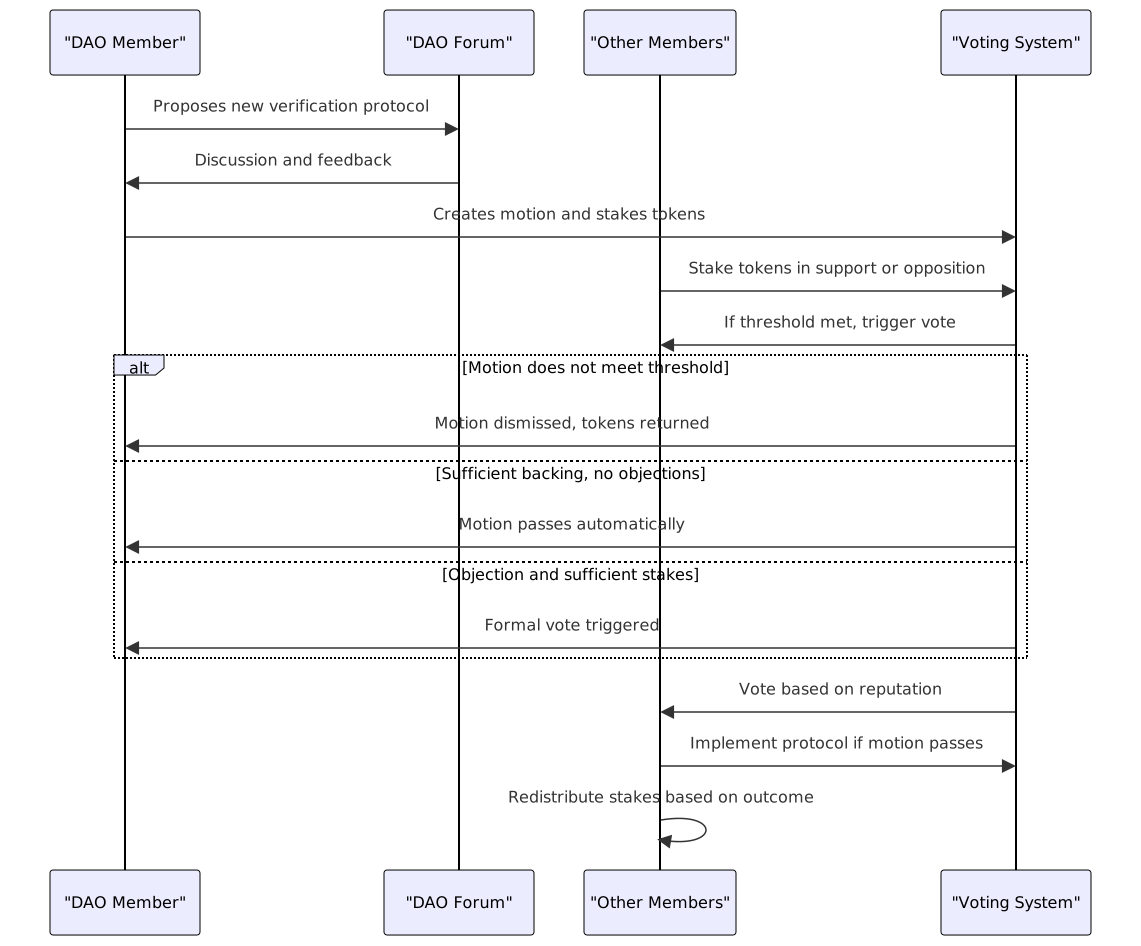 ### Advantages of Reputation-Based Voting Reputation-based voting in DAOs offers several compelling benefits that align closely with the principles of decentralized governance. This system not only enhances accountability and inclusivity but also mitigates risks associated with token-based systems where wealthier members could potentially dominate decision-making. In a reputation-based system, voting power is derived from the contributions a member makes to the DAO, rather than the number of tokens they hold. This mechanism ensures that those who are actively involved and invested in the DAO’s success have a greater say in its direction. For instance, in a DAO like Colony, members who consistently contribute valuable work and ideas gain reputation and thereby more influence on future decisions. This rewards long-term commitment and knowledge, fostering a governance model that is more meritocratic. Reputation is non-transferable and can only be earned through meaningful participation within the DAO. This characteristic significantly lowers the risk of vote buying and sybil attacks that are more feasible in purely token-based systems. Since reputation decays over time unless actively maintained by ongoing contributions, it also prevents former members who are no longer actively involved from having an undue influence on the DAO’s future. Reputation-based voting ensures that decision-making power is in the hands of those who have demonstrated a consistent alignment with the DAO’s objectives. This alignment is crucial for the long-term health and success of the DAO, as these members are likely to make decisions that benefit the collective rather than personal short-term gains. For example, in a project management DAO, members who have shown a deep understanding of the projects through active engagement and successful task completions will have more influence on critical decisions such as strategic pivots or budget allocations.  While reputation-based voting presents numerous advantages, it also introduces certain challenges and complexities that must be carefully managed to ensure its effectiveness in DAOs and other decentralized organizations. One of the main challenges of reputation-based voting is the complexity involved in managing and calculating reputation scores. This system requires robust algorithms to fairly assess contributions and translate them into voting power. The dynamic nature of reputation—where scores can fluctuate based on activity and contribution quality—adds layers of complexity to governance processes. Colony simplifies this complexity by automating the reputation calculation process. The platform uses smart contracts to track activities and automatically update reputation scores based on predetermined criteria, ensuring that the system is both transparent and tamper-proof. Another significant challenge is the risk of inactivity where members might become less active over time, leading to outdated reputation scores influencing critical decisions. This can skew governance processes, especially if inactive members hold large amounts of outdated reputation. ---- Shell cwd was reset to [worktree]stdouttextThis article delves into the innovative realm of reputation-based voting, **a method that prioritizes the contributions and activity levels of members rather than just their token holdings**. By focusing on [Colony](https://colony.io/?ref=blog.colony.io), a platform that integrates reputation-based voting seamlessly into its DAO structure, we'll explore how this approach not only enhances democratic participation but also aligns closely with the ethos of decentralized governance. Through Colony’s model, we see a voting system that rewards engagement and expertise, potentially setting a new standard for how decisions could be made in the digital age. ### Understanding Reputation-Based Voting [**Reputation-based voting**](https://docs.colony.io/learn/governance/reputation?ref=blog.colony.io) is a sophisticated mechanism in DAOs that prioritizes contribution and engagement over mere token possession. This system is designed to reward active members, ensuring that those who significantly contribute to the DAO's objectives wield greater influence over its governance. Such a system aligns voting power with demonstrated commitment and skill, as opposed to just financial investment. In **Colony**, this concept is embraced through its governance framework where reputation is an earned attribute reflecting the value a member brings through completing tasks, fulfilling roles, or actively engaging in governance. This reputation then dictates their voting power in the decision-making processes. The implementation of reputation-based voting in Colony is deeply integrated with **blockchain technology**. Smart contracts automatically update reputation scores to reflect each member's recent contributions accurately. These contracts manage the nuances of reputation accrual and decay, ensuring the system is dynamic and responsive to ongoing participation. This approach not only promotes a more engaged community but also bolsters the DAO's adaptability and resilience, tying decision-making power to the most active and invested members.  ### Mechanics of Reputation in Colony In Colony, reputation plays a central role in governing the autonomous organization. Unlike traditional token-based systems where voting power is often directly linked to the quantity of tokens held, **reputation in Colony** must be earned through meaningful participation and contributions. This reputation is strictly non-transferable, meaning it cannot be bought or sold, distinguishing it significantly from typical cryptocurrency or token assets. Reputation is primarily earned by completing tasks or fulfilling roles within the Colony. Each action that contributes positively to the community is rewarded with an increase in reputation scores in the relevant domains or categories. This can include anything from completing development tasks to participating in governance decisions. The **calculation of reputation scores** in Colony is dynamic, reflecting the recent contributions of members. The system uses an algorithm that accounts for the frequency and impact of a member’s activities. For example, more significant or valuable contributions result in greater reputation gains. Additionally, reputation naturally decays over time, which encourages continuous participation and engagement by members to maintain their influence in the DAO. The impact of these scores is directly observed in voting scenarios: **the higher a member's reputation, the greater their voting power**. This setup ensures that the most active and contributing members have a larger say in key decisions, aligning the DAO’s direction with the interests and efforts of its most engaged participants. This mechanism not only fosters fairness and meritocracy but also enhances the collective decision-making quality, as it amplifies the voices of those most invested in the Colony’s success.  ### Demonstration of Reputation Governance in Action Let's illustrate reputation-based voting using a hypothetical scenario within a Colony-based DAO, focusing on deciding on a major governance change like adopting a new protocol for transaction verification. 2. **Discussion and Feedback**: Before the voting begins, the proposal is discussed in the DAO’s forums. Members provide feedback, suggest adjustments, and debate the merits and potential risks associated with changing the verification protocol. During this phase, members with higher reputation scores, who are recognized for their technical expertise and previous contributions, play a pivotal role in shaping the discussion. 5. **Reputation-Based Voting**: If the staked amount reaches a predetermined threshold and triggers a vote, voting begins. Each member’s vote is weighted according to their reputation score within the DAO, ensuring that those who have contributed the most have a greater influence over critical decisions. 7. **Voting Process**: During the voting phase, all DAO members can cast their votes according to their reputation. The outcome is determined by the majority of reputation-weighted votes. 8. **Implementation**: If the motion passes, the new verification protocol is implemented in phases as outlined in the proposal. Each phase is monitored, and adjustments are made based on continuous member feedback and further reputation-weighted votes. This scenario demonstrates how reputation-based voting ensures that decision-making in a DAO is not only democratic but also meritocratic. It promotes fairness by allowing the most dedicated and knowledgeable members to have greater influence on critical decisions, thereby enhancing engagement and ensuring that governance decisions are well-informed and aligned with the DAO's long-term success.  ### Advantages of Reputation-Based Voting Reputation-based voting in DAOs offers several compelling benefits that align closely with the principles of decentralized governance. This system not only enhances accountability and inclusivity but also mitigates risks associated with token-based systems where wealthier members could potentially dominate decision-making. In a reputation-based system, voting power is derived from the contributions a member makes to the DAO, rather than the number of tokens they hold. This mechanism ensures that those who are actively involved and invested in the DAO’s success have a greater say in its direction. For instance, in a DAO like Colony, members who consistently contribute valuable work and ideas gain reputation and thereby more influence on future decisions. This rewards long-term commitment and knowledge, fostering a governance model that is more meritocratic. Reputation is non-transferable and can only be earned through meaningful participation within the DAO. This characteristic significantly lowers the risk of vote buying and sybil attacks that are more feasible in purely token-based systems. Since reputation decays over time unless actively maintained by ongoing contributions, it also prevents former members who are no longer actively involved from having an undue influence on the DAO’s future. Reputation-based voting ensures that decision-making power is in the hands of those who have demonstrated a consistent alignment with the DAO’s objectives. This alignment is crucial for the long-term health and success of the DAO, as these members are likely to make decisions that benefit the collective rather than personal short-term gains. For example, in a project management DAO, members who have shown a deep understanding of the projects through active engagement and successful task completions will have more influence on critical decisions such as strategic pivots or budget allocations.  While reputation-based voting presents numerous advantages, it also introduces certain challenges and complexities that must be carefully managed to ensure its effectiveness in DAOs and other decentralized organizations. One of the main challenges of reputation-based voting is the complexity involved in managing and calculating reputation scores. This system requires robust algorithms to fairly assess contributions and translate them into voting power. The dynamic nature of reputation—where scores can fluctuate based on activity and contribution quality—adds layers of complexity to governance processes. Colony simplifies this complexity by automating the reputation calculation process. The platform uses smart contracts to track activities and automatically update reputation scores based on predetermined criteria, ensuring that the system is both transparent and tamper-proof. Another significant challenge is the risk of inactivity where members might become less active over time, leading to outdated reputation scores influencing critical decisions. This can skew governance processes, especially if inactive members hold large amounts of outdated reputation. ----stderrtextShell cwd was reset to [worktree]
Used 1 tool1/1
- Bash
Bash
cd /tmp && firecrawl scrape "https://communitynotes.x.com/guide/en/under-the-hood/ranking-notes" 2>&1 | grep -iE "helpfulness" | head -15; echo ----; firecrawl scrape "https://bpb-us-e1.wpmucdn.com/wp.nyu.edu/dist/b/7118/files/2025/06/annurev-polisci-050123-113309.pdf" 2>&1 | grep -iE "weighted voting|plural voting|epistocra" | head -15
Check Community Notes rater helpfulness and the meritocracy review
bashcd /tmp && firecrawl scrape "https://communitynotes.x.com/guide/en/under-the-hood/ranking-notes" 2>&1 | grep -iE "helpfulness" | head -15; echo ----; firecrawl scrape "https://bpb-us-e1.wpmucdn.com/wp.nyu.edu/dist/b/7118/files/2025/06/annurev-polisci-050123-113309.pdf" 2>&1 | grep -iE "weighted voting|plural voting|epistocra" | head -15resulttext---- political meritocracy, representative democracy, expertise, weighted voting, meritocracy and weighted voting. We then describe and briefly evaluate five institutionalizations of political meritocracy: nondemocratic meritocracy and weighted voting. and weighted voting. ## WEIGHTED VOTING weights) in the voting scheme, which he describes as plural voting. Second, certain categories of citizens—e.g., the illiterate and the innumerate—should not be permitted to vote at all. Because restrictions on franchise and plural voting can both be thought of as forms of weighted voting (where weighted voting, which, rather than replacing elections with bureaucratic selection, aim to improve the performance of electoral systems by organizing them so that the educated or otherwise different kind of argument for weighted voting is epistemic: We are just more likely to get the right Other kinds of arguments work by showing that it is difficult to reject weighted voting if one is out weighted voting because age is relevant as a proxy for competence (Hinze 2023). While weighted voting and nondemocratic meritocracy are both forms of political meritocracy, conflict. By contrast, advocates of weighted voting focus primarily on the epistemically superior Still, the departure from egalitarian democracy that advocates of weighted voting suggest, though added benefits of weighted voting as somewhat more modest. Shell cwd was reset to [worktree]stdouttext---- political meritocracy, representative democracy, expertise, weighted voting, meritocracy and weighted voting. We then describe and briefly evaluate five institutionalizations of political meritocracy: nondemocratic meritocracy and weighted voting. and weighted voting. ## WEIGHTED VOTING weights) in the voting scheme, which he describes as plural voting. Second, certain categories of citizens—e.g., the illiterate and the innumerate—should not be permitted to vote at all. Because restrictions on franchise and plural voting can both be thought of as forms of weighted voting (where weighted voting, which, rather than replacing elections with bureaucratic selection, aim to improve the performance of electoral systems by organizing them so that the educated or otherwise different kind of argument for weighted voting is epistemic: We are just more likely to get the right Other kinds of arguments work by showing that it is difficult to reject weighted voting if one is out weighted voting because age is relevant as a proxy for competence (Hinze 2023). While weighted voting and nondemocratic meritocracy are both forms of political meritocracy, conflict. By contrast, advocates of weighted voting focus primarily on the epistemically superior Still, the departure from egalitarian democracy that advocates of weighted voting suggest, though added benefits of weighted voting as somewhat more modest.stderrtextShell cwd was reset to [worktree]
Used 1 tool1/1
- Bash
Bash
cd /tmp && firecrawl search "Community Notes contributor helpfulness score raters filtered second round matrix factorization" --limit 4 --scrape 2>&1 | grep -iE "helpfulness|URL:" | head -20
Find how Community Notes weighs raters by helpfulness
bashcd /tmp && firecrawl search "Community Notes contributor helpfulness score raters filtered second round matrix factorization" --limit 4 --scrape 2>&1 | grep -iE "helpfulness|URL:" | head -20resulttextURL: https://communitynotes.x.com/guide/en/under-the-hood/ranking-notes Rater Helpfulness Scores based on the results of the first matrix factorization, then filter out raters with low helpfulness scores from the ratings data A Dataset for Exploring the Helpfulness of Fact-Checking ... URL: https://arxiv.org/html/2510.24810v1 # COMMUNITYNOTES: A Dataset for Exploring the Helpfulness of Fact-Checking Explanations The algorithm is based on a Matrix Factorization (MF) model fit on the sparse note-rater matrix which generates a continuous "Note Helpfulness Score" for each note. A note receives CURRENTLY_RATED_HELPFUL status if its score is greater than 0.40. A note is assigned CURRENTLY_RATED_NOT_HELPFUL if its score is smaller than -0.05 - 0.8 ×\times|noteFactorScore||\text{noteFactorScore}|, or if its upper confidence bound is smaller than -0.04. | | 3. | Calculate & Filter Helpfulness: Compute Author/Rater Helpfulness Scores from the initial MF results. Filter out low-helpfulness raters. | # COMMUNITYNOTES: A Dataset for Exploring the Helpfulness of Fact-Checking Explanations Fact-checking on major platforms, such as X, Meta, and TikTok, is shifting from expert-driven verification to a community-based setup, where users contribute explanatory notes to clarify why a post might be misleading. An important challenge here is determining whether an explanation is helpful for understanding real-world claims and the reasons why, which remains largely underexplored in prior research. In practice, most community notes remain unpublished due to slow community annotation, and the reasons for helpfulness lack clear definitions. To bridge these gaps, we introduce the task of predicting both the helpfulness of explanatory notes and the reason for this. We present COMMUNITYNOTES, a large-scale multilingual dataset of 104k posts with user-provided notes and helpfulness labels. We further propose a framework that automatically generates and improves reason definitions via automatic prompt optimization, and integrate them into prediction. Our experiments show that the optimized definitions can improve both helpfulness and reason prediction. Finally, we show that the helpfulness information are beneficial for existing fact-checking systems. The code and data are available at: [https://github.com/ruixing76/Helpfulness-FCExp](https://github.com/ruixing76/Helpfulness-FCExp ""). Typically, fact-checking explanations are produced by expert organizations. Yet the ecosystem is currently shifting, and platforms are increasingly experimenting with community-based fact-checking, where contributors collaboratively provide explanatory notes on claims ( [Augenstein et al., 2025](https://arxiv.org/html/2510.24810v1#bib.bib3 "")). This crowdsourcing process distributes the labor of verification and offers diverse perspectives from the community. A representative example is _Community Notes_ on X (formerly Twitter), which allows users to attach notes explaining potentially misleading posts ( [Figure1](https://arxiv.org/html/2510.24810v1#S0.F1 "In COMMUNITYNOTES: A Dataset for Exploring the Helpfulness of Fact-Checking Explanations")).111 [https://communitynotes.x.com/guide/](https://communitynotes.x.com/guide/ "") Motivated by the above, here we explore the idea of simplifying and making more explicit the helpfulness annotation process. Our contributions are as follows: We introduce the task of predicting the helpfulness and its reasons given a note and the original X post. We present COMMUNITYNOTES, a large-scale explanation helpfulness dataset containing over 104K potentially misleading posts and corresponding user-provided notes. We propose a framework that automatically generates and optimizes reason label definitions via prompt optimization; integrating them to helpfulness/reason predictors to improve their performance. We apply helpfulness prediction to the evidence sufficiency task ( [Atanasova et al., 2022](https://arxiv.org/html/2510.24810v1#bib.bib2 "")) and further incorporate it as auxiliary signals into automated fact-checking on CLIMATE-FEVER( [Diggelmann et al., 2020](https://arxiv.org/html/2510.24810v1#bib.bib9 "")), showing its potential to enhance existing fact-checking systems. Empirical evidence suggests that community-based fact-checking can be highly effective in countering misinformation. Studies have shown that the presence of a Community Note can reduce the rate of retweets by nearly half ( [Renault et al., 2024](https://arxiv.org/html/2510.24810v1#bib.bib22 "")), while displaying such notes on misleading posts has been found to decrease their spread by an average of 61% ( [Chuai et al., 2024](https://arxiv.org/html/2510.24810v1#bib.bib7 "")). Moreover, authors of posts flagged by community notes are up to 80% more likely to delete their content, and such posts generally exhibit markedly lower virality ( [Drolsbach and Pröllochs, 2023](https://arxiv.org/html/2510.24810v1#bib.bib10 ""); [Renault et al., 2024](https://arxiv.org/html/2510.24810v1#bib.bib22 "")). However, _Community Notes_ often requires a long time to gather sufficient contributor ratings to determine helpfulness, and the absence of reason definitions further undermines the trustworthiness of the mechanism. Given a post PP that contains potentially misleading information and a note NN that provides an explanation about that post, the task is to predict two types of labels: a helpfulness labelLhelpfulL\_{helpful}, indicating whether the note is helpful in explaining the misleading nature of the post, and a reason labelLreasonL\_{reason}, specifying why the note is (un)helpful. The helpfulness prediction is formulated as a binary classification task with the label space {Helpful,Unhelpful}\\{Helpful,Unhelpful\\}. The reason prediction is a multi-label classification task, where the predefined label set includes eight reasons for helpful notes and ten reasons for unhelpful ones (See [Table14](https://arxiv.org/html/2510.24810v1#A1.T14 "In A.5 Experimental Details ‣ Appendix A Appendix ‣ COMMUNITYNOTES: A Dataset for Exploring the Helpfulness of Fact-Checking Explanations") for detailed reason labels). We collected all our data from official Community Notes website between January 2021 and December 2024.222 [https://communitynotes.x.com/guide/en/under-the-hood/download-data](https://communitynotes.x.com/guide/en/under-the-hood/download-data "") We construct our dataset by combining all publicly available data releases, which include the Notes, Ratings, Note Status History, and User Enrollment tables. Since the ratings data are provided in multiple shards due to their large volume, we first merge all shards and join them with the other components to obtain complete note–rating pairs. We then apply the official note-ranking algorithm to compute the aggregated helpfulness and reason labels for each note.333 [https://communitynotes.x.com/guide/en/under-the-hood/ranking-notes](https://communitynotes.x.com/guide/en/under-the-hood/ranking-notes "") For helpfulness prediction, we remove entries labeled as NEED\_MORE\_RATINGS, leaving the helpfulness label space binary—CURRENTLY\_RATED\_HELPFUL or CURRENTLY\_RATED\_NOT\_HELPFUL. The reason annotation is multi-label, covering 18 predefined categories. Finally, we retrieve tweet content and metadata via the X API and web crawling ( [Borenstein et al., 2025](https://arxiv.org/html/2510.24810v1#bib.bib5 "")), linking each post with its corresponding notes to form the final dataset used in our experiments. [Table1](https://arxiv.org/html/2510.24810v1#S3.T1 "In 3.2 Data Collection and Pre-processing ‣ 3 Predicting Whether an Explanation is Helpful and Why ‣ COMMUNITYNOTES: A Dataset for Exploring the Helpfulness of Fact-Checking Explanations") provides the data distribution. Our final dataset contains 104,966 posts, including 58,569 in English and 46,397 in other languages. We perform stratified partitioning with a 7:1:2 ratio for training, development, and testing sets, maintaining separate splits for English and other language data. Henceforth we will refer to this dataset as COMMUNITYNOTES. We inspected multiple aspects of our entire COMMUNITYNOTES dataset. [Table2](https://arxiv.org/html/2510.24810v1#S3.T2 "In 3.3 Dataset Statistics ‣ 3 Predicting Whether an Explanation is Helpful and Why ‣ COMMUNITYNOTES: A Dataset for Exploring the Helpfulness of Fact-Checking Explanations") shows the token length distribution for posts and notes correspondingly. The median token number are 42 for posts and 70 for notes, which suggests most posts and notes are short text snippets. Shell cwd was reset to [worktree]stdouttextURL: https://communitynotes.x.com/guide/en/under-the-hood/ranking-notes Rater Helpfulness Scores based on the results of the first matrix factorization, then filter out raters with low helpfulness scores from the ratings data A Dataset for Exploring the Helpfulness of Fact-Checking ... URL: https://arxiv.org/html/2510.24810v1 # COMMUNITYNOTES: A Dataset for Exploring the Helpfulness of Fact-Checking Explanations The algorithm is based on a Matrix Factorization (MF) model fit on the sparse note-rater matrix which generates a continuous "Note Helpfulness Score" for each note. A note receives CURRENTLY_RATED_HELPFUL status if its score is greater than 0.40. A note is assigned CURRENTLY_RATED_NOT_HELPFUL if its score is smaller than -0.05 - 0.8 ×\times|noteFactorScore||\text{noteFactorScore}|, or if its upper confidence bound is smaller than -0.04. | | 3. | Calculate & Filter Helpfulness: Compute Author/Rater Helpfulness Scores from the initial MF results. Filter out low-helpfulness raters. | # COMMUNITYNOTES: A Dataset for Exploring the Helpfulness of Fact-Checking Explanations Fact-checking on major platforms, such as X, Meta, and TikTok, is shifting from expert-driven verification to a community-based setup, where users contribute explanatory notes to clarify why a post might be misleading. An important challenge here is determining whether an explanation is helpful for understanding real-world claims and the reasons why, which remains largely underexplored in prior research. In practice, most community notes remain unpublished due to slow community annotation, and the reasons for helpfulness lack clear definitions. To bridge these gaps, we introduce the task of predicting both the helpfulness of explanatory notes and the reason for this. We present COMMUNITYNOTES, a large-scale multilingual dataset of 104k posts with user-provided notes and helpfulness labels. We further propose a framework that automatically generates and improves reason definitions via automatic prompt optimization, and integrate them into prediction. Our experiments show that the optimized definitions can improve both helpfulness and reason prediction. Finally, we show that the helpfulness information are beneficial for existing fact-checking systems. The code and data are available at: [https://github.com/ruixing76/Helpfulness-FCExp](https://github.com/ruixing76/Helpfulness-FCExp ""). Typically, fact-checking explanations are produced by expert organizations. Yet the ecosystem is currently shifting, and platforms are increasingly experimenting with community-based fact-checking, where contributors collaboratively provide explanatory notes on claims ( [Augenstein et al., 2025](https://arxiv.org/html/2510.24810v1#bib.bib3 "")). This crowdsourcing process distributes the labor of verification and offers diverse perspectives from the community. A representative example is _Community Notes_ on X (formerly Twitter), which allows users to attach notes explaining potentially misleading posts ( [Figure1](https://arxiv.org/html/2510.24810v1#S0.F1 "In COMMUNITYNOTES: A Dataset for Exploring the Helpfulness of Fact-Checking Explanations")).111 [https://communitynotes.x.com/guide/](https://communitynotes.x.com/guide/ "") Motivated by the above, here we explore the idea of simplifying and making more explicit the helpfulness annotation process. Our contributions are as follows: We introduce the task of predicting the helpfulness and its reasons given a note and the original X post. We present COMMUNITYNOTES, a large-scale explanation helpfulness dataset containing over 104K potentially misleading posts and corresponding user-provided notes. We propose a framework that automatically generates and optimizes reason label definitions via prompt optimization; integrating them to helpfulness/reason predictors to improve their performance. We apply helpfulness prediction to the evidence sufficiency task ( [Atanasova et al., 2022](https://arxiv.org/html/2510.24810v1#bib.bib2 "")) and further incorporate it as auxiliary signals into automated fact-checking on CLIMATE-FEVER( [Diggelmann et al., 2020](https://arxiv.org/html/2510.24810v1#bib.bib9 "")), showing its potential to enhance existing fact-checking systems. Empirical evidence suggests that community-based fact-checking can be highly effective in countering misinformation. Studies have shown that the presence of a Community Note can reduce the rate of retweets by nearly half ( [Renault et al., 2024](https://arxiv.org/html/2510.24810v1#bib.bib22 "")), while displaying such notes on misleading posts has been found to decrease their spread by an average of 61% ( [Chuai et al., 2024](https://arxiv.org/html/2510.24810v1#bib.bib7 "")). Moreover, authors of posts flagged by community notes are up to 80% more likely to delete their content, and such posts generally exhibit markedly lower virality ( [Drolsbach and Pröllochs, 2023](https://arxiv.org/html/2510.24810v1#bib.bib10 ""); [Renault et al., 2024](https://arxiv.org/html/2510.24810v1#bib.bib22 "")). However, _Community Notes_ often requires a long time to gather sufficient contributor ratings to determine helpfulness, and the absence of reason definitions further undermines the trustworthiness of the mechanism. Given a post PP that contains potentially misleading information and a note NN that provides an explanation about that post, the task is to predict two types of labels: a helpfulness labelLhelpfulL\_{helpful}, indicating whether the note is helpful in explaining the misleading nature of the post, and a reason labelLreasonL\_{reason}, specifying why the note is (un)helpful. The helpfulness prediction is formulated as a binary classification task with the label space {Helpful,Unhelpful}\\{Helpful,Unhelpful\\}. The reason prediction is a multi-label classification task, where the predefined label set includes eight reasons for helpful notes and ten reasons for unhelpful ones (See [Table14](https://arxiv.org/html/2510.24810v1#A1.T14 "In A.5 Experimental Details ‣ Appendix A Appendix ‣ COMMUNITYNOTES: A Dataset for Exploring the Helpfulness of Fact-Checking Explanations") for detailed reason labels). We collected all our data from official Community Notes website between January 2021 and December 2024.222 [https://communitynotes.x.com/guide/en/under-the-hood/download-data](https://communitynotes.x.com/guide/en/under-the-hood/download-data "") We construct our dataset by combining all publicly available data releases, which include the Notes, Ratings, Note Status History, and User Enrollment tables. Since the ratings data are provided in multiple shards due to their large volume, we first merge all shards and join them with the other components to obtain complete note–rating pairs. We then apply the official note-ranking algorithm to compute the aggregated helpfulness and reason labels for each note.333 [https://communitynotes.x.com/guide/en/under-the-hood/ranking-notes](https://communitynotes.x.com/guide/en/under-the-hood/ranking-notes "") For helpfulness prediction, we remove entries labeled as NEED\_MORE\_RATINGS, leaving the helpfulness label space binary—CURRENTLY\_RATED\_HELPFUL or CURRENTLY\_RATED\_NOT\_HELPFUL. The reason annotation is multi-label, covering 18 predefined categories. Finally, we retrieve tweet content and metadata via the X API and web crawling ( [Borenstein et al., 2025](https://arxiv.org/html/2510.24810v1#bib.bib5 "")), linking each post with its corresponding notes to form the final dataset used in our experiments. [Table1](https://arxiv.org/html/2510.24810v1#S3.T1 "In 3.2 Data Collection and Pre-processing ‣ 3 Predicting Whether an Explanation is Helpful and Why ‣ COMMUNITYNOTES: A Dataset for Exploring the Helpfulness of Fact-Checking Explanations") provides the data distribution. Our final dataset contains 104,966 posts, including 58,569 in English and 46,397 in other languages. We perform stratified partitioning with a 7:1:2 ratio for training, development, and testing sets, maintaining separate splits for English and other language data. Henceforth we will refer to this dataset as COMMUNITYNOTES. We inspected multiple aspects of our entire COMMUNITYNOTES dataset. [Table2](https://arxiv.org/html/2510.24810v1#S3.T2 "In 3.3 Dataset Statistics ‣ 3 Predicting Whether an Explanation is Helpful and Why ‣ COMMUNITYNOTES: A Dataset for Exploring the Helpfulness of Fact-Checking Explanations") shows the token length distribution for posts and notes correspondingly. The median token number are 42 for posts and 70 for notes, which suggests most posts and notes are short text snippets.stderrtextShell cwd was reset to [worktree]
There's no single official term for this. The closest established name for what you're describing is reputation-weighted voting, also called reputation-based voting or governance. Which word people use depends on the field.
The names, by field
| Field | Term | What it means |
|---|---|---|
| Online communities, DAOs | Reputation-weighted voting | Your vote counts in proportion to reputation you earned and can't buy or transfer. This is your idea exactly. |
| Social choice, political science | Weighted voting | The umbrella term for any rule that gives some voters more influence than others, as opposed to one person, one vote. |
| Political philosophy | Plural voting, epistocracy, political meritocracy | The historical and academic versions. J.S. Mill wanted extra votes for the educated, and Jason Brennan argues for weighting votes by political knowledge. These terms carry a lot of "anti-democratic" baggage. |
| Ratings, ranking, recommendations | Trust metric, rater reputation, trust-aware collaborative filtering | Each like or rating is weighted by how trustworthy the person giving it is. |
| The problem you're defending against | Sybil attack | Your "ghost member who joined yesterday" is a Sybil. The opposite fix is proof of personhood: one verified human, one equal vote. |
Systems that already do it
- Colony (a DAO platform) is the textbook case of earned influence. Reputation is earned only by contributing, can't be transferred or sold, decays over time, and "the higher a member's reputation, the greater their voting power." The decay matters: it stops old accounts that have gone quiet from controlling decisions forever. (
Colony blog,
docs)
- SourceCred is the most literally "contribution-aware" one. It builds a graph of contributions, scores it with a PageRank-like algorithm to produce "Cred", and the community voted with Cred-weighted votes. (
SourceCred docs,
forum)
- EigenTrust is the clean math version. A person's reputation is defined recursively by the people who trust them, weighted by those people's own reputation. Your "1 like from a veteran counts more" is one step of that recursion. (
Stanford paper,
OpenRank)
- IMDb says outright that it accepts every rating, but "not all votes have the same impact (or 'weight')." It doesn't publish the formula. (
IMDb help)
- Reddit's Contributor Quality Score (CQS) is a hidden reputation score for every account. Moderators' automatic filters can act on it. (
Reddit help)
- X Community Notes computes a helpfulness score for each rater, then removes low-helpfulness raters before scoring notes a second time. (
ranking docs)
- Slashdot gives moderation points to users with high karma, and other users then rate those moderators ("meta-moderation"). That makes it partly gating and partly weighting. (
Slashdot)
Gating vs. weighting
The distinction you drew is the right one. Stack Overflow's privileges and Hacker News's flagging threshold (about 31 karma, per an unofficial writeup) are gating: you either have the power or you don't. What you want is continuous weighting: everyone votes from day one, and a vote's weight grows with reputation. Colony, SourceCred, EigenTrust, and IMDb work that way.
Design notes
- Hide the weights. IMDb and Reddit both do. One
study of voter biases argues that visibly unequal votes "dissuade the disadvantaged voters from participation."
- Decay reputation, like Colony. Without it you end up with a gerontocracy of early accounts.
- Base reputation on what others endorse, not on raw activity. Counting posts or account age is easy to farm. The reputation-of-the-people-who-liked-you approach used by EigenTrust and SourceCred is much harder to fake.
- Don't confuse it with similar terms. Stake- or token-weighted voting (Steemit, most crypto DAOs) weights by money, not contribution. Liquid democracy and quadratic voting are different mechanisms entirely.
If you need one phrase for a design doc: reputation-weighted voting for decisions, and reputation-weighted or trust-weighted ranking for feeds and recommendations.
No backlinks found