Boomerangs
시간 제한0.5초메모리 제한512 MB
단순 무방향 그래프에서 두 변이 한 정점을 공유하는 붐어랭을 서로 변을 겹치지 않게 최대한 많이 찾아 출력한다.
문제
Let G = (V, E) be a simple undirected graph with N vertices and M edges, where V = {1, . . . , N}. A tuple <u, v, w> is called as boomerang in G if and only if {(u, v),(v, w)} ⊆ E and u ≠ w; in other words, a boomerang consists of two edges which share a common vertex.
Given G, your task is to find as many disjoint boomerangs as possible in G. A set S contains disjoint boomerangs if and only if each edge in G only appears at most once (in one boomerang) in S. You may output any valid disjoint boomerangs, but the number of disjoint boomerangs should be maximum.
For example, consider a graph G = (V, E) of N = 5 vertices and M = 7 edges where E = {(1, 2), (1, 4), (2, 3), (2, 4), (2, 5), (3, 4), (3, 5)}.
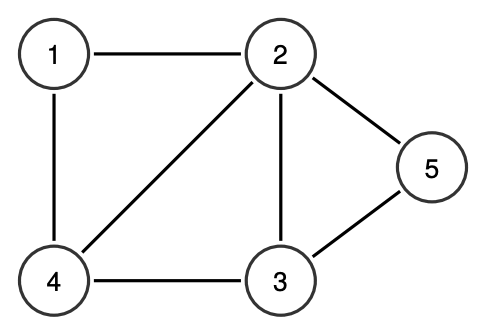
The maximum number of disjoint boomerangs in this example graph is 3. One example set containing the 3 disjoint boomerangs is {<4, 1, 2>,<4, 3, 2>,<2, 5, 3>}; no set can contain more than 3 disjoint boomerangs in this example.
입력
Input begins with a line containing two integers: N M (1 ≤ N, M ≤ 100000), representing the number of vertices and the number edges in G, respectively. The next M lines, each contains two integers: ui vi (1 ≤ ui < vi ≤ N), representing the edge (ui, vi) in G. You may safely assume that each edge appears at most once in the given list.
출력
The first line of output contains an integer: K, representing the maximum number of disjoint boomerangs in G. The next K lines, each contains three integers: u v w (each separated by a single space), representing a boomerang <u, v, w>. All boomerangs in the output should be disjoint. If there is more than one valid solution, you can output any of them.