A digital speedometer shows a vehicle's speed as integer miles per hour. There are occasions when the sensed speed varies between two integer values, such as during cruise control. Using a single threshold to round between adjacent integers often makes the display toggle rapidly between the two integers, which is distracting to the driver.
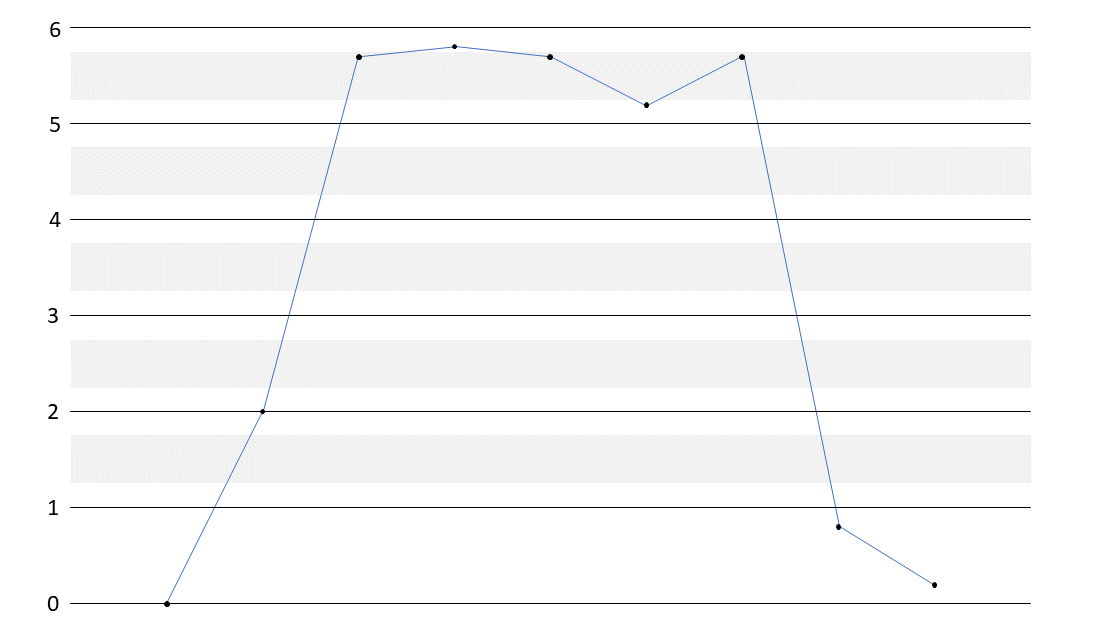
Your team must implement a smoothing technique for the display using separate rising and falling thresholds (t_r and t_f, t_f<t_r, respectively). See Figure 1 for a graphical depiction of the Sample Input for use with the following rules.

Figure 1: Sensor reading from the Sample Input, with t_f=0.25 and t_r=0.75.
Each sensed speed, s, falls between two adjacent integers i and j, i≤s<j, where j=i+1. When displaying the sensed speed s as an integer:
The first line of input contains t_f, the falling threshold. The second line of input contains t_r, the rising threshold. The speed sensor reports s in increments of 0.1 mph. The thresholds are always set halfway between speed increments. All remaining lines until end-of-file are successive decimal speeds, s, in miles per hour, one speed per line. The third line of input, which is the first measured speed, will always be 0. There are at most 1000 observed speeds s in input. 0<t_f,t_r<1; t_f<t_r; 0≤s≤120
Output is the list of speeds, one speed per line, smoothed to integer values appropriate to t_f and t_r.
| Input | Output | Explanation |
|---|---|---|
0.25 | Value of t_f. | |
0.75 | Value of t_r. | |
0 | 0 | Initial input. |
2.0 | 2 | Input greater than 0, below threshold of 2.25. |
5.7 | 5 | Input greater than 2.0, in threshold range. |
5.8 | 6 | Input greater than 2.0, exceeds upper threshold of 5.75. |
5.7 | 6 | Input less than 5.8, in threshold range. |
5.2 | 5 | Input less than 5.8, below threshold of 5.25. |
5.7 | 5 | Input greater than 5.2, in threshold range. |
0.8 | 1 | Input greater than 0 and less than 1. |
0.2 | 1 | Input greater than 0 and less than 1. |