Fence

아직 제출이 없습니다시간 제한2초메모리 제한512 MB

문제

Donald owns a nice small house in Manhattan. Due to recent elections it is important to protect yourself from the potential public unrest, so Donald has decided to build a fence around his house.

Donald's house can be represented as a polygon on the plane, with all the coordinates being integers. Moreover, all of his house corners are exactly 90deg90\deg, and each wall is parallel to either east-west or north-south axis. Donald wants to build a fence so that the house is completely inside of it and that the fence is not too close to the house. More precisely, Donald wants to build a fence in such way that Manhattan distance between any point of the fence and any point of the house is at least ll.

Recall that Manhattan distance between points (x_1,y_1)(x\_1, y\_1) and (x_2,y_2)(x\_2, y\_2) is x_1x_2+y_1y_2|x\_1 - x\_2| + |y\_1 - y\_2|.

Donald wants to minimize building costs, so he asks you to find the smallest possible length of the fence.

입력

The first line contains integers nn and ll (4n100,0004 \le n \le 100\\,000, 0l1080 \le l \le 10^8).

Each of the next nn lines contains integers x_ix\_i, y_iy\_i (x_i,y_i108|x\_i|, |y\_i| \le 10^8), describing the border of the house in clockwise or counterclockwise order.

It's guaranteed that the house is non-degenerate, doesn't contain any self-intersections (no two segments intersect except the neighboring segments having a common end), no two points coincide, all the house walls are either vertical or horizontal.

출력

Print a single real value, the smallest possible length of the fence. Your answer will be considered correct if it's absolute or relative error will be at most 10610^{-6}.

힌트

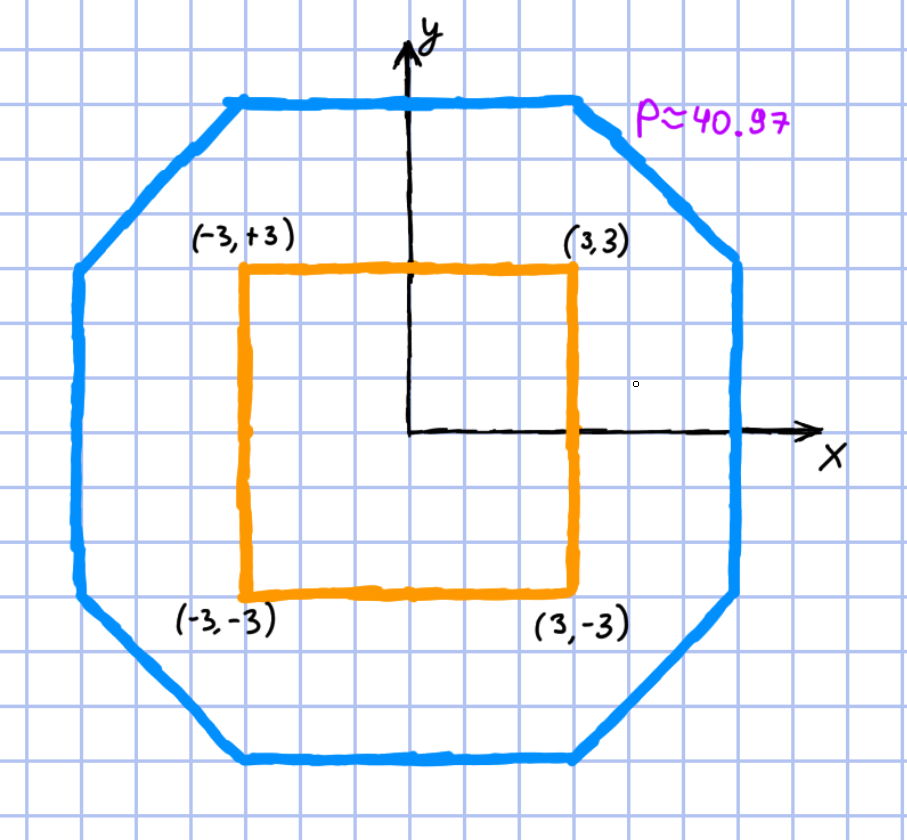
Example 1, the house is shown inside in orange, and the optimal fence is shown outside in blue.

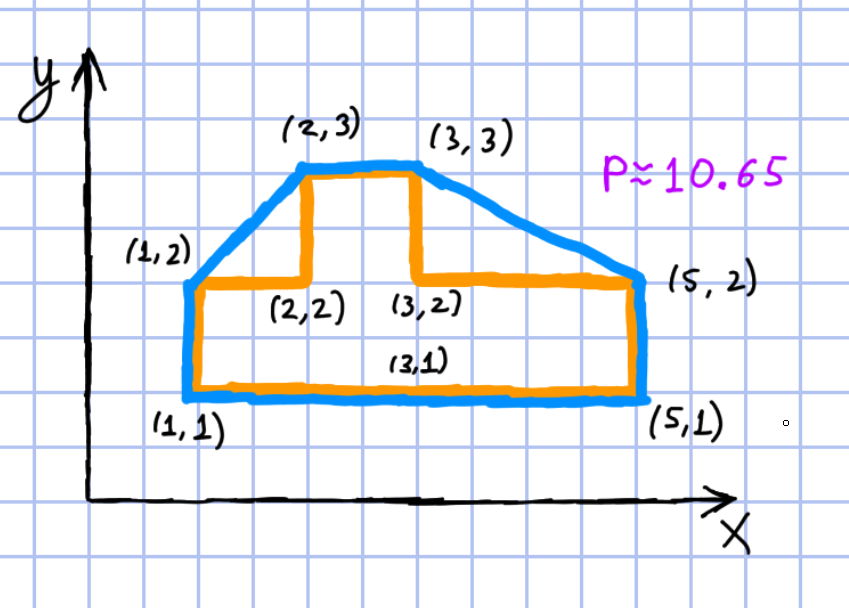
Example 2, the house is shown inside in orange, and the optimal fence is shown outside in blue.