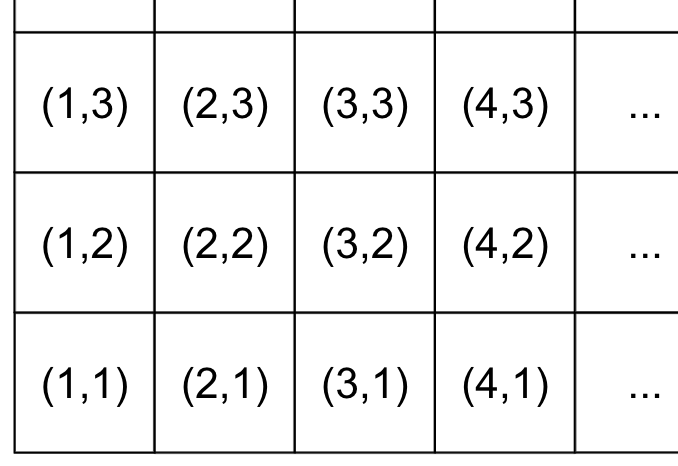
A 2-dimensional grid can be represented as a set of pairs of positive integers. Each cell can be numbered as in the figure below:

Suppose you are given a histogram where the height of each column is h_1,h_2,⋯,h_N. Its area can be represented as a set containing cells (i,1),(i,2),⋯,(i,h_i) for i=1,2,⋯,N. (If h_i=0, it means the histogram's area does not contain any cell from the i-th column.)
You may choose N integers x_1,x_2,⋯,x_N with 0≤x_i<h_i and subtract a sub-histogram with heights x_1,x_2,⋯,x_N. After removing such a sub-histogram, the remaining area can be written as: ⋃_i=1N(i,j):x_i<j≤h_i.
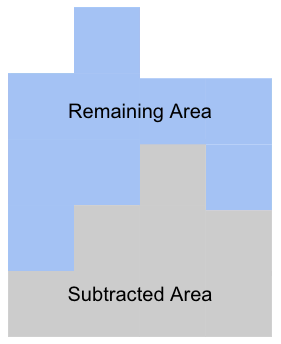
For example, the following figure shows an example of h_1=4, h_2=5, h_3=4, h_4=4 and x_1=1, x_2=2, x_3=3, x_4=2.

The remaining area is called connected if for every pair of cells ((r_1,c_1),(r_2,c_2)) in the remaining area, one can move from (r_1,c_1) to (r_2,c_2) using only the following moves without leaving the remaining area:
Compute the number of ways to choose (x_1,x_2,⋯,x_N) such that the remaining area is connected.
The first line contains a single integer, N. The second line contains N integers - h_1,h_2,⋯,h_N in order.
Output the number of ways to choose (x_1,x_2,⋯,x_N) such that the remaining area is connected, modulo 109+7.