Deni is the boss of a company with N workers, numbered from 1 to N. The company structure is strictly hierarchical – every worker (except number 1) has exactly one direct supervisor. So, every worker has 1 or more subordinates (direct and indirect) including himself. For example, worker 1 has exactly N subordinates, including himself. Of course, there isn’t a situation where some subordinate of a worker is his direct supervisor. For some worker x, we will call x a 0-level subordinate. Then, his direct subordinates will be called 1-level subordinates of x. All of their direct subordinates (which are indirect subordinates of x) will be called 2-level subordinates of x and so on.
There is a breaking piece of news that is known by some of the workers. Deni wants to inform all of the company employees. So, multiple times she chooses worker x and number k, and tells the news to all 0-level, 1-level (if they exist), …, k-level (if they exist) subordinates of x. We will call all these subordinates, k-subordinates of x. The problem with this type of announcement is that most of the time, many chosen subordinates already know the piece of news. That’s why Deni wants a system that can tell her the number of workers among all the k-subordinates of x that have already learned about the news. Write a program that can help her.
From the first line of the standard input read one integer N – the number of workers in Deni’s company. From each of the next N−1 lines read two integers x and y, which show that the worker y is a direct subordinate to the worker x. From the next line read N integers: b_1, b_2, …, b_N, where b_i is 1, if the worker i knows the news at the beginning and 0 otherwise. From the next line read one integer Q – the number of queries. From each of the last Q lines, read queries of two types:
For every query of type 2, on separate lines in the same order as in the input, write one integer – the answer for the corresponding question.

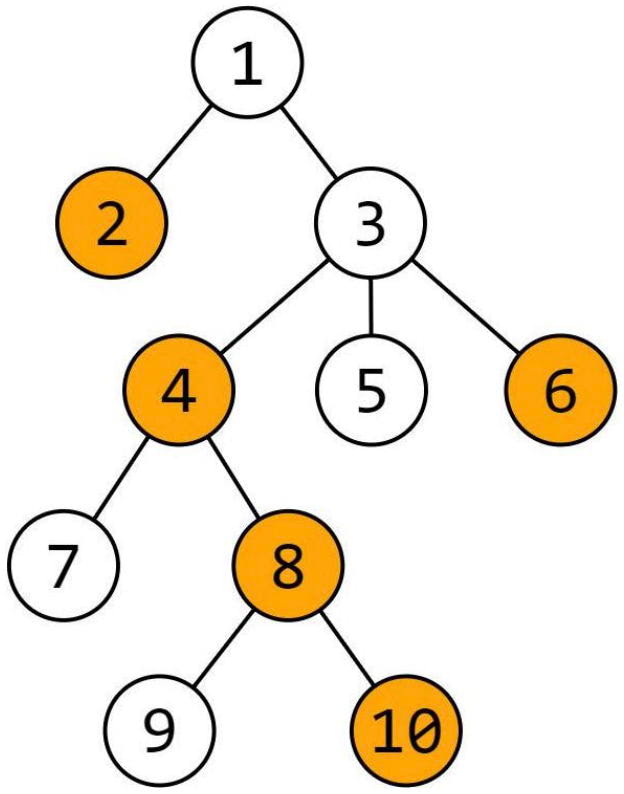
The above picture shows the hierarchy of the company and the workers that know the news at the beginning are colored in orange.
For the first query 2 4 4:
The 0-level subordinate of worker 4 is 4, the 1-level subordinates of worker 4 are workers 7 and 8, the 2-level subordinates of worker 4 are 9 and 10 and there are no 3-level and 4-level subordinates of worker 4. Workers 4, 8 and 10 know the news, so the answer to this question query is 3.
For query 1 4 1:
The 1-subordinates of worker 4 are workers 4, 7 and 8. Workers 4 and 8 already know the news, so only worker 7 learns the news at this time.
For the second query 2 4 4:
The 4-subordinates of worker 4 are 4, 7, 8, 9 and 10. Workers 4, 7, 8 and 10 know the news, so the answer to the query this time is 4.