Given a tetrahedron OABC with vertices O, A, B and C.
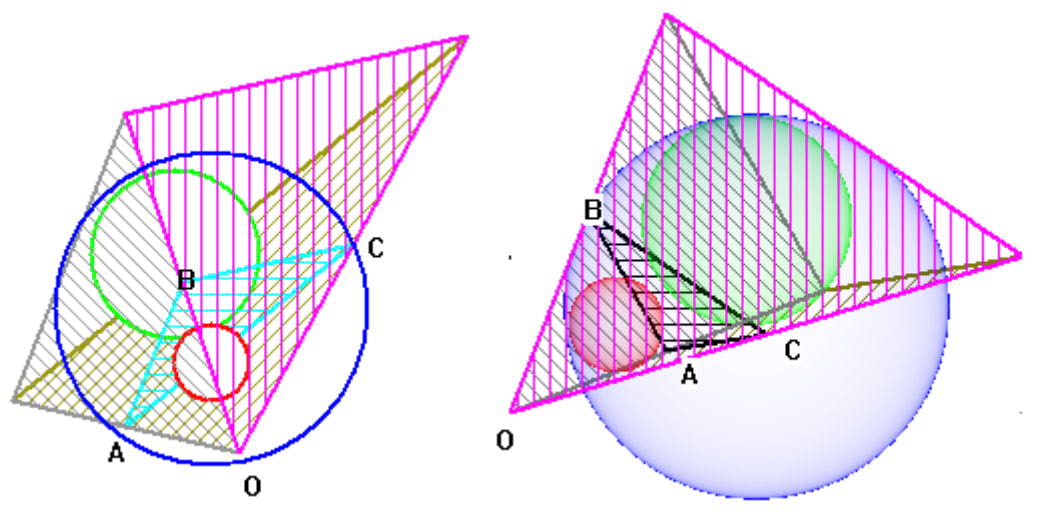
There is a sphere, S1 (red, center Q1), inscribed in the tetrahedron tangent to the inside of each face OAB (gray), OAC (brown), OBC (magenta) and ABC (cyan and black).
There is a second sphere, S2 (green, center Q2), tangent to the (extended) inside of OAB, OAC and OBC and to the outside of ABC. (There is actually such a sphere for each face, tangent to the outside of the face and the inside of the other extended faces).
There is a third larger sphere, S3 (blue, center Q3), which passes thru vertices A, B and C and is tangent to each of S1 and S2 so the outside of the smaller spheres is tangent to the inside of the largest sphere (see Figure 1, below, for two different views. Triangle ABC is cyan in the first picture and black in the second one for clarity):

Figure 1
The following figures give several views of the tetrahedron and spheres.
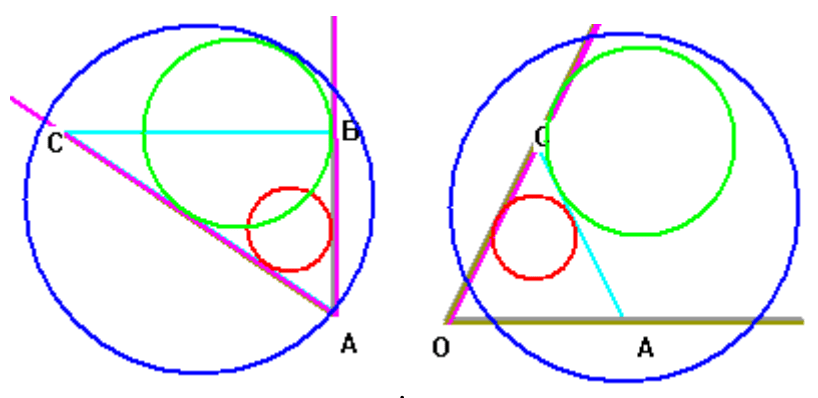
Figure 2 shows the view along OA, which shows the two smaller spheres tangent to OAB and OAC (left). The view along BC shows the two smaller spheres tangent to OBC and tangent on opposite sides of ABC (right):

Figure 2
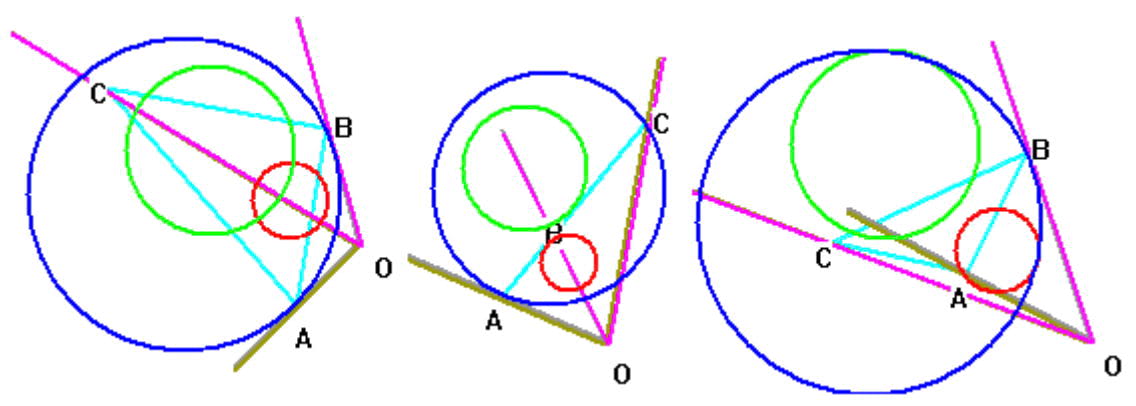
Figure 3 shows S3 passing through A, B and C and tangent to S1 and S2. On the left, the view perpendicular to the plane of triangle A, B, Q3 shows S3 passing through A and B. In the center, the view perpendicular to the plane of triangle A, C, Q3 shows S3 passing through A and C. On the right, the view perpendicular to the plane of triangle Q1, Q2, Q3 (the centers of the three spheres) shows S1 and S2 tangent to the inside of S3.

Figure 3
Write a program which takes as input the vertices O, A, B and C and computes the center and radius of the big sphere (which entails finding the other two spheres).
O will be the origin (0,0,0). A will lie on the positive x-axis (Ax,0,0), B will be on the xy−plane (Bx,By,0) and C will be in the first orthant (Cx,Cy,Cz). Ax, By and Cz will be strictly positive and the remaining values will be non-negative.
The input consists of a single line containing six double precision decimal values Ax, Bx, By, Cx, Cy and Cz in that order (as described above), (0<Ax,By,Cz≤10) and (0≤Bx,Cx,Cy≤10).
The single line of output contains four decimal values to four decimal places: center_x, center_y, center_z and radius of the big sphere.