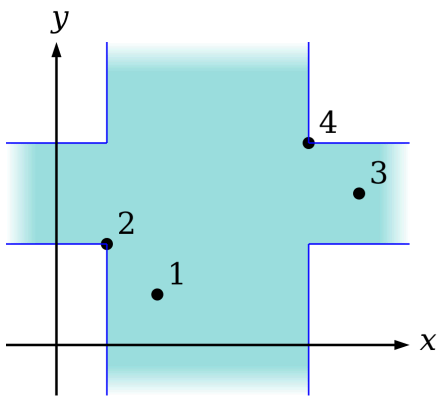
A cross-shaped infinite area on the x-y plane can be specified by two distinct points as depicted on the figure below.

Figure J.1. The cross area specified by two points numbered 2 and 4
Given a set of points on the plane, you are asked to figure out how many pairs of the points form a cross-shaped area that covers all the points. To be more precise, when n points with coordinates (x_i,y_i) (i=1,…,n) are given, the ordered pair \<p,q> is said to cover a point (x,y) if x_p≤x≤x_q, y_p≤y≤y_q, or both hold. Your task is to find how many pairs \<p,q> cover all the n points. No two given points have the same x-coordinate nor the same y-coordinate.
The input consists of a single test case of the following format.
\begin{align\*}& n \\\ & x\_1 \\, y\_1 \\\ & \vdots \\\ & x\_n \\, y\_n\end{align\*}
The first line contains an integer n (2≤n≤2×10⁵), which is the number of points given. Two integers x_i and y_i in the i-th line of the following n lines are the coordinates of the i-th point (1≤x_i≤106, 1≤y_i≤106). You may assume that x_j=x_k and y_j=y_k hold for all j=k.
Print in a line the number of ordered pairs of points that satisfy the condition.
Figure J.1 depicts the cross specified by two points numbered 2 and 4, that are the second and the fourth points of the Sample Input 1. This is one of the crosses covering all the points.