Move One Coin
시간 제한2초메모리 제한1024 MB
주어진 소스 패턴과 목표 패턴이 90도 회전과 평행 이동으로 일치하도록, 동전 하나를 옮겨 두 패턴을 맞추는 이동을 찾는다.
문제
Some coins are placed on grid points on a two-dimensional plane. No two coins are stacked on the same point. Let’s call this placement of coins the source pattern. Another placement of the same number of coins, called the target pattern, is also given.
The source pattern does not match the target pattern, but by moving exactly one coin in the source pattern to an empty grid point, the resulting new pattern matches the target pattern. Your task is to find out such a coin move.
Here, two patterns are said to match if one pattern is obtained from the other by applying some number of 90-degree rotations on the plane and a parallel displacement if necessary, but without mirroring. For example, in the source pattern on the left of Figure D.1, by moving the coin at to , we obtain the pattern on the right that matches the target pattern shown in Figure D.2.
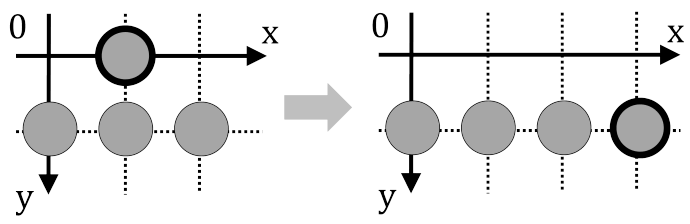
Figure D.1. Source pattern and a move
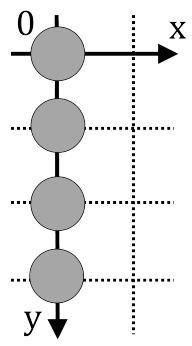
Figure D.2. Target Pattern
입력
The input consists of a single test case of the following format.
The first line consists of two integers and , both between and , inclusive. is the height and is the width of the source pattern description. The next lines each consisting of characters describe the source pattern. The character being ‘o’ means that a coin is placed at , while ‘x’ means no coin is there.
The following lines with integers and , and characters describe the target pattern in the same way.
출력
If the answer is to move the coin at to , print and in this order separated by a space character in the first line, and print and in this order separated by a space character in the second line.
It is ensured there is at least one move that satisfies the requirement. When multiple solutions exist, print any one of them.
Note that and always hold but and/or can be out of these ranges.