Cross-Polygon Road
Time limit1sMemory limit128 MB
Given a convex polygon with a cycle road, choose one chord to add so that the resulting maximum shortest-path distance between any two vertices is minimized.
- Level
Hard8 of 10
- Topics
- Shortest path, Geometry, Brute force
- Solved
- No attempts yet
Problem
There are N cities in a convex polygon-shaped land. Each city is located at one vertex of the polygon, and the polygon edges form a circular road connecting adjacent cities. To travel between cities, only this circular road can be used.
You will build exactly one additional straight road connecting two cities. After this road is built, consider the shortest path distance for every pair of cities. The goal is to make the largest of those shortest path distances as small as possible.
For instance, suppose the five cities and the circular road are arranged as in the figure below. The shortest path from city A to city C, A↔B↔C, has length √5 + √37, and it is the longest shortest path.
Connecting B and E, C and E, or B and D with the additional road does not reduce that longest shortest path.
If A and C are connected, then the shortest path from B to D, B↔A↔E↔D, has length √5 + √8 + √10 and becomes the longest one.
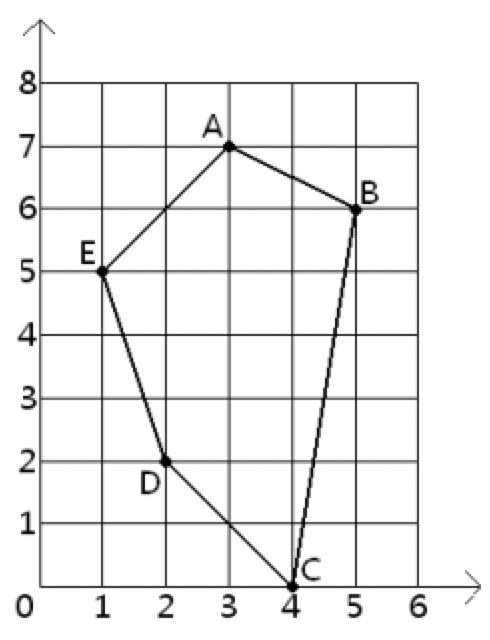
If A and D are connected instead, then the shortest path from A to C, A↔D↔C, has length √26 + √8 and becomes the longest one.
Because √26 + √8 < √5 + √8 + √10 < √5 + √37, connecting A and D is optimal in this case.
Given the positions of the N cities, determine which two cities should be connected by the additional road so that the maximum shortest path distance over all city pairs is minimized.
Input
The first line contains the number of cities N (4 ≤ N ≤ 300). The next N lines give the city coordinates in clockwise order. Each city is given as two integers X and Y, where 0 ≤ X, Y ≤ 200,000.
Output
Print four integers X1, Y1, X2, Y2 on one line, separated by spaces: the coordinates of two cities that should be connected by the additional road. If there is more than one valid answer, print any one of them.