XOR Shapes
Time limit1sMemory limit128 MB
Given up to 10 right isosceles triangles drawn with XOR-style color inversion, compute the total black area after all draws.
- Level
Medium6 of 10
- Topics
- Geometry, Bit manipulation, Brute force
- Solved
- No attempts yet
Problem
At first the entire sketchbook is white. On it you draw N right isosceles triangles one after another.
Each triangle has its bottom-left vertex at (X, Y) and both legs of length R. In other words, the region covered by a single triangle is the set of all points (x, y) satisfying x >= X, y >= Y, and x + y <= X + Y + R.
Every time a triangle is drawn, all colors inside it are inverted: white areas become black and black areas become white.
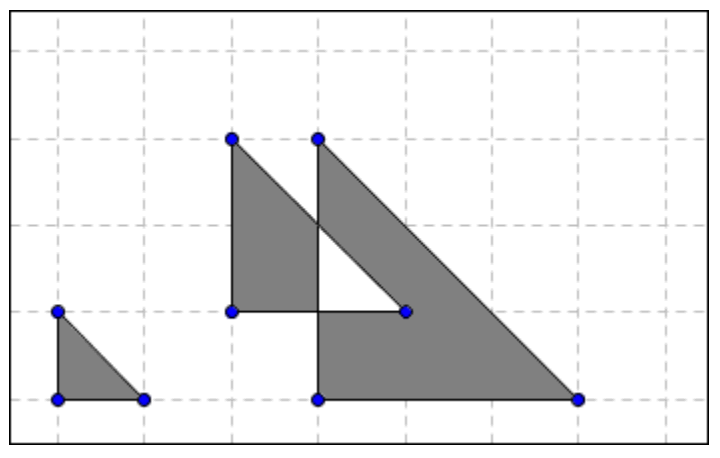
After drawing all N triangles, find the area of the region that remains black.
Input
The first line contains the number of triangles N (1 <= N <= 10).
Each of the next N lines contains the information of one triangle: X, Y, R (1 <= X, Y, R <= 10^6). (X, Y) is the bottom-left vertex of the triangle and R is the length of each leg.
Output
Print the area of the black region with one digit after the decimal point.