Kitchen Robot
Time limit3sMemory limit256 MB
Find the shortest robot route that starts at a given point, visits n bottles, and drops each bottle off at the nearest border point, requiring TSP-style optimization with precomputed border distances.
- Level
Medium7 of 10
- Topics
- Dynamic programming, Geometry, Math
- Solved
- No attempts yet
Problem
Robots are becoming more and more common: nowadays they are used not only in factories, but also at home. A group of programmers decided to build their own household robot. After their parties a lot of empty bottles are left on the table, so they programmed the robot to clear the empty bottles away.
The table is a rectangle with width w and length l. The robot starts at the point (xr, yr), and there are n bottles located at points (xi, yi) for i = 1, 2, ..., n. To collect a bottle, the robot must move to the point where the bottle lies, pick it up, and then carry it to some point on the border of the table to drop it. The robot can hold only one bottle at a time and, to keep the control program simple, it may release a bottle only on the border of the table.
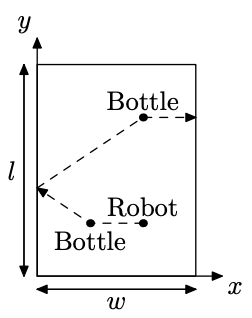
The robot and the bottles are treated as points (their sizes are negligible), so a robot that is carrying a bottle may pass through the point where another bottle lies.
One subroutine of the control program plans the route. Write a program that determines the minimum total length of the route the robot needs in order to collect all the bottles from the table.
Input
The first line contains two integers w and l — the width and the length of the table (2 ≤ w, l ≤ 1000).
The second line contains an integer n — the number of bottles (1 ≤ n ≤ 18).
Each of the next n lines contains two integers xi and yi — the coordinates of the i-th bottle (0 < xi < w, 0 < yi < l). No two bottles share the same point.
The last line contains two integers xr and yr — the coordinates of the robot's starting position (0 < xr < w, 0 < yr < l). The robot does not start at the same point as any bottle.
Output
Print a single line containing the minimum total length of the robot's route, rounded to exactly 6 digits after the decimal point (for example, using the %.6f format).