Confectionery
Time limit2sMemory limit64 MB
Simulate a leaking vertical tube with layered syrups, cracks, and a bottom hole, computing the exact rational volume of each syrup that ultimately reaches the mixer.
- Level
Hard8 of 10
- Topics
- Simulation, Math, Geometry
- Solved
- No attempts yet
Problem
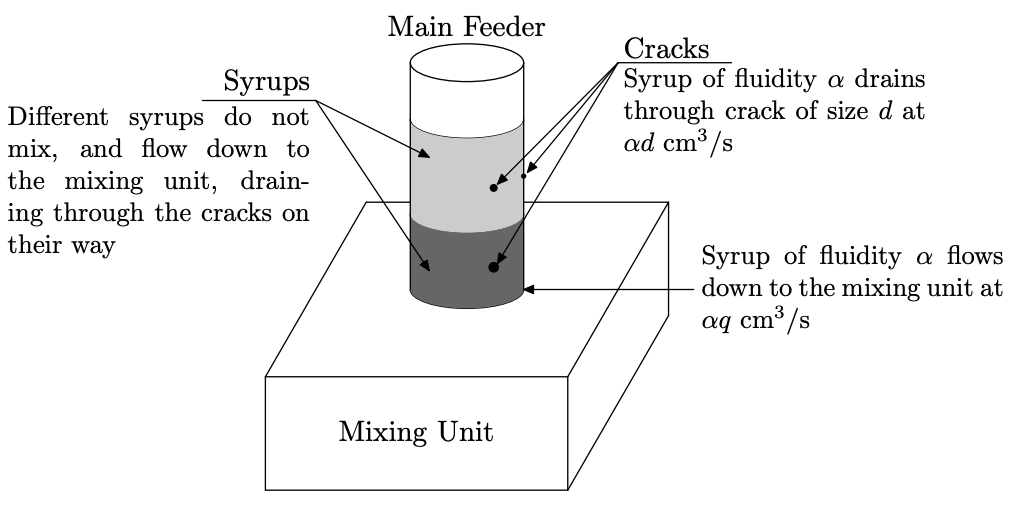
ACM Inc. manufactures the ACM-07, a household Automatic Confectionery Mixer. The weak point of the ACM-07 is its main feeder: a vertical plastic tube that holds syrup before it is injected into the mixing unit. Vibrations crack the feeder, so some syrup drains out through the cracks and never reaches the mixing unit.
One customer, Margaret, always cooks with the same formal recipe and the same ingredients. She pours n fruit syrups into the feeder one after another, numbered from 1 (poured first, so it rests at the bottom) up to n (poured last, so it rests at the top). The syrups have different densities and never mix. When every syrup is in place she opens the hole at the bottom and lets the liquid flow into the mixing unit.
The feeder is a vertical tube with constant cross-sectional area s (cm²), so a syrup of volume v occupies a column of height v / s. All heights are measured from the bottom of the feeder.
Each syrup has a fluidity α. Drainage is continuous and all flows happen at the same time:
- If the syrup currently sitting at a crack of size
dhas fluidityα, thenα · dcm³ of that syrup leaks out of the crack each second, and this syrup is lost. - If the syrup currently at the bottom of the feeder has fluidity
α, thenα · qcm³ of it flows through the bottom hole into the mixing unit each second, and this syrup is collected.
A crack leaks only while it is below the top surface of the remaining liquid; once the surface descends past a crack, that crack is above the liquid and stops leaking. Each crack is treated as a single point on the tube. Because the syrups never mix, the amount of each syrup that eventually reaches the mixing unit is well defined.
Given the syrups, the positions and sizes of the cracks, the size of the bottom hole, and the initial volume of each syrup, compute how much of each syrup eventually reaches the mixing unit.
Input
The first line contains three numbers: n — the number of syrups, m — the number of cracks, and s — the cross-sectional area of the feeder in cm² (1 ≤ n ≤ 10, 0 ≤ m ≤ 10, 1.0 ≤ s ≤ 100.0).
Each of the next n lines describes one syrup with two real numbers vᵢ and αᵢ — its initial volume in cm³ and its fluidity (1.0 ≤ vᵢ, αᵢ ≤ 100.0). The syrups are listed from the bottom of the feeder to the top, so the first of these lines is syrup 1 (the bottom syrup) and the last is syrup n (the top syrup).
Each of the next m lines describes one crack with two real numbers xᵢ and dᵢ — the height of the crack measured from the bottom of the feeder, and its size (1.0 ≤ xᵢ ≤ 1000.0, 0.1 ≤ dᵢ ≤ 10.0).
The last line contains one real number q — the size of the bottom hole (0.1 ≤ q ≤ 100.0).
Every input value is given as a terminating decimal.
Output
For each syrup, in the same order as the input (from the bottom syrup to the top syrup), print on its own line the exact total volume of that syrup that reaches the mixing unit.
Every input value is a terminating decimal and every drainage rate stays constant between the moments when a syrup boundary passes a crack or the bottom, so each answer is an exact rational number. Print each answer as a fraction reduced to lowest terms:
- write it as
p/q, whereq ≥ 1andgcd(|p|, q) = 1; - if the reduced denominator
qequals 1, print only the integerp(for example, print6, not6/1); - a syrup that reaches the mixing unit with nothing left is printed as
0.