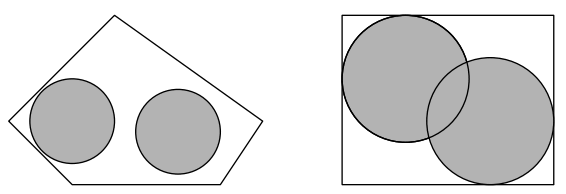
Feng shui is the ancient Chinese practice of arranging a space to bring it into harmony with its surroundings. George has recently taken an interest in it and wants to apply it to his home.
One principle says that a bare floor is bad for a living area, because spiritual energy drains away through it. So George bought two identical round carpets (feng shui says to avoid straight lines and sharp corners). His room is shaped like a convex polygon, so he cannot cover the whole floor, but he wants the two carpets to cover as much of it as possible.
Each carpet is a disk of radius $r$. A carpet must lie entirely inside the room and may not be cut or folded — not even along the room's border. The two carpets are allowed to overlap. Place them so that the total floor area they cover together (the area of the union of the two disks) is as large as possible, and report that maximum area.
The first line contains two integers $n$ and $r$: the number of corners of the room ($3 \le n \le 100$) and the radius of the carpets ($1 \le r \le 1000$; both carpets share this radius).
Each of the next $n$ lines contains two integers $x_i$ and $y_i$, the coordinates of the $i$-th corner ($-1000 \le x_i, y_i \le 1000$). All corners are distinct, no two adjacent walls are collinear, and the corners are given in clockwise order. The room is convex, and it is guaranteed that the two carpets can be placed inside it.
Print a single number: the maximum total area the two carpets can cover together (the area of the union of the two disks), rounded to exactly 4 digits after the decimal point.