Knockdown
Time limit1sMemory limit128 MB
Given up to 20 points on a unit sphere, compute the minimal covering radius such that balls of that geodesic radius centered at the points cover the whole sphere.
- Level
Hard8 of 10
- Topics
- Geometry, Binary search, Math
- Solved
- No attempts yet
Problem
An evil organization is planning to destroy the world in an operation they call “Knockdown”. The plan is to place several high-yield bombs at chosen locations around the world and detonate them simultaneously so that every place on the planet is destroyed. Each bomb has a destruction distance: the distance from the point of detonation to the places where everything is considered destroyed.
The locations for the bombs are already fixed. To minimize the production cost, all bombs are built to a single design with the same destruction distance. Your task is to find the smallest destruction distance for that design so that destruction of the whole world is guaranteed.
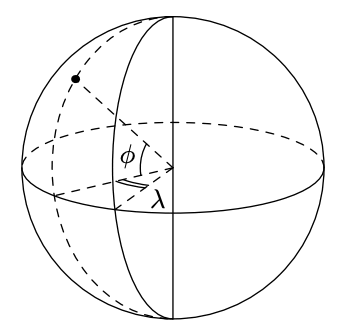
The world is modeled as a sphere of unit radius. Each bomb location is given in geographic coordinates: latitude () and longitude (), measured in degrees. Latitude is the angle between a point and the equator; longitude is the angle between a point and the prime meridian. No bomb is placed on a pole, so always.
All distances are measured along the surface of the sphere (great-circle distance). For example, the distance between the two poles is exactly . The world is considered destroyed when the distance from every point on the sphere to its nearest bomb is at most the destruction distance.
Input
The first line contains a single integer () — the number of bombs. Each of the next lines contains two integers and (, ) — the latitude and longitude of a bomb. No two bombs are located at the same place.
Output
Print a single number — the minimal destruction distance that guarantees the whole world is destroyed. Print the value rounded to exactly six digits after the decimal point.