Moonshine
Time limit1sMemory limit128 MB
Given the upright fill depth of a coaxial body-neck-shoulder can, find the whiskey depth when the can lies on its side.
- Level
Hard8 of 10
- Topics
- Geometry, Math, Binary search, Simulation
- Solved
- No attempts yet
Problem
Granny is preparing homemade moonshine whiskey for a large family reunion. Because the family is so big, she brews it in several batches and pours them all into one large metal cream can. After brewing — and sampling — a few batches, she stumbles and knocks the can onto its side. Fortunately the lid is sealed tight, so not a drop of whiskey is lost.
The can is a solid of revolution about a single central axis. It has a cylindrical body of height and diameter , and a cylindrical neck of height and diameter . The body and neck are coaxial and are joined by a tapered conic shoulder (a cone frustum), so that the can's total height is ; the shoulder's height is therefore . The bottom of the can (a disk of diameter ) closes the body, and the lid (a disk of diameter ) closes the neck.
With the can standing upright, the whiskey reached a depth of cm. After the can is laid on its side, what is the depth of the whiskey, measured from the lowest point of the can?
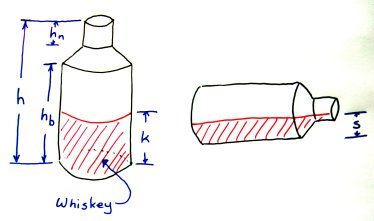
Input
The input consists of several test cases. Each test case is a line containing six real numbers , , , , , . You may assume that and that . A line containing 0 0 0 0 0 0 follows the last test case and must not be processed.
Output
For each test case, output a single line containing , the depth of the whiskey when the can is lying on its side, rounded to two decimal places.