Joining Points
Time limit1sMemory limit128 MB
Given two sets of colored points in general position inside a square, output a non-crossing spanning tree for each color separately.
- Level
Hard8 of 10
- Topics
- Geometry, Greedy, Sorting, Divide and conquer
- Solved
- No attempts yet
Problem
"Joining Points" is a single-player game. Choose two integers greater than 2 and call them and . Draw four points at the vertices of a square: the top two are green and the bottom two are red. Place more green and red points inside the square so that no three points, including the four corners, lie on one line. Stop when there are green points and red points in total.
After the board is ready, join points with line segments. You may connect two points when:
- the two points share the same color, and
- the segment between them does not cross any previously drawn segment except at endpoints.
Points and are in the same component when you can travel from to using segments already drawn.
You win by connecting all green points into one component with exactly green segments, and all red points into another component with exactly red segments. When the points are placed as described, a winning construction always exists.
You receive a square board of side length with green points and red points at integer coordinates . Green points are numbered 1 through : point 1 is at , point 2 at , and interior points are numbered 3 through . Red points are numbered 1 through : point 1 is at , point 2 at , and interior points are numbered 3 through .
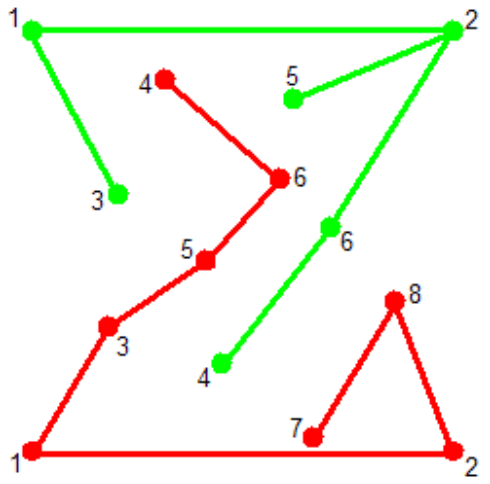
The figure shows one valid finish: all green points in one component and all red points in another. No three points are collinear, and segments meet only at endpoints.
Given the coordinates of all green and red points, output how to draw green segments and red segments that connect each color into a single component without crossing segments.
Input
- Line 1: integer .
- Next lines: two space-separated integers for green points 1 through .
- Line : integer .
- Next lines: two space-separated integers for red points 1 through .
Output
Print lines, one per drawn segment.
Each line contains two space-separated integers and one character. The integers are the numbers of the joined points; the character is g for green or r for red.
The order of lines and the order of endpoints within a line do not matter.
Constraints
- : number of green points.
- : number of red points.
- .