Mountains
Time limit3sMemory limit256 MB
Maintain a piecewise-constant sequence of elevation changes under range assignments, and after each update find the first prefix-sum position whose elevation exceeds a query height h.
- Level
Hard8 of 10
- Topics
- Segment tree, Binary search, Prefix sum, Array
- Solved
- No attempts yet
Problem
A new roller-coaster simulator has been installed at an amusement park. The simulated track is a sequence of rails joined end to end, with the start of the first rail fixed at elevation .
The simulator stores the track as a sequence of elevation changes . Here is the elevation change (in centimetres) over the -th rail: if a car is at elevation after traversing rails, then after traversing the -th rail it is at elevation . Thus the start is at elevation , and the elevation after rails is .
Initially every rail is horizontal; that is, for all .
Throughout the day two kinds of events are interleaved.
- Reconfiguration: given three integers , , and . For every rail with , the elevation change is set to . The elevation change over every other rail is unchanged. The start stays at elevation , and the rest of the track is shifted up or down as needed so that it remains connected.
- Ride: given one integer . A car is launched with just enough energy to reach height . The car keeps moving as long as the elevation of the track does not exceed and the end of the track has not been reached.
For each ride, determine the number of rails the car fully traverses before it stops.
Input
The first line contains the number of rails ().
The following lines contain reconfigurations and rides interleaved, followed by an end marker. Each line is one of:
- Reconfiguration: the letter
Iand three integers , , separated by single spaces (, ). It sets for every rail . - Ride: the letter
Qand an integer separated by a single space (). - A single letter
E: the end marker denoting the end of the input.
You may assume that at any moment the elevation of every point on the track lies in the interval centimetres. The input contains at most lines.
In of the test cases, satisfies and there are at most lines of input.
Output
For each ride, print on its own line a single integer — the number of rails the car traverses. The -th line corresponds to the -th ride.
Hint
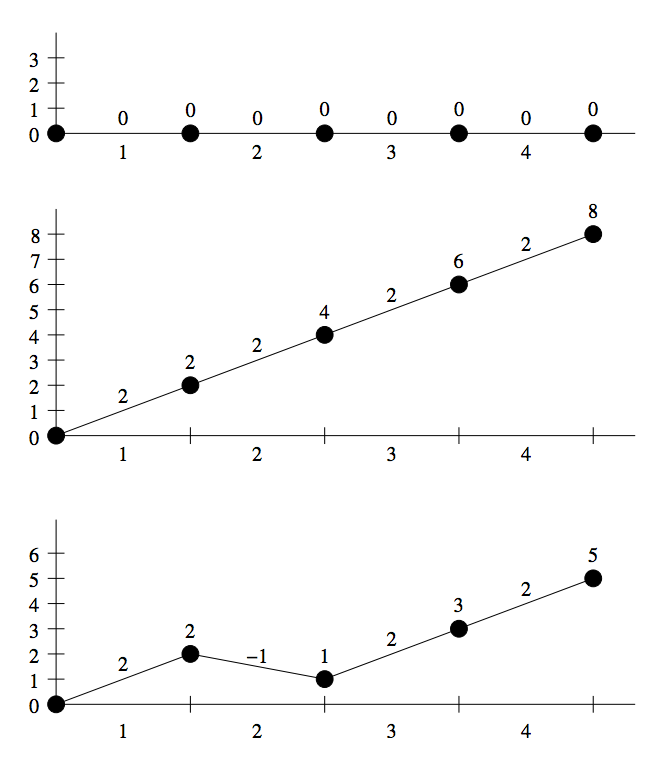
The track before and after each reconfiguration. The x axis denotes the rail number; the y axis and the numbers above points denote elevation; the numbers above segments denote elevation changes.