Starry Night
Time limit1sMemory limit128 MB
Find 8-connected star clusters in a grid and assign the same letter to clusters that match under rotation and reflection.
Task
High up in the night sky, the shining stars appear in clusters of various shapes. A cluster is a non-empty group of neighbouring stars that are adjacent horizontally, vertically, or diagonally. A cluster is maximal: it cannot be part of a larger cluster.
Clusters may be similar. Two clusters are similar if they have the same shape and the same number of stars, regardless of orientation. In general a cluster can appear in eight orientations (four rotations, each optionally mirrored), as illustrated below.
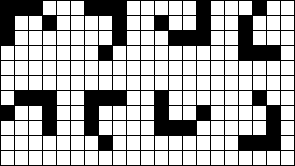
Eight similar clusters.
The night sky is represented by a sky map, a two-dimensional matrix of 0s and 1s. A cell holds 1 if it contains a star and 0 otherwise.
Mark every cluster with a lower-case letter by replacing each 1 of the cluster with that letter. Similar clusters must be marked with the same letter; clusters that are not similar must be marked with different letters.
Input
The first line contains the width of the sky map; the second line contains its height . The next lines contain the sky map, each with exactly characters (0 or 1).
- number of clusters
- number of non-similar clusters (letters
a..z) - number of stars per cluster
Output
Print the sky map with every cluster marked. To make the answer unique, assign the letters as follows.
Scan the map in row-major order (top to bottom, and within each row from left to right). The first time you reach a star that does not yet belong to a marked cluster, that star begins a new cluster; determine the cluster's shape. Keep a mapping from shapes to letters built in order of first appearance: the first distinct shape encountered is marked a, the next new distinct shape b, then c, and so on. Whenever a cluster's shape has already appeared (it is similar to an earlier cluster), reuse that shape's letter.
Replace every 1 of each cluster with its assigned letter and print the resulting lines.
Hint
The example below has a sky map of width 23 and height 15. This map corresponds to the following picture of the sky.
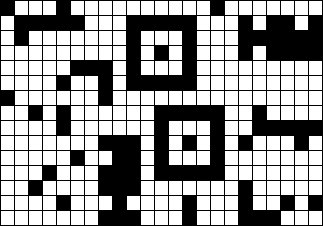
Picture of the sky.
After all clusters are marked, the picture becomes:
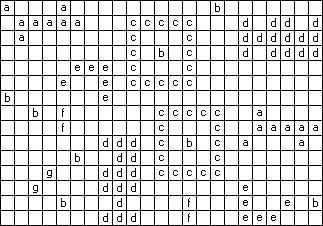
Picture with the clusters marked.