Senbei
InterviewTime limit1sMemory limit128 MB
Given a binary R x C grid with R at most 10, choose one subset of rows and one subset of columns to flip so the number of 1s is maximized.
- Level
Medium6 of 10
- Topics
- Brute force, Greedy, Bit manipulation, Matrix
- Solved
- No attempts yet
Problem
IOI Confectionery bakes senbei (rice crackers) using a traditional method handed down since its founding. In this method, the front side is grilled over charcoal for a fixed time; once the front is done, the cracker is flipped and the back side is grilled over charcoal for a fixed time. Keeping this tradition, the crackers are baked by a machine. The machine arranges the crackers in a rectangle of () rows and () columns and bakes them. Normally it runs automatically: once the fronts are done, all crackers are flipped at once and the backs are baked.
One day, while baking, an earthquake struck just before the flip, and several crackers were flipped over. Fortunately the charcoal stayed in good condition, but grilling the front side any further would exceed the traditional baking time, over-baking the front so the cracker can no longer be shipped. So the operator quickly switched the machine to manual to flip only the crackers that had not yet been flipped. The machine can flip several rows at once or several columns at once, but unfortunately it cannot flip a single cracker on its own.
Because taking too long to flip would over-bake the fronts of the crackers that the earthquake did not flip, the operator decided to flip some rows all at once one time, then flip some columns all at once one time, so as to maximize the number of crackers that can be baked on both sides without over-baking the front — that is, the number of 'shippable crackers'. Flipping no rows at all, or no columns at all, is also allowed. Write a program that outputs the maximum number of shippable crackers.
Suppose that right after the earthquake the crackers are in the state shown below. A black circle means the front side will be baked; a white circle means the back side will be baked.
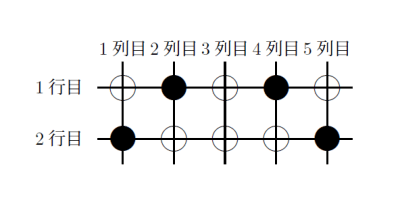
Flipping row 1 gives the following state.
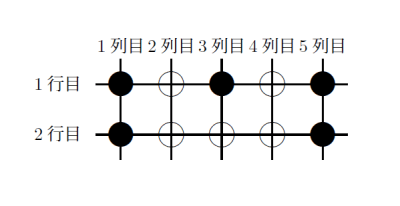
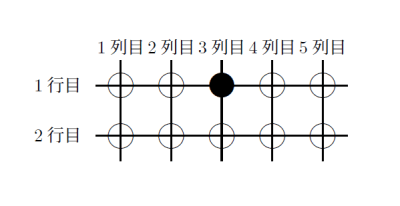
Then flipping columns 1 and 5 gives the following state. In this state, 9 crackers are shippable.
Input
The first line of input contains two integers , (, ) separated by a space. The next lines describe the state of the crackers right after the earthquake. Line () contains integers separated by spaces, where is the state of the cracker in row , column . If is 1, the front side will be baked; if 0, the back side will be baked.
Output
Output a single line containing only the maximum number of shippable crackers.
Hint
Note that the upper bound of , 10, is small compared with the upper bound of , 10000.