Gridland
Time limit1sMemory limit128 MB
For a rectangular grid of towns with eight-direction roads, compute the length of the shortest tour that visits every town once and returns to the start.
- Level
Medium5 of 10
- Topics
- Math, Greedy, Geometry, Implementation
- Solved
- No attempts yet
Problem
For years, computer scientists have tried to find efficient solutions to different computing problems. For some of them efficient algorithms are already known — these are the "easy" problems such as sorting, evaluating a polynomial, or finding the shortest path in a graph. For the "hard" ones only exponential-time algorithms are known. The Traveling Salesman Problem belongs to this latter group. Given a set of towns and the roads between them, the task is to compute the length of the shortest route that lets a salesman visit each town exactly once and return to the starting point.
The president of Gridland has hired you to write a program that computes the length of the shortest traveling-salesman tour of the towns in the country. In Gridland there is one town at each point of a rectangular grid. From every town, roads run in the eight directions North, Northwest, West, Southwest, South, Southeast, East, and Northeast, provided a neighbouring town exists in that direction. The distance between towns that are neighbours in the North–South or East–West direction is unit. Road lengths are measured by Euclidean distance. For example, the figure below shows Gridland, i.e. a rectangular grid of size ; there the shortest tour has length .
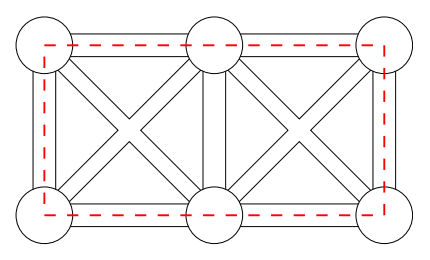
Figure: A traveling-salesman tour in Gridland.
Input
The first line contains the number of scenarios.
For each scenario, a single line contains the grid dimensions and as two integers separated by a single space, satisfying and .
Output
For each scenario, print Scenario #i: on the first line, where i is the scenario number starting at . On the second line, print the length of the shortest traveling-salesman tour rounded to two decimal places. Separate the outputs of consecutive scenarios with a single blank line.