Border
Time limit1sMemory limit128 MB
Given a counter-clockwise closed grid path, mark every square that lies outside the region and shares an edge with the path, then print the 32 by 32 bitmap.
- Level
Medium4 of 10
- Topics
- Simulation, Implementation, Geometry, Array
- Solved
- No attempts yet
Problem
Write a program that draws a border around a closed path on a bitmap, as shown in the figure below.
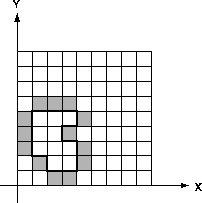
The path is closed and runs along the grid lines, that is, between the squares of the grid. The path runs counter-clockwise, so if you think of following the path as moving "forward", the border pixels are always to the "right" of the path. The bitmap always covers a 32 by 32 area of squares and has its lower-left corner at (0, 0). You may assume that the path never touches the bounding rectangle of the bitmap and never touches or crosses itself.
A square (bit) is set when it lies outside the region enclosed by the path and at least one of its edges lies on the path. A square is not set if only one of its corners touches the path. Looking at the convex corners in the figure should make this clear.
Input
The first line of the input contains the number of test cases.
Each test case consists of two lines:
- The first line contains two integers
xandy, the starting point of the path. - The second line contains a string of variable length describing the path. Each letter is one unit move along the grid:
W(west),E(east),N(north), andS(south). The character.marks the end of the path (no move) and appears immediately at the end of the line.
Output
For each test case, first print a line Bitmap #k, where k is the case number (starting from 1).
Then print the bitmap one line per row, from top to bottom. In each row, print one character per column from left to right: an uppercase X for a set bit and a period . for an unset bit. The bitmap has 32 rows and 32 columns.
Print a blank line between two consecutive bitmaps.