Maternity
InterviewTime limit1sMemory limit128 MB
Given the two alleles each parent carries for five genes, decide for each baby whether its five visible traits could result from that pairing.
- Level
Easy3 of 10
- Topics
- Implementation, Combinatorics, Simulation, Brute force
- Solved
- No attempts yet
Problem
Alice and Bob are fruit flies. They are now the proud parents of a new baby girl fly. Unfortunately, due to a slight mix-up, the nurses in the maternity ward at the hospital aren't sure which baby fly is their daughter. Luckily they've hired you to help them out. Using the full genetic profiles of the parents, can you figure out which baby fly is theirs?
Recall from biology that attributes (like eye colour, hair colour, etc.) are inherited, or passed, from generation to generation. A single gene controls each such attribute. Alternative versions of each gene, called alleles, account for the variation in the attributes. For example, the gene for eye colour exists in two versions, one for brown eyes and one for blue eyes. For each attribute, a fruit fly has two alleles, one inherited from each parent.
If two alleles differ, then one, the dominant allele, will appear in the fruit fly's appearance. The other, the recessive allele, does not affect the fruit fly's appearance. Conventionally, the dominant allele is represented by an uppercase letter, and the recessive allele by a lowercase letter. For example, consider the gene for eye colour, B. Each fruit fly has two alleles, each of which is either brown eyes (B, dominant) or blue eyes (b, recessive). If the fruit fly has BB or Bb, she will have brown eyes; if the fruit fly has bb, she will have blue eyes.
When reproducing, each parent fruit fly passes exactly one allele for each gene to its child. We can draw a Punnett square to see all possible allele combinations for the child. For example, here is the Punnett square for the possible offspring of Alice (Bb) and Bob (Bb).
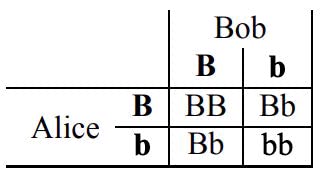
Unfortunately, the full genetic profiles of the babies were not available (as they take weeks to process). All we have are the attributes of each baby: whether or not it has brown eyes, its hair colour, and so on. Can you use this information, together with the full genetic profiles of the parents, to determine which babies could not possibly be theirs?
Input
Luckily for you, our fruit flies are simple and have exactly five genes, labelled A through E. The input begins with two lines, describing the mother and the father, respectively. Each line consists of five pairs of letters, one pair for each gene. Each pair describes the two alleles the parent has for a particular gene. The pairs are listed in order, from gene A through gene E.
Next is a line with the number (), the number of babies to check. The following lines describe the attributes of the babies. Each line consists of five letters, in order from gene A through gene E. An uppercase letter denotes that the baby shows the attribute of the dominant allele, and a lowercase letter denotes that the baby shows the attribute of the recessive allele. For example, if the baby has brown eyes the letter B is written; if the baby has blue eyes the letter b is written.
Output
For each baby, output on its own line "Possible baby." if the baby could be their offspring, or "Not their baby!" if it is impossible.