Checker's Check
Time limit1sMemory limit128 MB
Given a checkers position and a list of moves, report the first move that breaks the movement, capture, or promotion rules.
- Level
Medium6 of 10
- Topics
- Simulation, Implementation, Graph
- Solved
- No attempts yet
Problem
Checkers is played on an 8x8 board using only the 32 dark squares. Two players, Red and White, each control up to 12 pieces. The dark squares are numbered 1-32, row by row from the top of the board to the bottom, and left to right within each row:
   1   2   3   4
 5   6   7   8
   9  10  11  12
13  14  15  16
  17  18  19  20
21  22  23  24
  25  26  27  28
29  30  31  32
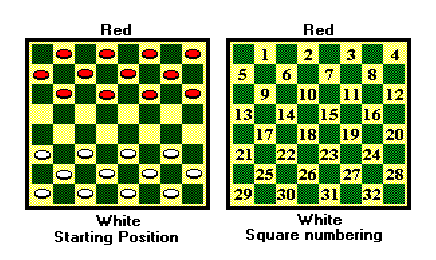
A forward move advances a piece toward the opponent's side. White pieces move forward toward lower-numbered squares (upward); Red pieces move forward toward higher-numbered squares (downward). The rules of movement and capture are:
- Players alternate moves.
- A piece may move one square diagonally forward to an empty square.
- A piece may jump forward over an adjacent opposing piece when the square immediately beyond it is empty; the jumped piece is captured (removed). If, after a jump, the jumping piece can jump again, it must continue - this is a multiple jump.
- If any jump is available, the player must make a jump. When several jumps are possible the player may choose any of them - even a single jump instead of a longer multiple jump - but once a multiple jump is begun it must be carried on until no further jump is possible.
- The far row on the opponent's side (squares 29-32 for Red, squares 1-4 for White) is the promotion row. A piece reaching it becomes a king and may thereafter move and capture both forward and backward. Promotion ends the move immediately: a piece cannot begin or continue a jump after being crowned until its next turn.
- During one move a piece may be jumped at most once (this matters only for a king making a multiple jump).
A move is written as the list of squares the moving piece visits, joined by hyphens. For example, 22-18 is a simple White move; 14-23 is a Red jump that captures the White piece on square 18; and 22-31-24-15 is a multiple jump by a White king capturing the Red pieces on 26, 27 and 19.
You are given a position from a game in progress and a sequence of moves to apply from that position. Determine whether every move is legal.
Input
The input contains several game instances. Each instance begins with two integers and - the number of Red and White pieces on the board (). A line with marks the end of the input.
The next line lists the squares holding Red pieces, and the following line lists the squares holding White pieces. A positive value means a normal piece stands on square ; a negative value means a king stands on square .
The next line contains an integer followed by a single character (R or W) giving the number of moves and which side moves first. Each of the following lines contains one move in the hyphen-separated notation above (at most 13 squares per move).
Every listed position is legal (no two pieces share a square), and any piece already on its promotion row is a king.
Output
For each instance, print All moves valid if every move is legal. Otherwise print Move n is invalid, where move 1 is the first move of the instance; if several moves are illegal, report only the first one.