Fuel
Time limit1sMemory limit128 MB
Find the maximum number of distinct vertices of a tree that can be visited by a walk of length at most m edges.
Problem
In the good old days, all towns of Byteland were joined by a dense network of two-way roads. The king of Byteland decided to cut down the number of roads, and as a result Byteland now has only two-way roads joining pairs of towns, arranged so that there is exactly one route between any two towns. In other words, the road network forms a tree. All roads have the same length.
Byteasar drives a car whose tank holds exactly enough fuel to travel across roads. He wants to plan a trip that visits as many distinct towns as possible. He may start in any town, and his trip may end in any town, not necessarily the one he started from. While maximizing the number of visited towns he may drive along the same road several times, in either direction. Find the maximum number of distinct towns that can be visited on one full tank of fuel.
Input
The first line contains two integers and (, ), where is the number of towns in Byteland (each town has a unique number from to ) and is the number of roads that can be traveled on one tank of fuel.
Each of the next lines describes one road with two integers and (), meaning towns and are connected by a two-way road.
Output
Print a single integer: the maximum number of distinct towns that can be visited on one full tank of fuel.
Hint
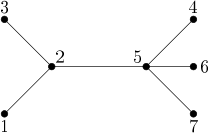
In the example above, Byteasar can visit at most five distinct towns. Several routes visit five towns for this input, for example or .