Folding the Map
Time limit1sMemory limit128 MB
Decide whether an n by m map with convex or concave creases folds to one square.
- Level
Hard8 of 10
- Topics
- Simulation, Divide and conquer, String matching
- Solved
- No attempts yet
Problem
On a hiking trail you meet a badly rattled tourist. Her husband gave her a brand new map, and once she opened it she could not fold it back up. You decide to help her.
The map is made of unit squares. A unit square is the smallest piece, and it cannot be folded any further.
Between every two neighbouring unit squares there is one crease, and each crease is either convex or concave. The map can be folded along the vertical and horizontal lines that run between unit squares, provided that two conditions hold.
First, all creases lying on that line must be of the same kind. Second, creases that come into contact after the fold have to match each other, that is, they have to be of opposite kinds before the fold is made.
Decide whether the map can be folded down to the size of one unit square.
Input
The first line contains the height and the width of the map (). A unit square measures .
The next lines describe the creases between horizontally neighbouring unit squares. The -th of them contains characters ^ (a convex crease) or v (a concave crease) with no spaces, listing the creases in the -th row of unit squares from left to right.
The next lines describe the creases between vertically neighbouring unit squares. The -th of them contains characters ^ or v, listing the creases between the -th and the -st row of unit squares from left to right.
Output
Print TAK on the first line if the map can be folded down to one unit square, and NIE if it cannot.
Hint
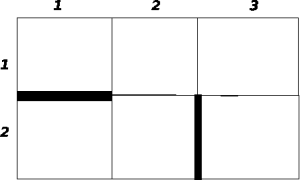
Bold edges are concave creases and thin edges are convex ones. The picture shows the map from the sample input.