This page is still under construction.

Parts of this page are still being built. What you see may change.

Salesmen

Interview

Time limit1sMemory limit128 MB

Summary
Given a graph and a reported vertex sequence, find the fewest entries to change so consecutive vertices stay put or follow an edge.
Level

Medium5 of 10

Topics
Dynamic programming, Graph
Solved
No attempts yet

Problem

Traveling salesmen of a company report their current location to the company on a regular basis. They must also report a new location whenever they move to a different place. The company records each salesman's working path on a map of his working area and uses that path to plan the salesman's next assignment.

The map of a salesman's working area is a connected, undirected graph. Vertices are the possible locations of the salesman and edges are the possible movements between locations. A salesman's working path is therefore a sequence of vertices in the graph.

Because a salesman reports his position regularly and may stay at one place for a very long time, the same vertex can appear several times in a row in a working path. A working path is called correct if, for every pair of consecutive vertices, the two vertices are either the same vertex or two adjacent vertices in the graph.

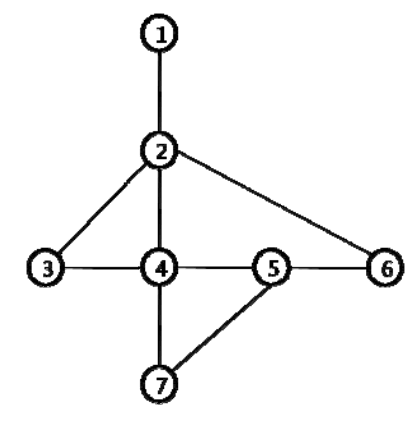
For example, on the graph below representing a salesman's working area,

Example working-area graph

the reported working path [1 2 2 6 5 5 5 7 4] is correct, but the reported working path [1 2 2 7 5 5 5 7 4] is not, because there is no edge between vertices 22 and 77. If we assume that the salesman reports his location every time he is required to (but possibly incorrectly), the intended correct path could be [1 2 2 4 5 5 5 7 4], [1 2 4 7 5 5 5 7 4], or [1 2 2 6 5 5 5 7 4].

The length of a working path is the number of vertices in it. For two paths A=a1a2…anA = a_1 a_2 \dots a_n and B=b1b2…bnB = b_1 b_2 \dots b_n of the same length nn, the distance between them is

dist⁡(A,B)=∑i=1nd(ai,bi)\operatorname{dist}(A, B) = \sum_{i=1}^{n} d(a_i, b_i)

where

d(a,b)={0(a=b)1(a≠b)d(a, b) = \begin{cases} 0 & (a = b) \\ 1 & (a \ne b) \end{cases}

Given the graph of a salesman's working area and a working path AA (which may not be a correct path), compute a correct working path BB of the same length that minimizes dist⁡(A,B)\operatorname{dist}(A, B), and report that minimum distance.

Input

The first line contains the number of test cases TT. Each test case has the following format.

The first line of a test case contains two integers n1n_1 and n2n_2 (3≤n1≤1003 \le n_1 \le 100, 2≤n2≤49502 \le n_2 \le 4950), where n1n_1 is the number of vertices of the graph and n2n_2 is the number of edges. The graph is connected. Vertices are numbered from 11 to n1n_1.

Each of the next n2n_2 lines contains two vertices describing one edge of the graph.

The last line of the test case describes a working path. The first integer nn (2≤n≤2002 \le n \le 200) is the length of the path, followed by nn integers giving the sequence of vertices along the path.

Output

For each test case, print a single line containing the minimum distance from the given path to a correct path of the same length.

Examples1

  1. Example 1

    Input
    2
    7 9
    1 2
    2 3
    2 4
    2 6
    3 4
    4 5
    5 6
    7 4
    7 5
    9 1 2 2 7 5 5 5 7 4
    7 9
    1 2
    2 3
    2 4
    2 6
    3 4
    4 5
    5 6
    7 4
    7 5
    9 1 2 2 6 5 5 5 7 4
    
    Expected output
    1
    0