Signals
Time limit1sMemory limit128 MB
Compare the signal sets generated by two series-parallel circuit expressions and print whether they are equal, nested, disjoint or overlapping.
- Level
Medium6 of 10
- Topics
- String matching, Recursion, Brute force
- Solved
- No attempts yet
Problem
Consider DC (direct current) circuits. Each DC circuit produces a set of output signals. A circuit is made of devices wired together in parallel or in series, and it never contains a feedback loop. Every device emits one specific signal, and the set of output signals of a circuit is fixed by which devices it contains and how they are connected.
For example, take two circuits C1 and C2:
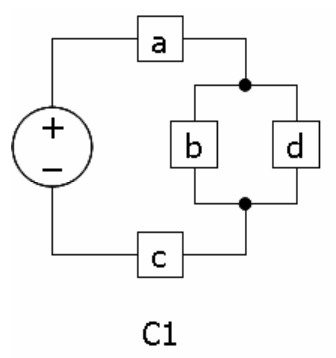
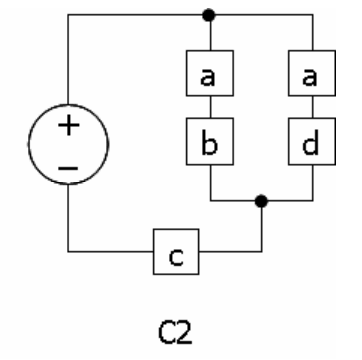
C1 can generate the two signals abc and adc. For a circuit C, its output OUT(C) is the set of every signal it can generate, so OUT(C1) = {abc, adc}. Here OUT(C2) is also {abc, adc}, therefore OUT(C1) = OUT(C2).
There is a special device called the pass device, written 1, that emits no signal at all (it contributes the empty signal). Parallel and serial connections of sub-circuits may be nested and combined freely. For example, take C3 and C4:
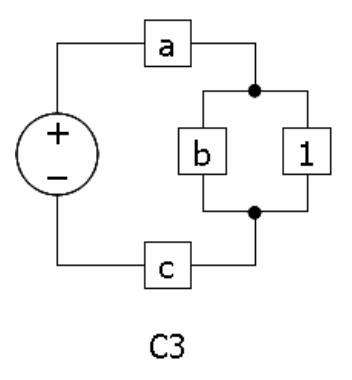
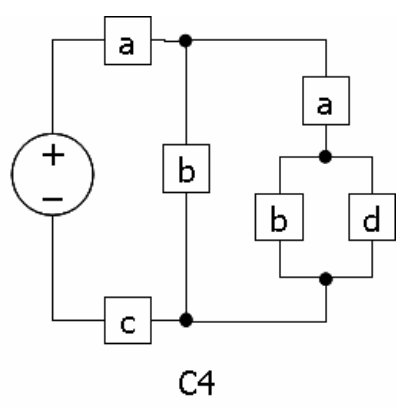
Then OUT(C3) = {abc, ac} and OUT(C4) = {abc, aabc, aadc}.
A circuit is written as a string:
- A normal device is written as the lowercase letter that names its signal.
- The pass device is written as
1. - The parallel connection of two circuits C and D is written
C|D. - The serial connection of C and D (C followed by D) is written by placing them next to each other:
CD. - Parentheses may be used wherever needed to make the connection topology clear. No spaces are allowed inside a circuit description.
The strings that denote the circuits above are:
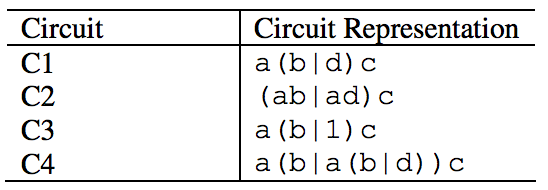
A sub-circuit may carry redundant parentheses. For instance, C1 may be written (a((b)|((d)))c) instead of a(b|d)c; both denote the same circuit.
Given two circuits C and D, print a single character that describes how their outputs are related, using this table:
Assume that every circuit generates at least one signal; that is, no circuit has the empty output set {}. Nested pass-only circuits such as 1 or (1|1) are still allowed, because their output is the set containing just the empty signal, which is different from the empty set.
Input
The first line contains the number of test cases T (T < 30). Each of the next T lines contains one test case: two circuit descriptions separated by one or more spaces. Each circuit description is shorter than 50 characters.
Output
For each test case, print on its own line the single character (=, <, >, 0, or 1) that describes the relation between the two circuits C and D, in the order they were given. The number of output lines equals the number of test cases.