In a hunting ground there are N animals, each living at a particular spot. A hunter may only shoot from M firing positions that all lie on one straight line. Treat that line as the x-axis, so each firing position is given by an x-coordinate x1,x2,…,xM. Each animal lives at a spot written with an x- and a y-coordinate: (a1,b1),(a2,b2),…,(aN,bN). Every coordinate value describing an animal's position is a positive integer.
If the hunter's gun has range L, then from a single firing position the hunter can catch any animal whose distance is at most L. Here the distance between a firing position xi and an animal at (aj,bj) is defined as ∣xi−aj∣+bj.
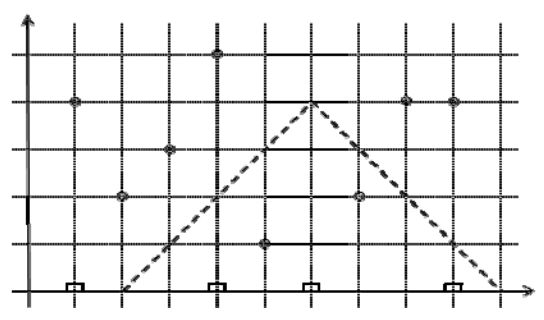
For example, consider the hunting ground drawn below. (Firing positions are small squares and animal positions are small circles.) If the range L is 4, the dashed region is the area that can be hunted from the third firing position counted from the left.

Given the firing positions and the animal positions, write a program that prints how many animals can be caught.
The first line contains the number of firing positions M (1≤M≤100,000), the number of animals N (1≤N≤100,000), and the range L (1≤L≤1,000,000,000), separated by spaces.
The second line contains the M x-coordinates of the firing positions, given as positive integers separated by spaces.
Each of the next N lines contains one animal's position as its x-coordinate followed by its y-coordinate, given as positive integers separated by spaces.
No two firing positions coincide, and no two animals share the same position. Every coordinate value is a positive integer not greater than 1,000,000,000.
Print, on a single line, the number of animals that can be caught, as a non-negative integer.