PCB

No attempts yetTime limit1sMemory limit128 MB

Problem

A printed circuit board (PCB for short) electrically connects electronic components through conductive pathways (wires) etched from a thin copper layer laminated onto a non-conductive substrate. PCBs are everywhere inside a personal computer: the mainboard, the graphics card, the RAM modules, and more. For many reasons a PCB should wire its components together as compactly and efficiently as possible, so deciding how to route each component is a central issue in PCB design.

A company that manufactures PCBs to order was asked to design a PCB (model code iCPC-2012) for a next generation smart device. According to its specification the board holds NN components C1,,CNC_1, \dots, C_N plus two special components called clocks. A clock can periodically send signals to at most KK components connected to it (that is, one clock serves at most KK components), where KN/2K \ge N/2. Because every component must stay synchronized while operating, each component CiC_i has to be connected to exactly one of the two clocks. The two clocks are assumed to be perfectly synchronized with each other.

The shape of the board and the positions of the NN components are already fixed, but where to place the two clocks is not. To keep the components synchronized, we want to minimize the length of the longest pathway from a component to its clock. Write a program that computes this minimum possible length of the longest pathway when the two clocks are placed optimally.

iCPC-2012 has the following properties.

  1. Every pathway between a component and a clock consists only of horizontal or vertical segments.
  2. Every pathway runs underneath the components, so you may design each one freely and as short as possible without worrying about crossings.
  3. The position pi=(xi,yi)p_i = (x_i, y_i) of each component CiC_i is given as a pair of even integers.
  4. Each clock may be placed at any position (x,y)(x, y) with 106x,y106-10^6 \le x, y \le 10^6, and may even sit at the same position as some component CiC_i.

By properties (1) and (2), the length of the pathway from CiC_i to its clock depends only on the two positions, not on how they are connected. In other words, that length equals the sum of the horizontal and vertical distances between the two positions (the Manhattan distance).

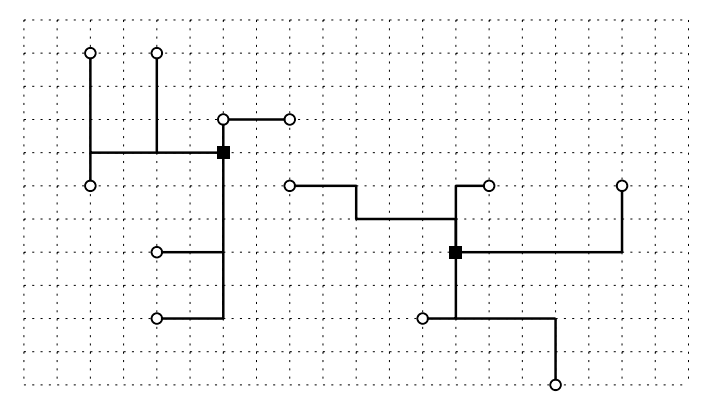
The figure above shows an example with N=12N = 12 and K=7K = 7. The positions pip_i of the 12 components are drawn as small circles, and one optimal placement of the two clocks is marked with black squares. The pathways satisfy (1) and (2), and the longest pathway has length 77, which is the correct answer. Note that this optimal placement of the clocks is not unique.

Input

Input is given on standard input. It consists of TT test cases. The first line contains the number of test cases TT. The test cases follow in order. The first line of each test case contains two integers NN and KK (2N100,0002 \le N \le 100{,}000, N/2K100,000N/2 \le K \le 100{,}000). Each of the next NN lines contains two even integers xix_i and yiy_i, the position pi=(xi,yi)p_i = (x_i, y_i) of component CiC_i, each between 1,000,000-1{,}000{,}000 and 1,000,0001{,}000{,}000 inclusive. The two integers on a line are separated by a single space, and there is no blank line between two consecutive test cases.

Output

For each test case, print exactly one line on standard output. The line contains a single integer: the minimum possible length of the longest pathway, rounded to the nearest integer. For example, if the value you obtain is 5.525.52, print 66; if it is 5.495.49, print 55. (Because all coordinates are even, this minimum length is always an integer.)