Plot of Land
Time limit1sMemory limit128 MB
Given N bead positions, compute the area of the smallest axis-aligned rectangle that contains them all.
- Level
Easy1 of 10
- Topics
- Geometry, Implementation
- Solved
- No attempts yet
Problem
Mr. Lim lost a great deal in the Korean War of 1950. Until the war broke out he was a wealthy man who owned a wide plot of land in Chungcheong Province. When the fighting started he took only the deed to his land and whatever else was valuable and fled to Japan, and somewhere along the way he lost the deed. By the time the war ended his land had already become other people's fields, and without the deed his demand to have it back was no better than a tantrum.
Then Mr. Lim remembered an old habit of his. Whenever he had a quiet moment he would walk his own fields and bury a jade bead carved with his name deep in the ground. If a bead with his name on it turns up at some spot, that spot was once his land.
Mr. Lim filed a civil suit and convinced the judge that every spot where such a bead turns up was a point of his original land. The judge ruled as follows. "Ninety-nine percent of privately owned plots before the war were rectangles with sides parallel to the north-south and east-west directions. This court therefore recognizes as Mr. Lim's property the smallest rectangle with sides parallel to those directions that contains every spot where a jade bead carved with his name is found." The ruling costs Mr. Lim a lot of land, but he had no grounds to ask for more, so he accepted it.
Given the spots where the beads were found, write a program that computes the area of the land Mr. Lim receives. Bead positions are given as two-dimensional integer coordinates, and several beads may be found at the same position. The positive x direction is east and the positive y direction is north.
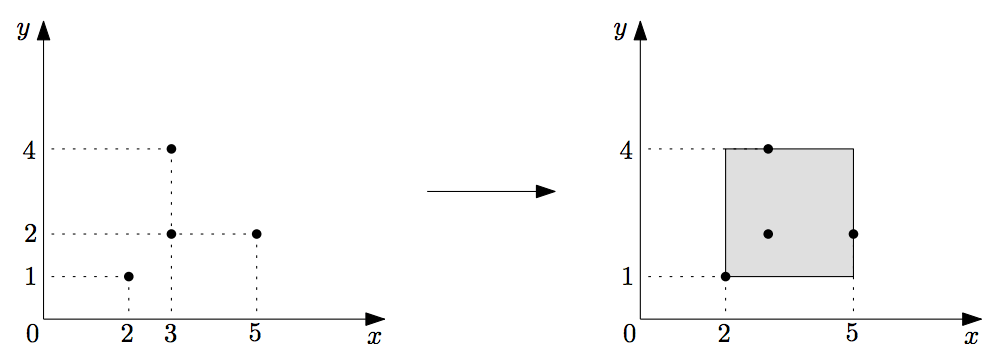
The figure above shows beads found at the four spots (2, 1), (3, 2), (5, 2), (3, 4). The land awarded to Mr. Lim is the rectangle with corners (2, 1), (5, 1), (5, 4), (2, 4), and its area is .
Input
The first line contains the number of points (). Each of the next lines contains the coordinates of one point as two integers. Every coordinate is an integer between and .
Output
Print on the first line the area of the smallest rectangle that contains all points.