Straightening a bent wire
Time limit1sMemory limit128 MB
Decide whether an axis-aligned wire can be straightened joint by joint from one end without ever touching itself during each unfolding.
- Level
Hard8 of 10
- Topics
- Geometry, Simulation
- Solved
- No attempts yet
Problem
Steel maker P ran into trouble. Something went wrong on the line, and a wire that used to be straight now has right-angle bends all over it. The wire has to be pulled straight again.
Only one joint of the wire can be opened at a time, and the wire must not collide with itself while a joint is opening. Contact at a single point already counts as a collision. Opening a joint means the two edges meeting at that joint end up on one straight line. The joints are opened starting from one end of the wire, following the order in which they are connected, and that starting end is given in the input.
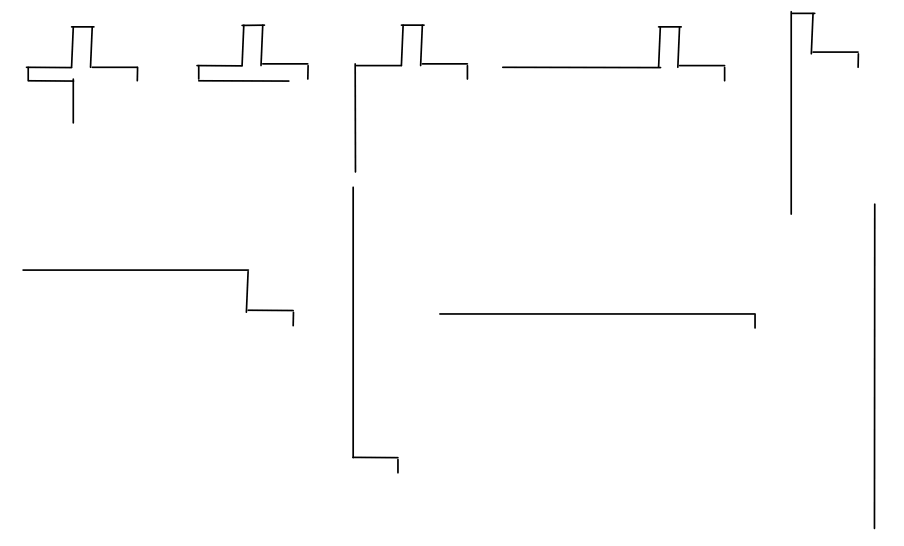
The figure below shows a wire lying in the plane, with its joints opened one after another from one end until the wire finally becomes a straight line.
Input
Input is read from standard input. The first line holds the number of test cases ().
The first line of each test case holds the number of joints of the wire, counting both endpoints. The next line holds the and coordinate of every joint in connected order starting from one end, separated by single spaces. Every coordinate is an integer with and . The whole wire is at most long, and there are at most joints. Every edge of the wire is parallel to a coordinate axis.
The joints are opened in the order the coordinates are given. Coordinates are no longer restricted once a joint has been opened. In the starting state, with nothing opened yet, the wire has no collision, and it has no joint that is bent by anything other than a right angle.
Output
Output is written to standard output. For each test case, print YES if opening the joints in the given coordinate order finally pulls the wire into a straight line, and NO otherwise, one answer per line.