Cube
Time limit2sMemory limit1024 MB
Decide whether six numbered cells in a 6 by 6 grid fold into a cube and report the face opposite face 1.
- Level
Medium6 of 10
- Topics
- Simulation, BFS, Matrix
- Solved
- No attempts yet
Problem
Six squares joined edge to edge in the right pattern can be folded into a cube. The six squares on the left below fold into a cube, and there face 1 is opposite face 4, face 2 is opposite face 6, and face 3 is opposite face 5. The six squares on the right do not fold into a cube, because faces 3 and 5 land on the same face.
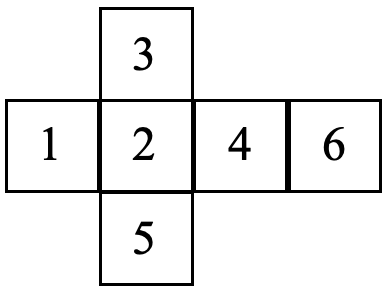 | 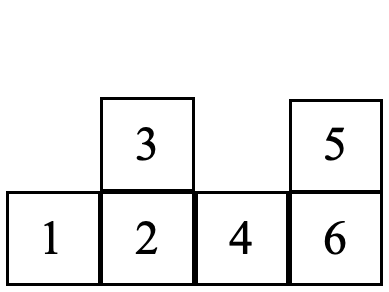 |
A 6 × 6 array holds the six squares. Only 6 of the 36 cells hold a square, and each of those cells contains the number of that square. Every other cell contains 0. One figure has many representations, because it can sit anywhere in the array and in any orientation. Rotating the whole array by 90 degrees turns one representation into another.
If the six squares are not joined edge to edge into a single piece, they cannot be folded into a cube.
Given one array, decide whether the squares fold into a cube, and if they do, find the face opposite face 1.
Input
The input has six lines, and each line has six integers. All but six of the integers are 0. The six non-zero integers are 1, 2, 3, 4, 5, 6.
Output
Print a single integer. Print 0 if the squares cannot be folded into a cube. Otherwise print the number of the face opposite face 1.