Asteroids
Time limit2sMemory limit256 MB
Find the positive time when two steadily moving convex polygons share their largest overlap area, or report the first touch or never.
Problem
The year is 2115. The asteroid communication relay network was built ten years ago by the Asteroid Communication Ministry. It runs well except for one problem: there are too many asteroids. The small ones interfere with the signals from the relay stations, and they endanger the maintenance craft that fly between the stations. Those small asteroids have to be destroyed. The Interplanetary Coalition to Prevent Catastrophes (ICPC) was put in charge of removing them and hired a team of hot-shot pilots for the job. Han Duo is the captain of that team. Armed with his missiles, Han flies through the asteroid belt and blows up every asteroid the ICPC calls a nuisance.
The ICPC budget is tight. The team has fewer missiles than it wants, so it cannot blow up every troublesome asteroid. The asteroids are small and the missiles are powerful, so two asteroids that sit near each other and line up properly can be taken out with a single missile.
Han's screen draws each asteroid as a non-rotating two-dimensional simple convex polygon that moves at a constant velocity. The best moment to hit two asteroids is when the area shared by the two polygons is at its maximum.
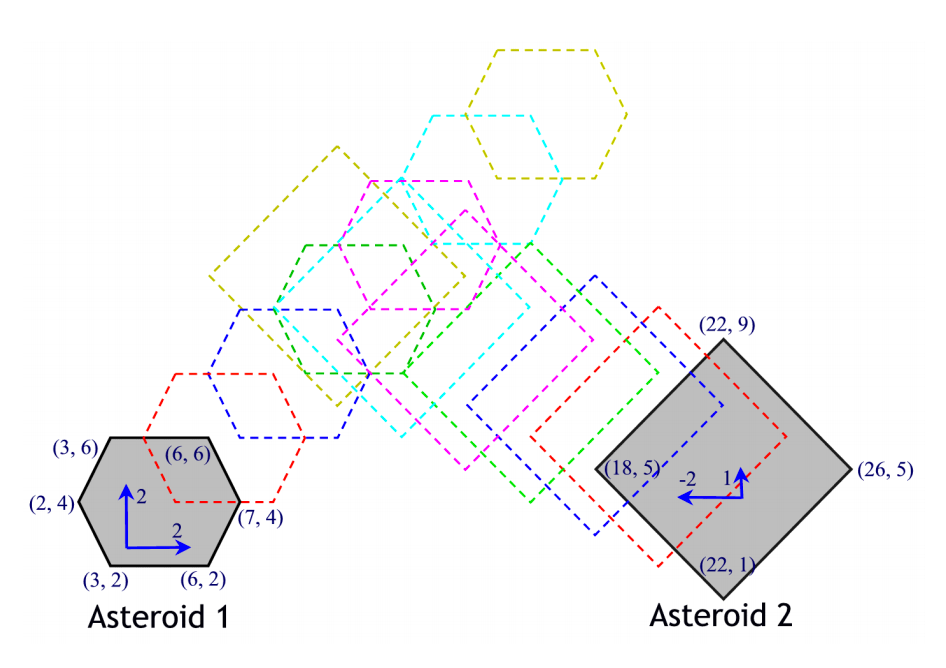
The picture matches the first example. It shows two asteroids and snapshots of their later positions at 1-second intervals. These two asteroids start touching after 3 seconds, and the largest overlap occurs between 4 and 5 seconds.
Han slept through most of his coding classes at the flight academy, so working out that moment is left to you.
Input
The input describes two asteroids. Each asteroid is given in the form
n x1 y1 x2 y2 ... xn yn vx vy
where () is the number of vertices, () are the coordinates of a vertex on Han's screen listed in clockwise order, and () are the velocity components in units per second. The coordinates give the position of the asteroid at time , and at that time the two polygons neither overlap nor touch. No side of an asteroid is longer than 500. Every number in the input is an integer.
Output
Consider positive times only.
Print the time in seconds at which the two polygons share the largest area, rounded to exactly three digits after the decimal point, for example 4.194. If more than one time reaches that largest area, print the earliest of them. If the two polygons never overlap but do touch, treat the contact as an intersection of area zero and print the earliest time at which they touch. If they never overlap and never touch, print never instead.