Cutting an L-shaped paper
Time limit2sMemory limit256 MB
The program cuts the given L-shaped sheet with guillotine cuts into integer-sided squares with the fewest pieces.
- Level
Medium7 of 10
- Topics
- Dynamic programming, Geometry, Recursion
- Solved
- No attempts yet
Problem
You have one sheet of paper shaped like the letter L, and every side of it has a positive integer length. You want to cut the sheet several times so that every piece is a square whose side length is a positive integer.
The cutting rules are these.
- A cut runs vertically or horizontally. Diagonal cuts are not allowed.
- The blade cannot change direction in the middle of a cut.
- The blade cannot stop in the middle of a cut. Once you start cutting a piece, you keep cutting until that piece separates into two pieces.
- Every side of every piece must have a positive integer length.
In the figure below, the left drawing is a given sheet and the right drawing is the result of cutting it into the smallest possible number of squares under these rules.
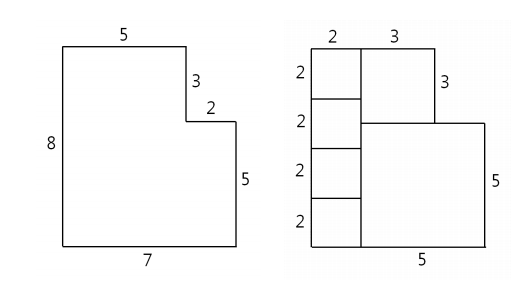
Write a program that cuts the given L-shaped sheet into squares under these rules with as few pieces as possible.
Input
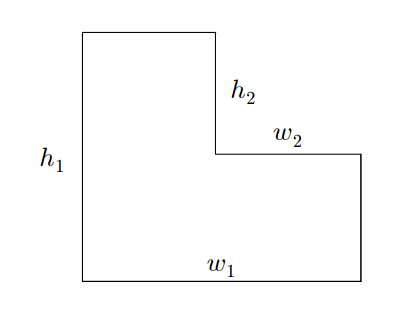
The first line contains four integers , , , , separated by spaces, that give the side lengths of the L-shaped sheet. (, , )
The sheet is what is left after a rectangle of height and width is removed from one corner of a rectangle of height and width . The figure below shows which side each integer refers to.
Output
Print, on one line, the minimum number of pieces produced by cutting the given L-shaped sheet under the rules.