Summer on the Beach
Time limit1sMemory limit256 MB
Compute the share of a body rectangle that falls outside the moving elliptical shadow of a circular parasol at some sun angle in the given interval.
Problem
One of the most common things to do on a beach is to lie on the sand and sunbathe. Long exposure to the sun causes painful burns, so people use sunscreen or lie under a parasol. Given the position of your body and of the parasol, compute what percentage of your body gets sunlight at some moment of your sunbath.
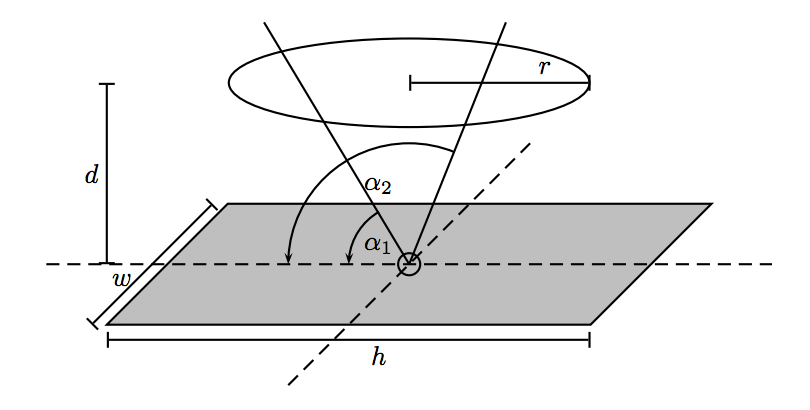
Your body is a rectangle of size centimeters. The beach is a two dimensional plane and the origin is the center of your body. The side of length runs from your feet to your head, along the direction the sun travels, and the side of length is perpendicular to it. The parasol is a circle of radius , held horizontally at height above your body, with its center directly over the origin.
The sunbath starts when the sun makes an angle of with the beach and ends when the angle is . The sun is a point infinitely far away, so its rays are parallel, and it travels in a straight line from your feet to your head. A point of your body gets sunlight if at some moment between and it lies outside the shadow of the parasol.
Input
The first line contains the number of data sets . Then data sets follow.
Each data set is a single line holding the real numbers , , , , , in this order. Here , and the angles are given in degrees with .
The figure below shows what these quantities mean. Notice that the sun travels from your feet to your head, not from your left arm to your right arm.
Output
For each data set, first print Data Set x: on a line of its own, where is the number of the data set counting from 1. On the next line print the percentage of your body that gets sunlight at some moment, rounded to two decimal places and followed by a percent sign.
Print one blank line after each data set.