Tomosynthesis
Time limit1sMemory limit256 MB
Given N disjoint disks, find the widest angle range over which their parallel projections stay pairwise disjoint.
Problem
Tomosynthesis is a medical imaging method that computes a 3D dataset from X-ray images taken in several directions within a limited range of angles. A wider range of angles usually gives a better reconstruction, but it is harder to acquire. Arvid is building a reconstruction algorithm for the 3D image, and so far it fails whenever structures overlap in any of the input images. The first sample he will reconstruct is a test object made of parallel cylinders of equal length and varying diameters, rotated around the axis of the cylinders.
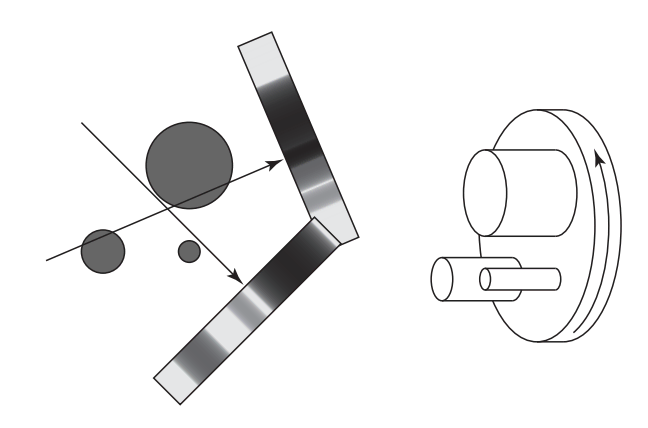
Figure D.1: On the left, a cross section of the test object from the first example input. The upper projection is not acceptable because the two larger cylinders overlap. In the lower projection no cylinders overlap, so this direction and a range of angles around it are fine. On the right, the same test object seen from the side.
Setting aside the fact that the algorithm will not work in practice, Arvid asks you for help. What is the largest range of angles in which the test object can be imaged without any cylinders overlapping in any of the images? An image is a plane projection of the structure perpendicular to the axes of the cylinders, and two cylinders overlap in an image when their projected intervals meet.
Input
The first line contains one integer , the number of cylinders that make up the test object (). Each of the next lines contains three real numbers , and : the x coordinate of the center of a cylinder, the y coordinate of that center, and the radius of that cylinder. The coordinates satisfy and the radius satisfies . No two cylinders touch or overlap.
Output
Print one line with the size in radians of the largest continuous range of projection directions over which no cylinders overlap. If no such direction exists, print 0. Print the value rounded to exactly nine digits after the decimal point, so an answer of 0 is printed as 0.000000000.