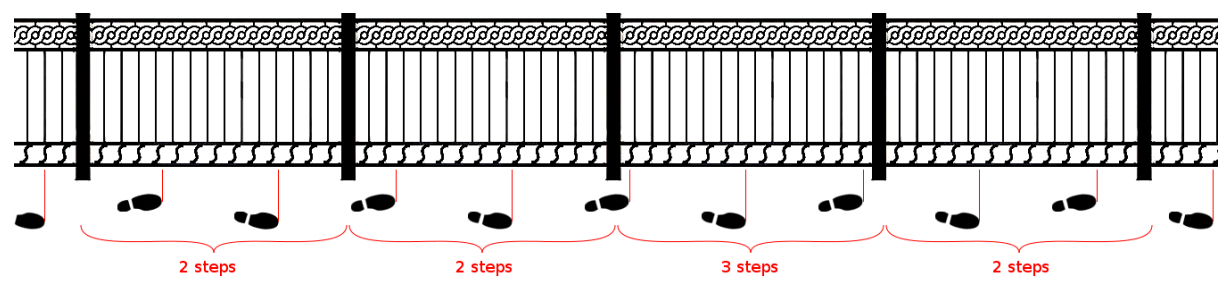
Old Count von Walken strolls along the fence of his backyard. The fence has poles driven into the ground at equal distances, and since the count has nothing better to do, he counts how many steps he takes between one pole and the next.
The distance between two consecutive poles is not an integer multiple of his step length: in some gaps he takes two steps, in others he takes three.

Figure: the situation in the second example
The count's steps are always 1 meter long, so he starts guessing what the distance between the poles might be. "It must be more than 2 meters, since I occasionally fit 3 steps between the poles, and it must be less than 3 meters, since I sometimes fit only 2."
The count walks along the fence in one direction with a fixed step length of 1 meter. There are N+1 poles, and the i-th step count ci is the number of times he puts a foot down between pole i and pole i+1.
Given the list of step counts and a distance D, decide whether the distance between two poles can be D meters. The poles have width 0, and every point where he puts a foot down must lie strictly between two poles, so he never lands exactly on a pole.
To avoid floating point trouble, the input is such that the answer stays the same even if any pole is moved by up to 10−7 meters.
The first line contains the real number D and the integer N. The second line contains the step counts c1,c2,…,cN separated by spaces.
It holds that 2≤ci≤3, 2≤D≤3, and 0≤N≤10000. If N is 0, the second line is empty.
Print possible if D meters can be the distance between the poles, and impossible otherwise.