Brocard Point of a Triangle
Time limit1sMemory limit256 MB
Given the vertices of a counter-clockwise triangle, compute the coordinates of its Brocard point rounded to five decimals.
Problem
The Brocard point of a triangle is the point inside the triangle with . See the figure below.
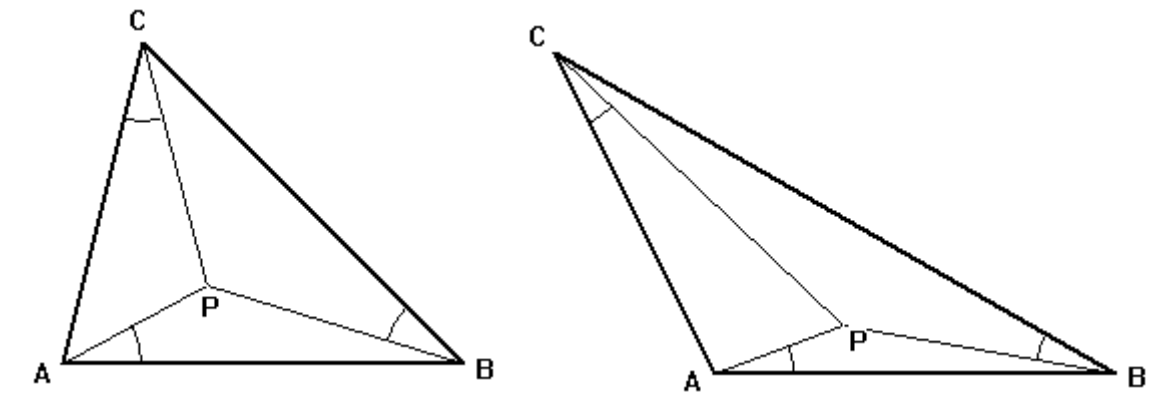
The size the three angles share is called the Brocard angle. The Brocard angle is at most , and that maximum occurs for an equilateral triangle. The Brocard point of an equilateral triangle is its centroid.
Given the coordinates of the three vertices, write a program that computes the coordinates of the Brocard point.
Input
The first line contains the number of data sets (). The data sets are independent and every one is processed the same way.
Each data set is a single line. The line begins with the data set number , followed by the coordinates , , , , , of the three vertices, separated by spaces. is an integer between and . Each coordinate is a real number whose absolute value is at most .
The vertices are always given so that going from to , from to , and from back to circles the triangle counter-clockwise. The three points are never collinear.
Output
Print one line for each data set. Print the data set number , a space, the coordinate of the Brocard point, a space, and the coordinate of the Brocard point.
Round both coordinates to five decimal places. If a rounded coordinate is zero, print 0.00000 and never -0.00000.