Find the fastest drive from intersection S to D when each intersection only lets cars arriving from one road pass during each P-second window.
Medium7Shortest pathGraphNo attempts yetTime limit1sMemory limit256 MBDijkstra's algorithm finds a shortest path between a source and a target in a graph whose edges all have non-negative weights. If the vertices are intersections and each edge is the length of a road joining two intersections, the algorithm gives a shortest route between two intersections.
Real roads have a traffic light at every intersection, so a car cannot pass through an intersection whenever it likes. Taking a detour off the shortest route sometimes reaches the destination sooner.
A traffic light changes its signal every P seconds. Let the intersections joined to intersection i be numbered x1<x2<⋯<xn. During the first P seconds only cars that came from x1 may pass through i toward x2,…,xn, and during the next P seconds only cars that came from x2 may pass through i toward x1,x3,…,xn. The right to pass through i moves over the neighbours in increasing order of number, P seconds each, and after n×P seconds it returns to x1. A car that came from xk may leave toward any neighbour except xk.
![]() | ![]() | ![]() |
| (a) | (b) | (c) |
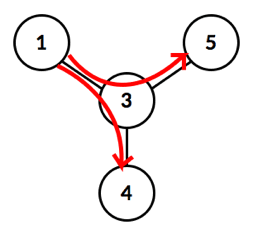
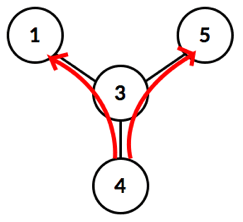
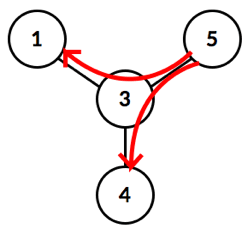
For example, suppose intersection 3 is joined to intersections 1, 4 and 5. From 0 seconds up to P seconds, picture (a) applies and cars that reached intersection 3 over the road from intersection 1 may take a road to another intersection. From P seconds up to 2P seconds, picture (b) applies and cars that came from intersection 4 may move on. From 2P seconds up to 3P seconds, picture (c) applies and cars that came from intersection 5 may go to intersection 1 or intersection 4. From 3P seconds up to 4P seconds the state of (a) returns.
Find the minimum time for a car to travel from its origin to its destination under these conditions.

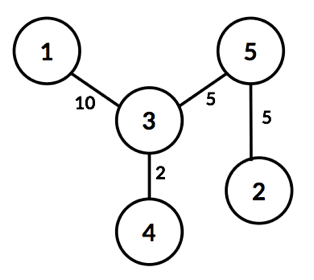
For example, take the road network above with intersection 1 as the origin and intersection 4 as the destination. A car leaving intersection 1 reaches intersection 3 at second 10. If the period of intersection 3 is 2 seconds, then from second 10 up to second 12 only cars that came from intersection 5 may use the roads, so a car that came from intersection 1 waits until second 12. Driving from intersection 1 to intersection 4 therefore takes 14 seconds.
Given every road length and every signal period, find the minimum time to drive from the origin intersection to the destination intersection.
The first line has the number of test cases T (1≤T≤10).
The first line of each test case has the number of intersections N (1≤N≤105), the number of roads M (0≤M≤105), the number of the origin intersection S (1≤S≤N) and the number of the destination intersection D (1≤D≤N).
Each of the next M lines has a, b, c (1≤a,b≤N, a=b, 1≤c≤105). It means that a two-way road of length c joins intersection a and intersection b.
The next line has the signal periods P1,P2,…,PN (1≤Pi≤100) of the intersections, separated by single spaces.
At most one road joins any two intersections.
For each test case, print on its own line the minimum time to drive from the origin intersection to the destination intersection. The result can exceed the range of a 32-bit integer, so a 64-bit integer type is recommended. If no route reaches the destination intersection, print -1.