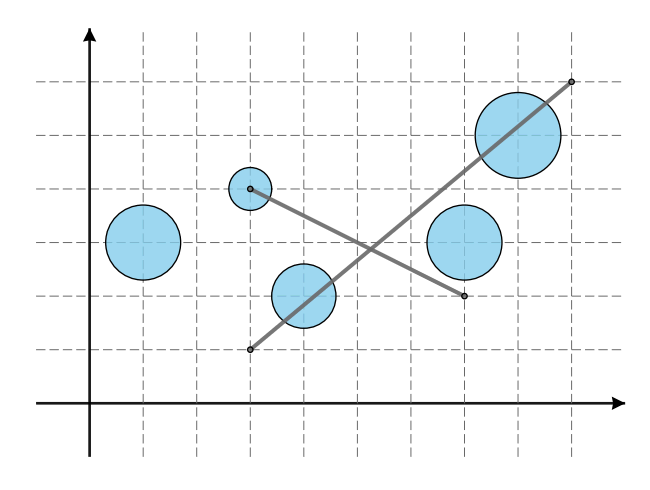
Count how many of up to 100000 small disjoint circles each of up to 100000 query segments passes through.
Medium7GeometryMatrixNo attempts yetTime limit10sMemory limit512 MBA fishing village built on the surface of a frozen lake in the far north is in danger from global warming: cracks are starting to form on the lake surface. The village consists of n igloos of spherical shape, and each igloo covers a circular area of the surface.
An igloo can be represented as a circle in the coordinate plane. The centre of the circle is a point with integer coordinates, and the radius is a positive real number smaller than 1 with exactly one digit after the decimal point.
Given the locations of possible cracks, the villagers want to know how many igloos each crack affects. Formally, you are given q queries, and each query is a line segment defined by its two endpoints. For each segment, find the number of igloos it intersects. A segment intersects an igloo if the segment and the interior of the circle share at least one point.
The first line contains an integer n (1≤n≤100000), the number of igloos. Each of the next n lines contains three numbers x, y and r, the coordinates of the centre and the radius of one igloo. The coordinates x and y are integers with 1≤x,y≤500, and r is a real number with exactly one digit after the decimal point such that 0<r<1. No two igloos overlap or touch.
The next line contains an integer q (1≤q≤100000), the number of queries. Each of the next q lines contains four integers x1, y1, x2, y2 (1≤x1,y1,x2,y2≤500), the coordinates of the two endpoints of one segment. The two endpoints are different. An endpoint may lie inside an igloo.
For every igloo i and every segment s, the square of the distance between s and the centre of i is either smaller than r2−10−5 or greater than r2+10−5, where r is the radius of igloo i.
Print q lines. The k-th line contains the number of igloos that the k-th segment intersects.