Delete This!

Find the fewest icons to move so a single box encloses all delete centers and excludes all keep centers.

Medium7GeometryPrefix sumBrute forceNo attempts yetTime limit1sMemory limit256 MB

Problem

Andrew has never deleted a file. His screen is packed with icons, finding anything takes forever, and he finally decided to throw a large batch of them out.

Andrew deletes files by dragging a box around their icons with the mouse and pressing delete. An icon counts as inside the box when the center of the icon is inside the box, and every icon inside the box is deleted. One delete operation is enough only when the box holds the center of every icon he wants to delete and no center of an icon he wants to keep.

Andrew may drag icons to new places first. Dragging one icon is one move. He can move an icon he wants to delete into the box, and he can move an icon he wants to keep out of it.

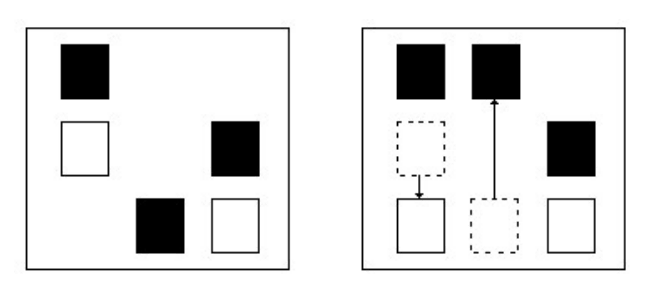
In the picture below the three black icons are files to delete and the two white icons are files to keep. Moving two icons as shown on the right puts all three black icons in one box. Other pairs of moves work too, but one move is never enough.

Given the layout of the screen, find the smallest number of icons Andrew has to move so that one delete operation removes exactly the files he wants gone.

Input

The first line has four integers nr, nc, n, m. The screen is nr pixel rows tall and nc pixel columns wide (1nr,nc100001 \le nr, nc \le 10000), n icons must be deleted and m icons must be kept (0n0 \le n, 0m0 \le m, n+m100n + m \le 100).

After that come 2(n+m)2(n + m) integers. The first n pairs are the icons to delete, the remaining m pairs are the icons to keep. Each pair r c gives the row and the column of the upper left corner of one icon (0r<nr0 \le r < nr, 0c<nc0 \le c < nc). No two icons start at the same position, but icons may overlap.

Every icon is 15 pixels tall and 9 pixels wide, so the icon with its upper left corner at (r, c) covers rows r through r+14 and columns c through c+8, and its center is at (r+7.5, c+4.5)(r + 7.5,\ c + 4.5). An icon may hang over the bottom edge or the right edge of the screen, and then its center lies outside the screen.

Andrew may drag an icon to any position that keeps at least one of its pixels on the screen, and two icons may end up at the same position.

Andrew draws the box on the screen, so its four sides lie on pixel boundaries with 0top<bottomnr0 \le \text{top} < \text{bottom} \le nr and 0left<rightnc0 \le \text{left} < \text{right} \le nc. No icon center ever lies on a pixel boundary, so every icon is either inside the box or outside it. An icon whose center lies outside the screen is outside every box.

Output

Print one integer, the smallest number of icons that must be moved so that one delete operation removes exactly the n icons to delete.