Havannah (Small)
Time limit5sMemory limit512 MB
The program places the given stones in order on a hexagonal board and reports the first move that completes a ring, bridge, or fork.
- Level
Medium5 of 10
- Topics
- Union-find, BFS
- Solved
- No attempts yet
Problem
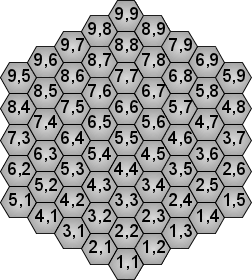
Havannah is an abstract strategy board game created by Christian Freeling. It is played on a hexagonal board with hexagons along each side. Every hexagon has two horizontal edges and four slanted edges. Hexagons are named by pairs of integers. The hexagon in the bottom corner of the board is . The hexagon next to in the two o'clock direction is , and the hexagon next to in the ten o'clock direction is . Here is a board with :
A hexagon holds at most one stone. A stone that has been placed is never removed and never moved. The goal is to build a connected set of stones of one of three kinds:
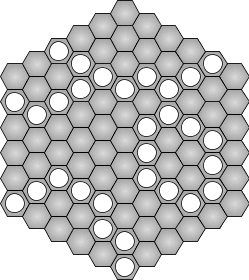
- A ring encircles one or more empty hexagons. At least one of the enclosed hexagons must be empty: there is an empty hexagon that is cut off from the outer border of the board by hexagons with stones. This rule differs from the official rules of Havannah.
- A bridge connects any two corners of the board.
- A fork connects any three of the six board edges. A corner belongs to neither of the two edges next to it.
This picture shows examples of the winning structures:
A sequence of moves by a single player is given. Decide whether the moves build a winning structure. If they do, report the name of the structure and the number of the move that completed it. A move that completes several rings, connects more than two corners, or connects more than three edges still counts as one ring, one bridge, or one fork. A move that completes structures of different kinds at the same time reports every one of their names. Only the first winning move matters: ignore every move after it. If no winning structure exists once all the moves have been played, print none.
Input
The first line contains the number of test cases . The first line of each test case contains two integers and : the number of hexagons along each side of the board and the number of moves. The next lines give the moves in order, each holding a hexagon's coordinates and separated by a space. Every move lies on the board of size . Each test case starts from an empty board, and no hexagon is played twice.
Limits
Output
For each test case print one line holding Case #n: followed by one of:
nonebridge in move kfork in move kring in move kbridge-fork in move kbridge-ring in move kfork-ring in move kbridge-fork-ring in move k
Here is the test case number and is the number of the move that completed the winning structure. Both are counted from 1.
Note
Havannah was created by Christian Freeling and MindSports. Christian Freeling and MindSports do not endorse this problem and have no involvement with it.