Grazing Goats (Small)
Time limit5sMemory limit512 MB
Each of the two disks centered at the poles must cover the bucket point, and the answer is the overlap area of the smallest such disks.
Problem
Farmer John has brought in goats. Goat is tied to a pole at position with a rope of length , so goat can go anywhere within distance of the point and nowhere else. The field is large and flat, so treat it as an infinite plane.
The pole positions are already fixed, and Farmer John only has to pick the rope lengths. Two things make that choice awkward.
- Every goat has to reach a single water bucket. Farmer John has not decided where the bucket goes, but he has narrowed the choice down to .
- The goats are ill tempered and fight noisily when they end up in the same spot. Farmer John therefore wants the area that every goat can reach to be as small as possible.
For each bucket position , pick rope lengths that minimize the area reachable by every goat, then compute that .
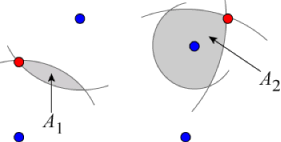
The picture below shows a field with four poles. The four blue points are the pole positions and the two red points are the candidate bucket positions and . The two shaded regions have areas and . In this problem there are always two poles.
Input
The first line contains the number of test cases . The first line of each test case contains the integers and .
The next lines contain the pole positions , one per line, followed by lines containing the bucket positions , one per line. Each of these lines contains the and coordinate of that point, separated by a single space.
Limits
- Every coordinate is an integer between and .
- Within one test case the points are distinct and no three of them lie on one line.
Output
For each test case, print one line in the form Case #x: A1 A2 ... AM, where is the test case number starting from and is the area defined above.
Round every area and always print four digits after the decimal point, separating the values with a single space. For example, print 0.2939 for an area of and 10.7080 for an area of .