Bracelets
Time limit1sMemory limit512 MB
Count the distinct bracelets (necklaces up to rotation and reflection) with at most N beads over K colors, modulo 1e9+7.
- Level
Medium7 of 10
- Topics
- Combinatorics, Number theory, Math, Implementation
- Solved
- No attempts yet
Problem
He took up making bracelets out of colored beads. He lays several beads in a row, runs a thread through them, then ties the two ends of the thread together so the beads form a ring. The number of bracelets he could build is enormous, and because he dislikes near duplicates he decided that two bracelets are the same kind whenever rotating or flipping one of them makes the order of bead colors match the other.
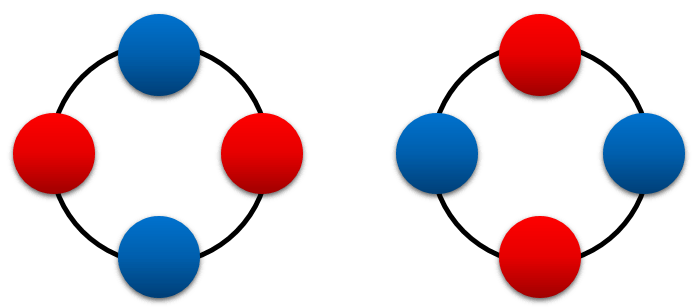
The picture above shows a bracelet of four beads with red and blue alternating. Which color you read first splits it into two apparent kinds. Rotating the left bracelet slightly clockwise produces the same arrangement as the right one, so the two count as a single kind.
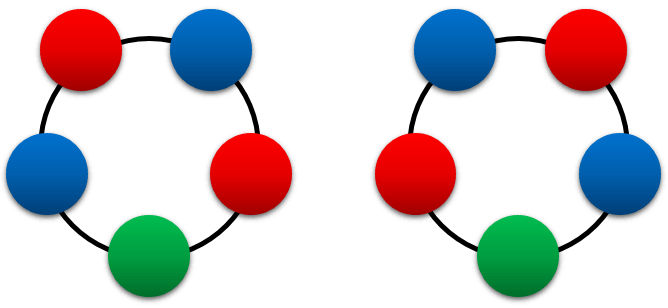
The picture above shows bracelets of five beads. Flipping the left bracelet left to right produces the right one, so these two also count as a single kind.
He has colors of beads, with an unlimited supply of each color. Write a program that counts the distinct kinds of bracelets he can make using at most beads. The bracelet that uses no beads at all counts as one kind.
Input
The first line has two integers and , separated by a space: the number of beads he may use and the number of bead colors. (, )
Output
Print on the first line how many kinds of bracelets can be made using at most beads. The count grows very large, so print it modulo 1,000,000,007.