Radioactive Islands (Small)
Time limit30sMemory limit512 MB
Find the minimum radiation dose for a boat crossing from (-10, A) to (10, B) at speed 1, given 1 unit/hour plus 1/D^2 per island at (0, C_i).
- Level
Hard8 of 10
- Topics
- Geometry, Math, Greedy, Implementation
- Solved
- No attempts yet
Problem
You are steering a boat from the coordinates to the coordinates . The coordinates are measured in kilometers, and your boat travels at a constant speed of 1 kilometer per hour. You have full control over the path the boat takes. We model the boat as a single point.
There are islands in the area; we model them as single points. The -th island is at the coordinates .
The area is radioactive, and you constantly receive 1 microsievert per hour of radiation from the general environment, no matter where you are. The islands themselves are also radioactive, and you constantly receive additional radiation at a rate of microsieverts per hour from the -th island, where is your current distance (in kilometers) from the -th island. (Formally: let be your distance from the -th island as a function of time , and let be the total time your journey takes. Then the total radiation received from the -th island is the definite integral .) You can get as close to an island as you like, as long as you do not match its exact coordinates.
Find the minimum total radiation dose that you can receive if you plot your course optimally.
Input
The first line of the input gives the number of test cases, ; test cases follow. Each test case consists of two lines. The first line of a test case contains an integer and two floating-point numbers and , as described above. The second line of a test case contains floating-point numbers ; the -th of these numbers is the coordinate of the -th island.
All floating-point numbers are given with exactly two decimal places.
Limits
- for all
- for all
Output
For each test case, output one line containing Case #x: y, where x is the test case number (starting from 1) and y is the minimum radiation dose (in microsieverts) received while completing the journey.
Print y rounded to exactly two digits after the decimal point.
Hint
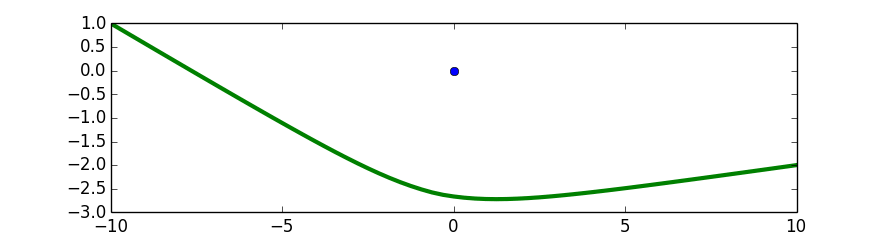
Here is a diagram of the optimal path for the first test case of sample 1. The island is drawn enlarged to make it visible, but remember to treat it as a single point.