What Is Dynamic Programming?
InterviewTime limit2sMemory limit512 MB
Count paths from the top-left cell to the bottom-right cell of an n by m grid when each step moves right, down, or diagonally down-right, printed modulo 1e9+7.
- Level
Medium5 of 10
- Topics
- Dynamic programming, Matrix, Combinatorics
- Solved
- No attempts yet
Problem
Hi! I'm Wookje, and today I'm here to explain dynamic programming. The name sounds grand, but the idea is simple. The basic idea of dynamic programming is to reuse values you have already computed (the fancy word for this is memoization) so that the same computation is not repeated again and again.
For example, look at how , the 5th Fibonacci number, is computed.
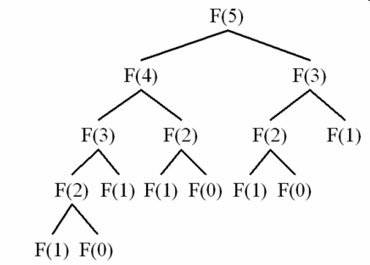
See how the same function is called many times for nothing? If you compute and first and use those stored values when you compute , you avoid the unnecessary calls. Let me put it a bit more rigorously. Mathematically, the Fibonacci sequence can be defined as . Writing down such a formula is called setting up a recurrence. Build a formula that fits the conditions of the problem, move it into code as it is, and dynamic programming becomes very easy to implement.
It works with multidimensional arrays too! Suppose you can move only right or down, and you want the number of ways to get from to . You do not have to count every case one by one. Let be the accumulated number of ways to reach . Then the recurrence solves the problem.
See? Dynamic programming is not hard. Now let's solve a problem!
Moving one cell at a time using only the three directions →, ↓, and ↘, count the number of ways to start at the top-left cell and arrive at the bottom-right cell .
Go!
Input
The first line contains two integers and separated by a space. (1 ≤ n, m ≤ 1,000)
Output
Print the number of ways to get from to . The number can be very large, so print it modulo 1,000,000,007 ().