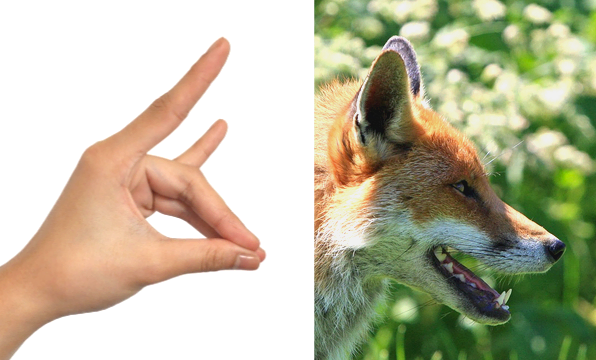
Fox Sign

Given up to 10 touching pairs among five fingers, decide whether the pattern matches the fox sign: thumb, middle, and ring all touch, while index and little touch nothing.

Easy2ImplementationArrayNo attempts yetTime limit0.5sMemory limit512 MB

Problem

Dojoo likes animals, and foxes most of all. One day, while looking through fox photos to relax, Dojoo found a hand shape called the fox sign.

In the fox sign the thumb, the middle finger and the ring finger meet tip to tip, while the index finger and the little finger stay straight and touch no other finger, so the hand shows a fox face with two ears.

Dojoo decided to strike this pose now and then to let everyone know about that love of foxes. Given Dojoo's hand shape, decide whether it can be called a fox sign. For convenience the hand shape is written as a list of pairs of fingers that touch each other, and the shape counts as a fox sign when the touching relation between the fingers is the same as the touching relation of a correct fox sign.

Input

The first line contains NN (1N101 \le N \le 10), the number of pairs of fingers that touch each other.

Each of the next NN lines contains two integers between 1 and 5, separated by a space, naming two fingers that touch each other. 1 is the thumb, 2 is the index finger, 3 is the middle finger, 4 is the ring finger and 5 is the little finger.

The same pair is never given more than once, not even with the two numbers in the other order, and no pair is made of the same finger twice.

Output

If Dojoo's hand shape can be called a fox sign, print Wa-pa-pa-pa-pa-pa-pow! on the first line. Otherwise print Woof-meow-tweet-squeek.

Hint

In the first example the thumb and the middle finger, the ring finger and the middle finger, and the thumb and the ring finger touch each other, while the index finger and the little finger touch no finger at all, so the shape can be called a fox sign.

The second example is a hand shape with only the index finger extended and the other fingers folded.