Landing slots
Time limit2sMemory limit512 MB
For each incoming aircraft, find the lowest free landing slot it can physically reach and report the join point and arrival time.
- Level
Medium7 of 10
- Topics
- Geometry, Simulation, Brute force
- Solved
- No attempts yet
Problem
The airport control area is a circle of radius km. The runway lies north of the centre, and the landing path is the straight line running south from the centre.
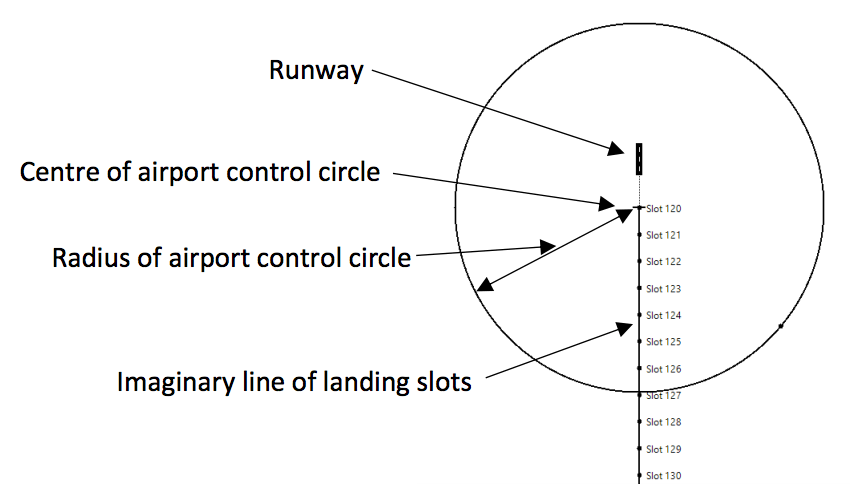
Think of the landing path as a huge conveyor belt in the sky. At midnight slot 0 sits at the centre, and slots 1, 2, and onward follow it to the south, each one 30 seconds of flying time behind the one before. Every aircraft flies at 400 km/h, so neighbouring slots are km apart. The belt moves north at 400 km/h, so hours after midnight slot sits km south of the centre. At 1am slot 120 is exactly at the centre.
Aircraft come in from far away, flying straight at the centre. Aircraft reaches the edge of the control area hours after midnight on heading degrees. A heading is measured clockwise from north, so a negative heading points west of north. No aircraft flies due north or due south.
An aircraft is given a slot the moment it reaches the edge. It turns once, flies straight at 400 km/h to the point where it meets that slot exactly, then turns onto the landing path and rides the belt to the centre. An aircraft may use a slot only when it meets the slot south of the centre and no more than km from the centre, so the meeting point lies on the landing path inside the control area.
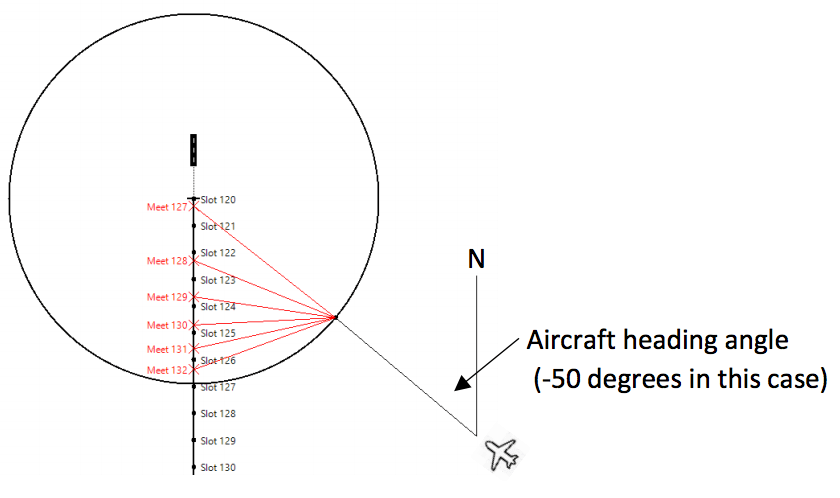
Take and an aircraft arriving at 1am on heading -50. The lowest slot it can meet is 127. Turning left by a larger angle each time lets it meet 128, 129, and so on up to 132. Slot 133 is out of reach, because the meeting point would fall outside the control area.
Aircraft are processed in the order the control system receives them. Each aircraft takes the lowest numbered slot it can meet that no earlier aircraft in the same scenario has taken. The allocation does not check whether flight paths cross, because another part of the system does that.
Input
The first line holds the number of scenarios .
Each scenario begins with a line holding two integers: the radius () of the control area in km, and the number of aircraft (). The next lines describe the aircraft in the order the control system receives them. Each of those lines holds the arrival time () at the edge of the control area, given in hours after midnight with exactly four decimal places, then the integer heading in degrees, which satisfies or .
Within one scenario the arrival times do not decrease. Values on a line are separated by single spaces, with no leading or trailing spaces. Every aircraft has at least one slot available.
Output
For each scenario, print a line holding Scenario and the scenario number, counting from 1. Then print one line per aircraft, in the order the aircraft were given:
Slot k, joining at Dkm south, final approach at T
is the allocated slot number, is the distance in km from the centre to the point where the aircraft joins the landing path, and is the time in hours after midnight at which the aircraft reaches the centre. Print and rounded to exactly four decimal places. No value in the data sits on a rounding boundary.