Panda Preserve
Time limit10sMemory limit1024 MB
Given a simple polygon and receivers at its vertices with a common radius, find the smallest radius whose union of disks covers the whole polygon.
- Level
Hard8 of 10
- Topics
- Geometry, Binary search, Brute force, Implementation
- Solved
- No attempts yet
Problem
Sichuan province set aside land for a national park, a preserve for a population of more than 1800 giant pandas. A polygonal fence runs along the border of the park. To track the pandas, the researchers put one wireless receiver at every vertex of that polygon and fit every animal with a transmitter. A receiver covers a disk centered at its own position, and all receivers have the same range. A receiver with a shorter range costs less, so find the shortest range that still covers the whole park.
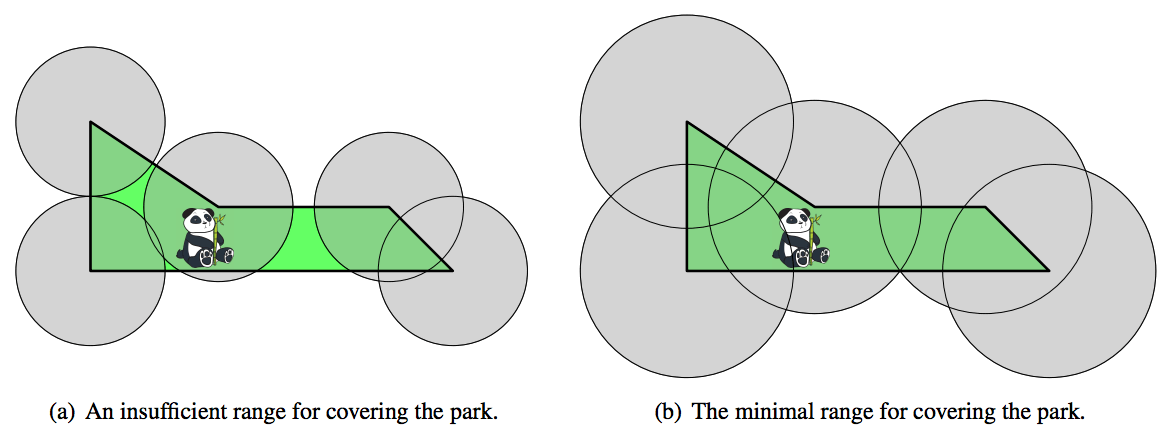
The figure below shows the park of the first example. A range of 35 leaves part of the park uncovered (a). A range of 50 covers all of it (b).
Input
The first line contains an integer (), the number of vertices of the polygon that bounds the park. Each of the next lines contains two integers and (), the coordinates of one vertex. The vertices are given in counter-clockwise order.
The polygon is simple. Its vertices are distinct, and no two edges intersect or touch, except that consecutive edges touch at their shared vertex.
Output
Print the shortest range that covers the whole park, with exactly six digits after the decimal point.